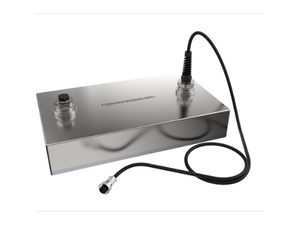
A dual-frequency element is one bolt-clamped Langevin transducer built with two resonances rather than one. The generator switches between them — a coarse note to break the deposit, a fine note to clear what it loosens — in the same tank, on the same parts, off the same array.
If the work is all one kind of soil on one kind of substrate, buy the right single frequency instead. Dual is for a tank that has to do two jobs.
Sold as elements — for building transducer plates, for OEM machines, and for re-elementing a tank whose bonded array has gone deaf. Quoted with the dual-frequency VarioSonic G4 that drives them.
The first number does the work; the second does the finish. Choose the split by the deposit you are breaking and by what the surface will still tolerate on the second pass. All five are sourced against a firm order — power per element and dimensions are fixed at quotation, against the plate or vessel they are going into.
25 / 45 kHz · to orderThe heaviest split. 25 kHz to break scale, hard carbon and weld deposit; 45 kHz to clear what it loosens without chewing the surface.Enquire →
28 / 68 kHz · to orderWorkshop to finish in one tank — 28 kHz for the deposit, 68 kHz for the finish pass.Enquire →
40 / 80 kHz · to orderGeneral engineering with a fine second pass. The pairing we are asked for most.Enquire →
40 / 130 kHz · to orderThe widest useful split: general work at 40 kHz, sub-micron particulate at 130 kHz.Enquire →
80 / 130 kHz · to orderBoth fine. For work that will not take 40 kHz at all — plated, polished and coated surfaces.Enquire →Element count, spacing and bonding are specified against the plate or the vessel. Dimensions, mounting detail and power per element are confirmed at quotation. Renders of the dual elements are being produced — the cards above are placeholders, not the part.
| Pairing | Coarse note | Fine note | What it is for |
|---|---|---|---|
| 25/45 kHz | 25 kHz | 45 kHz | Scale, hard carbon and weld deposit, then a clearing pass |
| 28/68 kHz | 28 kHz | 68 kHz | Heavy deposit and a finish pass without moving the part |
| 40/80 kHz | 40 kHz | 80 kHz | General engineering, then fine particulate off the surface |
| 40/130 kHz | 40 kHz | 130 kHz | General work, then sub-micron particulate |
| 80/130 kHz | 80 kHz | 130 kHz | Delicate and coated surfaces only, two levels of fine |
All five are bolt-clamped Langevin elements built with two resonances: a piezo stack clamped between a front and back mass, tuned so the assembly has a usable mode at each of the two frequencies. Power is the rating of a single element — a plate or an immersible box carries several, and the total is set by the tank.
We do not publish a power or a dimension against these until the element is specified. Dual elements are sourced against a firm order, and the generator is quoted with them — a dual element on a single-frequency drive only ever runs on one of its two notes.
One note only? The single-frequency elements run 28, 40, 68, 80 and 130 kHz, four of them off the shelf.
We do not sell a generator on its own to drive transducers we have not specified, and we do not sell transducers to run on a generator we did not supply. It is not a policy about paperwork — the two are tuned to each other, and an unmatched pair usually means no cavitation, a drive running hot, and both halves replaced inside a year.
There is no warranty on an unmatched pair. If you already own one half, tell us what it is and roughly when it went in and we will tell you where you stand before you spend anything.
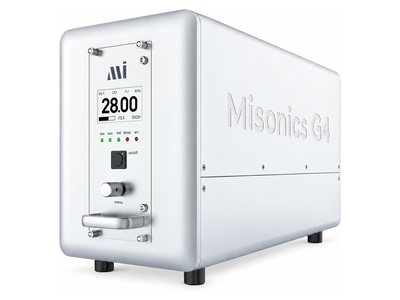
Dual elements run on a dual-frequency VarioSonic G4 — the drive has to track two resonances and hold a recipe for each, which a single-frequency generator does not do. They do not run on the rod-resonator SonoDrive G5, and a rod does not run on a G4.
A generator is tuned to the transducers it drives. Four things have to line up: the frequency the generator tracks, the total capacitance of the array wired to it, the impedance and phase that array presents once it is in the liquid, and the voltage across the group under load. We specify all four against each other, so the pair is quoted, built and commissioned as one item.
A new generator will not rescue an old set. Transducers age — output falls away, the resonant point drifts and the impedance climbs — so an older array is no longer the load a new drive was tuned for. A set of mixed ages is worse again: the weakest element pulls the rest off tune and the drive spends its power hunting for a resonance that has moved. What you get is a generator running hot or dropping out, a bath cleaning unevenly, and transducers failing earlier than they should — and from the outside there is no way to tell which end is at fault, so you end up replacing both anyway.
There is no warranty on an unmatched pair. Equipment warranty covers a generator and transducers supplied and matched by Misonics. A Misonics transducer driven by a generator we did not supply, or a Misonics generator fitted to transducers we have not specified, is not covered — we have no way to characterise the combination, so we will not stand behind it. If you already own one half, tell us what it is and roughly when it went in, and we will tell you where you stand before you spend anything.
Tell us the pairing you want, how many elements, and what they are going into — a plate you are building, an OEM machine, or a repair. If you are not sure of the pairing, tell us the deposit and the substrate and we will pick it.