Home / Naked Sonics / Generators / VarioSonic G4
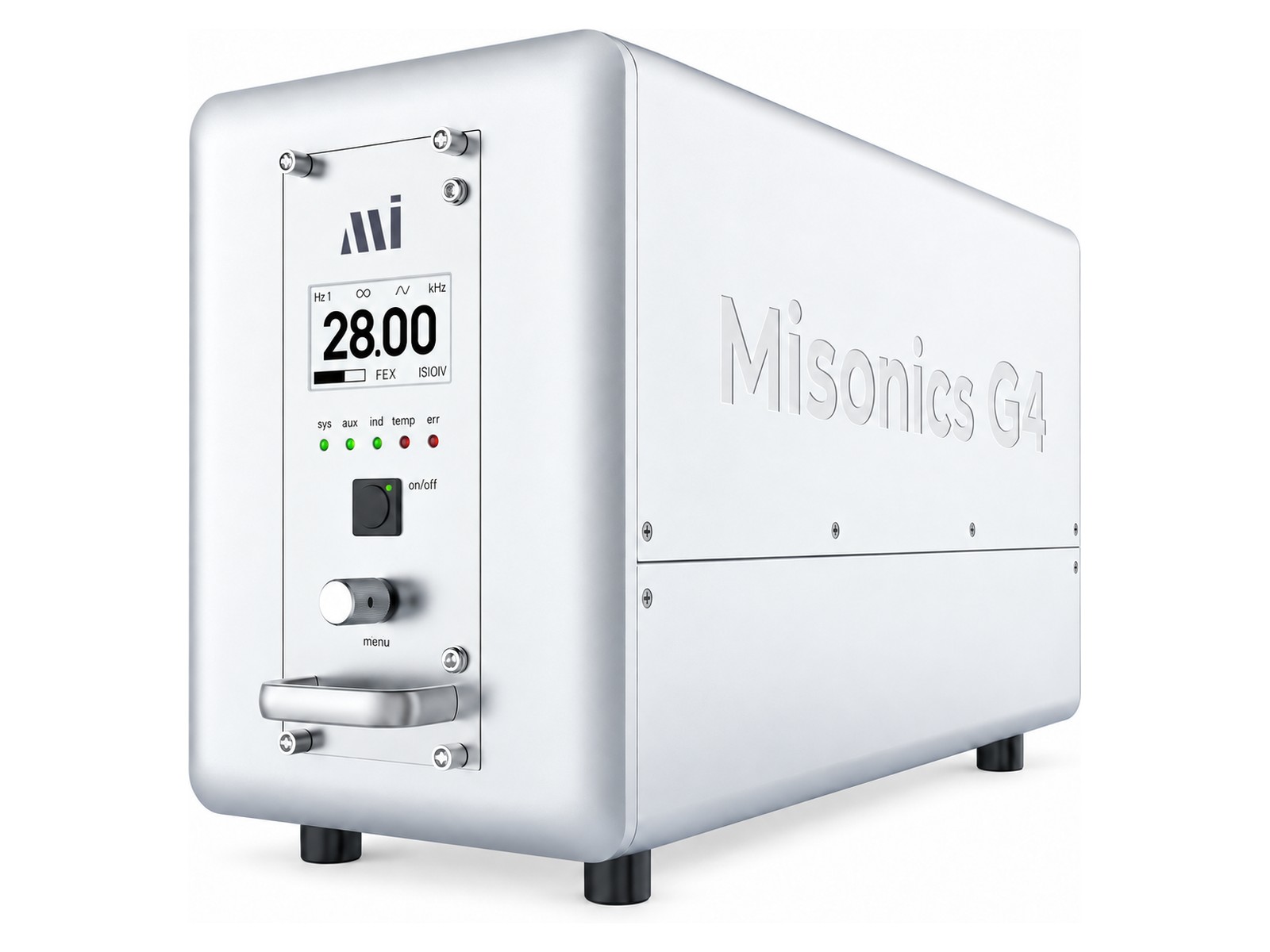
Misonics VarioSonic G4 dual-frequency ultrasonic generator

Specification

ModelG4-1040/80
Ultrasonic frequencies40 & 80 kHz
Rated power1,000 W
Power adjustment10–100 %Linear control across the range
Power supply220 VAC ±10 %, 50/60 Hz
Control topologyFull-bridge phase shift
Power regulationConstant power control
Frequency controlAutomatic trackingLoad self-adaptation
Frequency switching24 VDC ±10 %, 20 mA
CommunicationsRS485 (Modbus RTU)
Protection classIP21
Ambient conditions0–40 °C, 0–90 % RH
Enclosure size412 × 160 × 238 mmL × W × H — 19-inch cabinet integration supported
Conversion efficiencyUp to 95 %

What the control actually does

Full-bridge phase shiftStable, efficient power conversion for industrial ultrasonic loads.
Constant power outputHolds controlled output as the load and the bath conditions change.
Automatic trackingFollows the resonant frequency and adapts to impedance changes — no manual retuning visit.
Peak powerAvailable on demand for stubborn contamination — the figure is confirmed against the model.
SweepBreaks up standing waves and evens out the energy distribution.
MonitoringVoltage, current, phase, status, temperature, run time and both frequencies on the front LCD.
ProtectionOver-current, over-voltage and short circuit, internally.
IntegrationRemote control to PLC and HMI, RS485 Modbus RTU, 19-inch cabinet mounting.

VarioSonic G4-1040/80

40 & 80 kHz · 1,000 W rated

One generator, two selected operating frequencies — aggressive soil removal and fine cleaning on the same platform. Pick the frequency pair your parts need, then the power your transducer set draws.

Frequency pairrun either, or both

Which frequency should I choose? → How loud is each band? →

Rated power
Single frequency buys you powerTwo bands share one generator, so the dual models stop at 1,500 W. Where the process only ever runs one band, the same platform is built single-frequency and drives higher power — all of it into that band. Say which you need on the enquiry.
Only after a generator? Read this firstOpen

We do not sell a generator on its own to drive transducers we have not specified, and we do not sell transducers to run on a generator we did not supply. It is not a policy about paperwork — the two are tuned to each other, and an unmatched pair usually means no cavitation, a drive running hot, and both halves replaced inside a year.

There is no warranty on an unmatched pair. If you already own one half, tell us what it is and roughly when it went in and we will tell you where you stand before you spend anything.

Why that is — the five things that have to line up →

Price on application
Quoted with the transducer set it drives
Units
1
Not sure which — ask us
The VarioSonic G4 drives immersible transducers and transducer plates. It does not drive rod resonators — those are fixed-frequency and take the matched SonoDrive G5 instead. If you are retrofitting a tank with rods, start there.
The range

Nine dual-frequency models

Model codes read power then frequencies: G4‑10 40/80 is 1,000 W at 40 and 80 kHz. Tap a row to load that model into the configurator above.

ModelFrequencyRated power

These nine are the dual-frequency range, and 1,500 W is the ceiling for running two bands from one generator. Built as a single-frequency unit the same platform drives higher power, because all of it goes into one band instead of being shared across two. Tell us the transducer set and we will confirm the generator, or the number of them, that drives it.

Pairing

What the G4 is matched to

  1. Immersible transducers — built to your tank. Send length, width and height, the material (SS304 or SS316), the frequency you need and, above all, the fixing or spigot points.
  2. Transducer plates — where the geometry suits a plate rather than a box.
  3. Not rod resonators. Rods are fixed-frequency and run on the matched SonoDrive G5. The two are not interchangeable.
How it is sold

The generator and the transducer are bought together

A generator is tuned to the transducers it drives. Four things have to line up: the frequency the generator tracks, the total capacitance of the array wired to it, the impedance and phase that array presents once it is in the liquid, and the voltage across the group under load. We specify all four against each other, so the pair is quoted, built and commissioned as one item.

What goes wrong when they are not matched

The label is not the loadTwo transducers both marked 40 kHz are not the same electrical load — they differ in capacitance, in phase, and in how the assembly moves. A generator is tuned to a particular array, not to a number on a plate.
The tuning is inside the generatorA matching network — transformer ratio and a tuning inductance — cancels that array's capacitance so the drive sees a near-resistive load at resonance. Change the array and the power goes into heat and reactive current instead of cavitation.
Tracking only has a windowThe generator hunts for resonance within a narrow band around its design frequency. A stack outside that window is never found: the drive sits off resonance, runs hot, and trips or limits.
Power has to match both waysOverdriven, the ceramic depoles and the bond lines and the radiating face fail years early. Underdriven, there is no useful cavitation at all — a bath that looks like it is running and does not clean.
The cable counts tooCable capacitance sits inside the tuned circuit, which is why the length is quoted with the set and should not be extended on site.

A new generator will not rescue an old set. Transducers age — output falls away, the resonant point drifts and the impedance climbs — so an older array is no longer the load a new drive was tuned for. A set of mixed ages is worse again: the weakest element pulls the rest off tune and the drive spends its power hunting for a resonance that has moved. What you get is a generator running hot or dropping out, a bath cleaning unevenly, and transducers failing earlier than they should — and from the outside there is no way to tell which end is at fault, so you end up replacing both anyway.

There is no warranty on an unmatched pair. Equipment warranty covers a generator and transducers supplied and matched by Misonics. A Misonics transducer driven by a generator we did not supply, or a Misonics generator fitted to transducers we have not specified, is not covered — we have no way to characterise the combination, so we will not stand behind it. If you already own one half, tell us what it is and roughly when it went in, and we will tell you where you stand before you spend anything.

Get a price on a VarioSonic G4

Tell us what it is driving — tank size, transducer count and the frequency your parts need — and we will confirm the model and quote it. If you already know the model you want, say so and we will just quote it.