Load the parts in an open-mesh basket, in a single layer where you can, with holes and galleries facing up or sideways. Keep the basket and the parts off the tank floor and walls, and never nest parts inside each other. Size the machine against the basket, not the litres. Cavitation only cleans where the liquid reaches, so anything that blocks the liquid or traps air leaves a dirty spot.
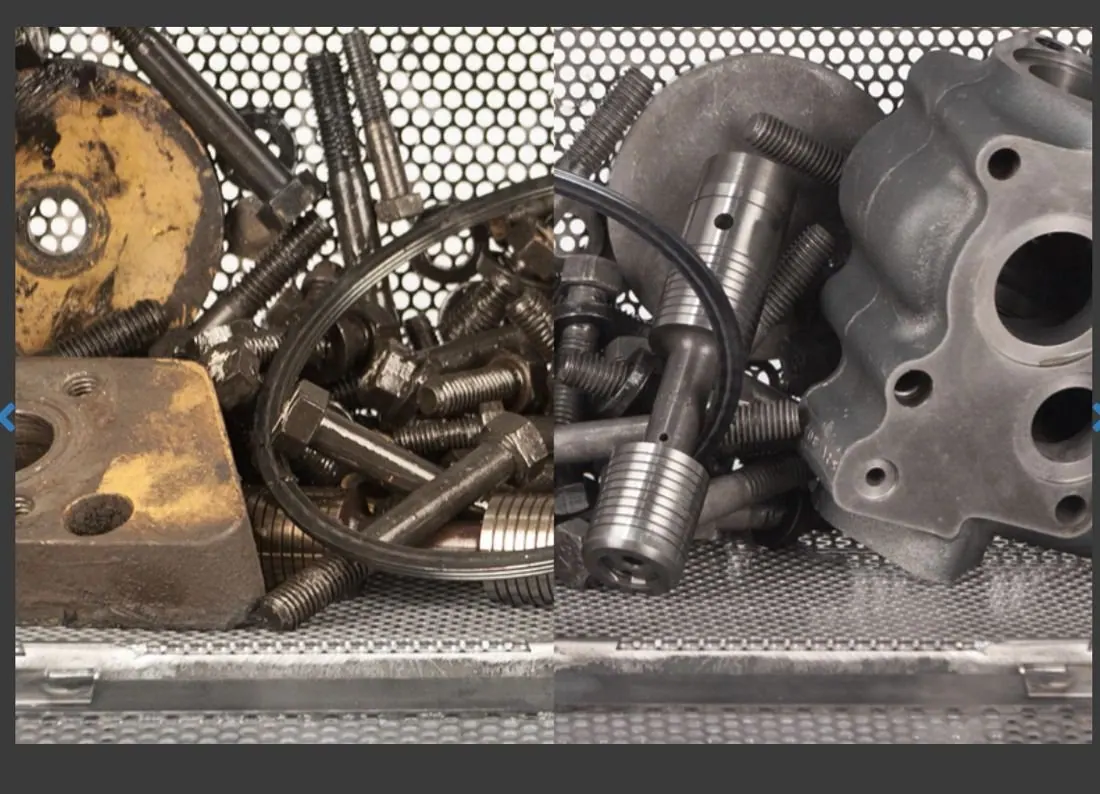
Why the basket decides the result
Cavitation happens in the liquid itself. Wherever solution sits, the bubbles form and collapse, with no line of sight needed. That is why ultrasonic cleaning reaches inside galleries and blind holes that no brush or spray can.
The same rule works against you. A part the liquid cannot reach, or a pocket full of air, does not get cleaned. Loading is where that is won or lost.
How to load the basket, step by step
- Use the basket every time. Parts resting on the tank floor concentrate energy at that point and erode the tank. It is a common cause of a tank that leaks after a few years.
- One layer where you can. An overloaded basket shadows the parts in the middle. Run two short loads instead of one deep one.
- Do not nest parts. Cups, sleeves and housings stacked inside each other mask each other.
- Open mesh, not a solid tray. A part lying flat on a solid tray shadows its own underside.
- Holes up or sideways. A blind hole that goes in mouth-down keeps its bubble of air. Tip the part 20 to 30 degrees off vertical and lower it slowly so the air leaves as the solution comes in.
- Keep the basket off the floor and walls. A basket resting on the tank floor couples the energy into the frame instead of the work.
- Keep the parts under the liquid. Check the level with the basket in and the parts loaded. Parts must sit fully under the liquid, with clearance.
- Move the parts if the same spot stays dirty. If one spot on every part comes out dirty, that spot is in shadow. Rotate or re-fixture the part. Platform agitation or basket oscillation helps trapped air escape.
- Lift on the basket. Stop the ultrasonics before reaching in, and lift parts on the basket, never by hand.
Common loading faults and the fix
| What you see | Likely cause | Fix |
|---|---|---|
| Middle parts dirty, outside parts clean | Basket overloaded | Single layer, or two shorter loads |
| Inside of a bore or gallery untouched | Air trapped, hole facing down | Holes up or sideways, lower slowly, use agitation |
| Underside of flat parts dirty | Solid tray or part lying flat | Open-mesh basket, stand the part on edge |
| The same spot dirty on every part | That spot is in shadow | Rotate or re-fixture the part |
| Inside of nested parts dirty | Parts masking each other | Separate them |
| Worn or pitted patch on the tank floor | Parts or basket resting on the floor | Basket on its supports, parts never on the base |
To find a loading fault, photograph the basket that failed and the basket that passed. The shadow map is usually visible. More causes and fixes are in ultrasonic cleaner not cleaning? five fixes.
Size the machine against the basket
The litres on a machine count the whole tank, including the pockets that carry the resonators, heaters and platform. The part has to sit inside the basket, fully under the liquid, with clearance. Measure your largest part, then compare it with the basket and the working depth.
| Machine | Basket area | Working depth |
|---|---|---|
| MSX 30 | 490 × 235 mm | 140 mm |
| MSX 50 | 500 × 300 mm | 300 mm |
The two baskets are within 10 mm of each other in length, yet the MSX 50 has more than twice the working depth. That is why it is the smallest machine in the range specified for cylinder heads. The full table is on ultrasonic cleaner sizes, and comparing ultrasonic cleaners covers what else to ask for.
Parts with holes and galleries
Valve blocks, injector bodies, manifolds and engine heads are where loading matters most. Turn the part so the air can get out, keep the bath filtered so swarf flushed from one part does not settle in the next, and see cleaning blind holes and internal passages for frequency choice on fine drillings.
Questions we are asked
Should parts sit on the bottom of an ultrasonic tank?
No. Parts resting on the tank floor concentrate energy at that point and erode the tank. It is a common cause of a tank that develops a leak after a few years, and it is why baskets exist. Load parts in the basket, never on the base.
Why do the parts in the middle of the basket come out dirty?
They are in shadow. An overloaded basket shadows the middle parts, nested parts mask each other, and parts lying flat on a solid tray shadow themselves. Load in a single layer where you can and use an open-mesh basket.
Which way should parts with blind holes face?
Holes up or sideways. A blind hole that enters the bath mouth-down keeps its bubble of air, and cavitation cannot happen in a gas. Tip the part 20 to 30 degrees off vertical and lower it slowly so the air leaves as the solution arrives.
Does a plastic basket work for parts cleaning?
A jewellery or retainer cleaner uses a small, lightly heated bath with a plastic basket. Parts cleaning needs a heated stainless tank and a basket rated for the load.
How do I know if the tank is big enough for my parts?
Size against the basket, not the litres. Tank volume counts the whole tank, including the pockets that carry the resonators, heaters and platform. Measure your largest part and ask for the internal basket dimensions and the working depth.
Can I reach into the tank to move a part?
No. Stop the ultrasonics first and lift parts on the basket, never by hand. Gloves protect against heat and chemistry; they are not a licence to reach into a live sound field.
Related: Parts not coming clean · Cavitation erosion · Operator safety · Machines
Send us a part
Tell us what the part is and what is on it. We clean it and send back the result, with how it was loaded.