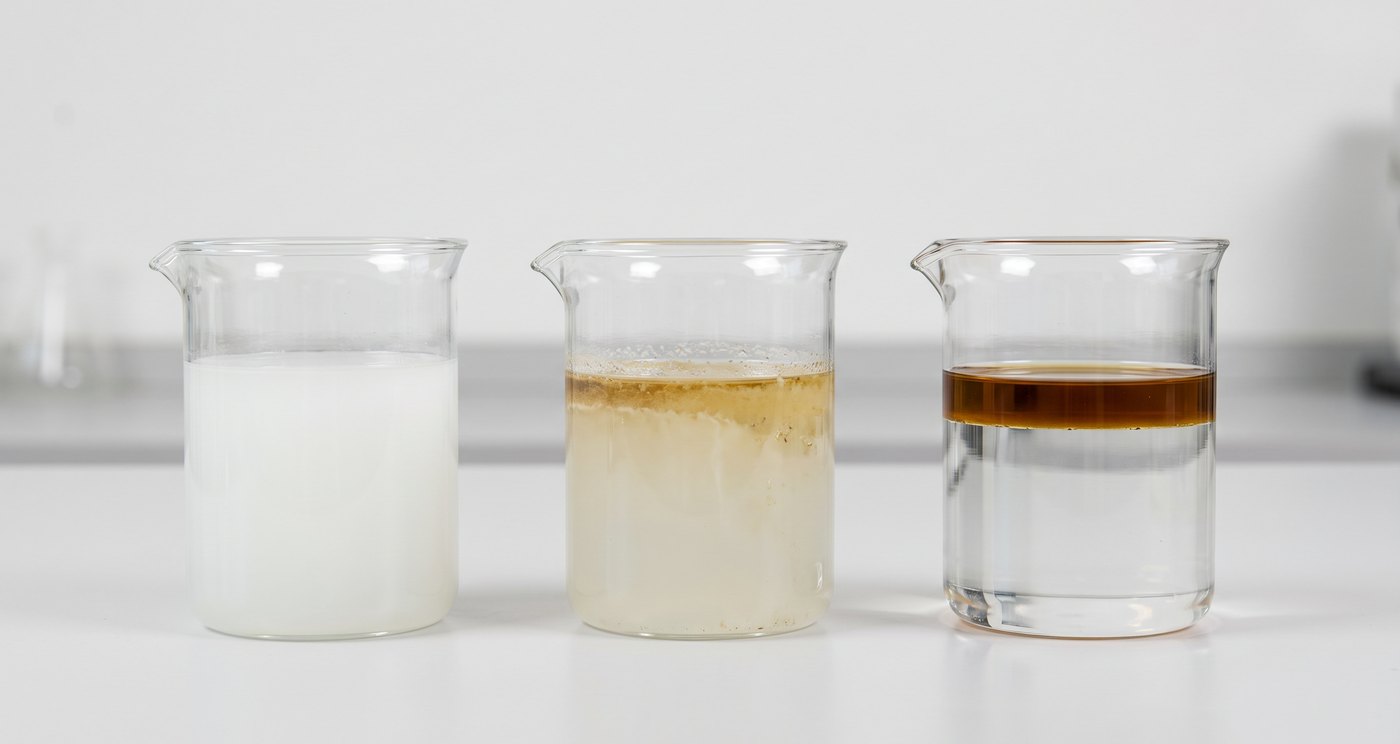
Every contaminant on every part belongs to one of two chemical families, and the difference decides what will remove it. Non-polar contamination is built mostly of carbon and hydrogen with charge spread evenly through the molecule — it repels water and shrugs off anything watery. Polar contamination carries uneven charge — partial positives and negatives — and it bonds happily with water and anything ionic.
The oldest rule in chemistry — like dissolves like — says a solvent removes what resembles it. Water, the most polar liquid there is, dissolves salts and minerals beautifully and slides straight off oil. That is the whole reason cleaning chemistry exists: to bridge the gap between a water-based bath and the soils water cannot touch.
A cylinder head off a high-hour diesel wears oil film and coked carbon (non-polar) over ash and corrosion (polar). A marine heat exchanger carries lubricant residues on one side and calcium scale with chloride attack on the other. A fire-damaged tool carries PAH-laden soot bonded onto flash rust. One bath cannot dissolve both families at once — the chemistry that attacks one barely notices the other.
The answer is sequence, and it is why our machines and processes are built in stages: an alkaline stage to strip the organic load, rinse, then an acid-side stage for scale and ash, rinse again, then protection. The two-stage carbon-and-ash chain on the chemicals page — alkaline decarboniser followed by RegeniK ash dissolution — is exactly this science applied to DPFs and engine components.
1 · Diagnose before you dose. Name the soil before choosing the drum: is it oil-family or mineral-family — or layered? A wipe test tells you a lot: oily smear says non-polar; white, crusty or rust-coloured says polar; both says staged process.
2 · Match the strength to the soil, not the frustration. When a correct-family chemistry stalls, the answer is usually temperature, time or the next strength up in the same family — not switching families, and not doubling the concentration. Needing to run far above recommended concentration is evidence of the wrong product, not the cure.
3 · Respect what the chemistry also wants to attack. The same acid that dissolves scale dissolves zinc plating; the same alkali that saponifies grease etches aluminium. Every product card in our range states its material cautions up front — read them as part of the diagnosis, not after the damage.
The fastest way to get the diagnosis right is to describe the soil to us first. Where that is not enough, a quoted trial protocol on parts carrying the real contamination and the trial returns the family, the product, the concentration and the cycle — proven, not guessed.
That is a ten-minute answer in the laboratory — and the wrong guess costs a drum, a bath, and sometimes a part. Send us the real contamination.