Added to cart
Near-neutral · two-part

CoreKleen HX

Immersion & UltrasonicIMMERSION& ULTRASONICImmersion & Ultrasonic

Rust, scale and red dirt off at pH 6

Two-part chelating descaler — CoreKleen HX at 20% v/v with CoreKleen Plus at 1–2% v/v. Safe on aluminium and zinc, and it passivates as it cleans.

pH 6.0–6.5 — chelates the oxide, not the base metalSafe on aluminium alloys and zinc — takes white rust tooPassivates as it cleans — short-term protection before paint
From $220.00 ex GST
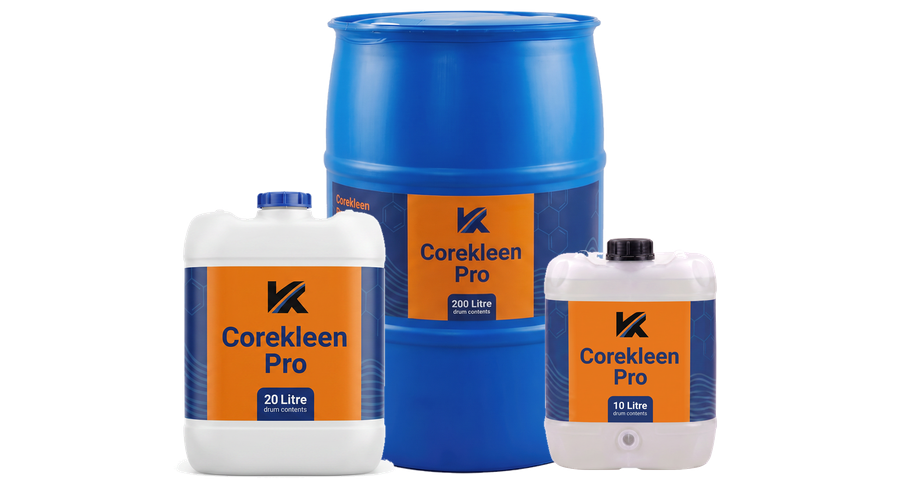
corekleen pro container
Why It Wins

Rust, scale and red dirt off at pH 6

CoreKleen HX is the near-neutral way to take rust, scale, red dirt and grime off industrial components in an ultrasonic or immersion tank. The chelating phosphonate chemistry lifts the oxide layer at pH 6.0–6.5 instead of dissolving the base metal the way acid pickling does — gentler on the operator, gentler on the tank, and safe on aluminium alloys and zinc.

It runs as a two-part bath: CoreKleen HX at 20% v/v with CoreKleen Plus dosed alongside at 1–2% v/v. Heat it to 50–60 °C and give it time — about an hour for light rust, two for heavy — and titrate the bath so it stays at working strength. At a 25% make-up the bath holds roughly 15 g/L of dissolved iron before it is spent.

It passivates as it cleans, so a part comes out with short-term corrosion protection and can go straight to paint. Never run it on magnesium, and time-limit copper and brass — they are chelated on prolonged contact.

Applications

Where it earns its keep

Rust, scale, red dirt and grime on industrial components — mining and heavy plant, engine reconditioning, transport and rail, tank and system cleaning.

MiningAutomotiveRailManufacturing
Material caution: Two-part system: CoreKleen Plus is dosed alongside at 1–2% v/v. Near-neutral (pH 6.0–6.5) — never on magnesium; time-limit copper and brass; use EPDM or Viton seals. Replace the bath at about 15 g/L of dissolved iron.
Temperature & Dose
SWEET SPOT 60 °C50–60 °C20 °C100 °C

Dose: 20% v/v CoreKleen HX + 1–2% v/v CoreKleen Plus. The trial sets your exact process values; the TDS governs.

Run It Right

The working process

The CoreKleen Family

Right product, right job

This Page

HX + Plus — near-neutral chelating descaler

Rust, scale and red dirt without acid pickling.

Also Consider

Descale

Phosphoric acid where a strong acid is allowed

View →
KT-CC-CRK-HX-A · supplier code, Part A
Buy CoreKleen HXex GST
10 L$220.00
20 L$385.00
200 L$3,075.00
1,000 L$11,490.00

Delivered within Australia. Outside Australia, request a delivered price.
Complete The Job
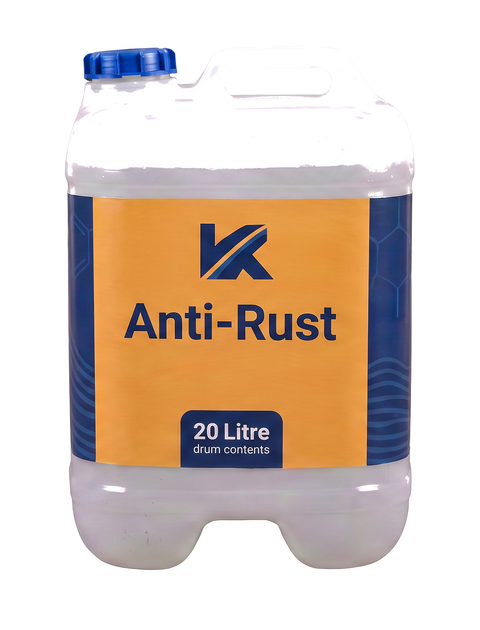
Anti-RustProtect the freshly bared metalView & buy →
Machine-cycle note. Also worth considering: Anti-Rust as a post-wash stage, and AquaVantage 815 GD where the load is all-aluminium and an inhibited alkaline is acceptable. Tell us the parts and the machine and we will specify the stage sequence.
Compatibility
Mild & carbon steelCarbon steel on the TDS list
Stainless steelSafe in prescribed use
Cast ironCast iron on the TDS list
Aluminium & titaniumAluminium alloys and titanium on the TDS list
Magnesium & soft alloysDo not use
Zinc & galvanisedZinc on the TDS list — removes white rust
Copper & brassChelated on prolonged contact — time-limit and test
Plated finishes (Cd·Cr·Ni)Chrome plating and nickel listed; cadmium — test first
Plastics & rubbersHDPE · PP · EPDM · Viton safe; PVC and nitrile soften; acrylic, polycarbonate and ABS craze
Painted / coated surfacesNot on the TDS list — test first
Per prescribed use — the cleaning trial confirms on your parts; the TDS governs. Full range matrix →
Transport
TransportNot classified as Dangerous Goods for road and rail
No DG freight surcharge applies.
Bath Life

This is not a single-use chemical

A common misconception treats industrial chemistry like dishwater — used once, tipped out. A defended bath of CoreKleen HX works for weeks of production: weir oil separation and filtration defend the bath, solids leave through the filter, and the chemistry keeps working until genuine depletion.

Change out on evidence, not anxiety: when cycle times stretch or results fade at correct concentration, the bath has earned its retirement. Top-ups at specification carry it between changes.

Keep It In Spec
  • Skim or weir oils continuously — oil load is bath killer #1
  • Filter solids; drain settled sludge from the sump
  • Verify concentration on schedule per the TDS check method
  • Log it — the trend predicts top-ups before cleaning fades
Storage

Drum and bath, both looked after

The Concentrate
  • Handling: Avoid eye contact and repeated or prolonged skin contact.
  • Avoid inhalation of vapour, mist or aerosols.
  • Storage: Store in a cool, dry, well-ventilated place and out of direct sunlight.
  • Store away from foodstuffs.
  • Store away from incompatible materials described in Section 10.
  • Store away from sources of heat and/or ignition.
  • Keep container standing upright.
  • Keep containers closed when not in use - check regularly for leaks.
Compliant with the product SDS.
The Working Bath

Lid the tank between shifts — holds temperature, limits evaporation, keeps dust out.

Idle periods: a warm, stagnant aqueous bath can support biological growth over extended stagnation. Circulate periodically, keep concentration at specification, never leave an open tank standing for weeks.

Extended shutdown: drain to sealed, labelled containers — or schedule changeover for restart day.

On the drum

The icons on the label, and what they mean

ConcentrateSupplied concentrated. Dilute before use.
All MetalsMarked for use across ferrous and non-ferrous metals.

These are the manufacturer’s own label marks, not third-party certifications. Where a named approval exists it is listed in full on this page. The compatibility table above is what governs.

Documents & Safety

The paperwork, on the page

Safety Data Sheet (SDS)
CoreKleen HX — Australian GHS SDS for your chemical register and risk assessments. PDF, 199 KB. Issued 01/01/2026.
View SDSDownload
Technical Data Sheet (TDS)
Kleentek KT-TDS-CRKHX · Rev 3 · issued 10 Sep 2026. Dose, temperature, material compatibility, soils, bath control and transport. PDF, 731 KB.
View TDSDownload
Hazard identification
DANGERPer Safe Work Australia GHS 7
Serious Eye Damage - Category 1
Hazard statements
H318Causes serious eye damage.
Key precautions
P102Keep out of reach of children.
P103Read carefully and follow all instructions.
P280Wear protective gloves/protective clothing including eye/face protection.
P101If medical advice is needed, have product container or label at hand.
P305+P351+P338IF IN EYES: Rinse cautiously with water for several minutes.
P310Immediately call a POISON CENTER/doctor.
Compliant with the product SDS — full document available for your chemical register.
PPE & exposure controls
  • National Occupational Exposure Limits: No value assigned for this specific material by Safe Work Australia.
  • Biological Limit Values: As per the "National Model Regulations for the Control of Workplace Hazardous Substances (Safe Work Australia)" the ingredients in this material do not have a Biological Limit Allocated.
  • Engineering Measures: Natural ventilation should be adequate under normal use conditions.
  • Hygiene Measures: Keep away from food, drink and animal feeding stuffs.
  • When using do not eat, drink or smoke.
  • Wash hands prior to eating, drinking or smoking.
  • Avoid contact with clothing.
  • Avoid eye contact and repeated or prolonged skin contact.
  • Avoid inhalation of vapour, mist or aerosols.
  • Ensure that eyewash stations and safety showers are close to the workstation location.
Compliant with the product SDS — full document available for your chemical register.
First aid
  • If poisoning occurs, contact a doctor or Poisons Information Centre (Phone Australia 131 126, New Zealand 0800 764 766).
  • Inhalation: Remove victim from exposure - avoid becoming a casualty.
  • Remove contaminated clothing and loosen remaining clothing.
  • Allow patient to assume most comfortable position and keep warm.
  • Keep at rest until fully recovered.
  • Seek medical advice if effects persist.
  • Skin Contact: If skin or hair contact occurs, remove contaminated clothing and flush skin and hair with running water.
  • If swelling, redness, blistering or irritation occurs seek medical assistance.
  • Eye Contact: Immediately irrigate with copious quantities of water for 15 minutes.
  • Eyelids to be held open.
Compliant with the product SDS — full document available for your chemical register.
Storage & handling
  • Handling: Avoid eye contact and repeated or prolonged skin contact.
  • Avoid inhalation of vapour, mist or aerosols.
  • Storage: Store in a cool, dry, well-ventilated place and out of direct sunlight.
  • Store away from foodstuffs.
  • Store away from incompatible materials described in Section 10.
  • Store away from sources of heat and/or ignition.
  • Keep container standing upright.
  • Keep containers closed when not in use - check regularly for leaks.
Compliant with the product SDS — full document available for your chemical register.
Disposal
  • Persons conducting disposal, recycling or reclamation activities should ensure that appropriate personal protection equipment is used, see "Section 8.
  • Exposure Controls and Personal Protection" of this SDS.
  • If possible material and its container should be recycled.
  • If material or container cannot be recycled, dispose in accordance with local, regional, national and international Regulations.
Compliant with the product SDS — full document available for your chemical register.
Transport & dangerous goods
  • Not classified as Dangerous Goods by the criteria of the "Australian Code for the Transport of Dangerous Goods by Road & Rail" and the "New Zealand NZS5433:
  • Transport of Dangerous Goods on Land".
  • MARINE TRANSPORT Not classified as Dangerous Goods by the criteria of the International Maritime Dangerous Goods Code (IMDG Code) for transport by sea.
  • AIR TRANSPORT Not classified as Dangerous Goods by the criteria of the International Air Transport Association (IATA) Dangerous Goods Regulations for transport by air.
Compliant with the product SDS — full document available for your chemical register.
CoreKleen HX FAQ

Asked at the tank

What dilution and temperature do I run?
CoreKleen HX at 20% v/v plus CoreKleen Plus at 1–2% v/v, at 50–60 °C (typically 60 °C), for 60–90 minutes — and the trial sets your exact process values against your soil. Running richer than specified wastes chemical without cleaning faster. That range is the chemistry’s window — not the whole answer. The substrate sets its own ceiling, and it is usually lower: aluminium and anodised finishes discolour above about 65 °C, zinc and coated parts lower again, and magnesium is governed by pH before temperature. Run at the lower of the two. Bath temperature — chemistry vs substrate →
When do I change the bath?
When cycle times stretch, results fade, or filtration stops holding the debris. Drain, clean the tank, refill — never lay fresh solution over settled sludge.
Will it attack my tank?
Acid work runs in tanks specified for it — 316 stainless or polymer, never bare mild steel. Misonics acid-duty tanks are built for exactly this; if you are retrofitting chemistry into an existing tank, confirm the tank material against the card before the first fill.
Can I get the SDS before buying?
Yes — every product ships with its SDS, and documents are available ahead of purchase for your chemical register and risk assessments.

Prove it on your parts

The trial pairs CoreKleen HX with your components — concentration, temperature and cycle documented before you order a drum. Wrong chemistry for your soil? The trial says so.

Talk to an engineer Back to the Range
Goes with this

Filter bags for this bath

The bag is what keeps the bath working — it takes the soil out before it settles back onto the next load. This is a neutral bath, and that rules the media in and out before micron rating comes into it.

what we would sendPolypropylene needlefeltNeutral bath · pH 6 – 8

Fine. Start at 25 µm unless something downstream needs finer.

Which size, media and micron — the full guide →
Payment is processed by Stripe; we do not see your card number. We use your details to process and deliver the order, as our Privacy Policy describes.