Added to cart
BRULIN ENGINEERED · AEROSPACE QUALIFIEDBest seller

AquaVantage 815 GD

Immersion & UltrasonicIMMERSION& ULTRASONICImmersion & Ultrasonic

The precision-cleaning benchmark. When the specification says aerospace, medical or critical, this is the aqueous chemistry the industry qualified first — and kept.

40+ OEM approvals — Boeing to NASASafe on virtually all metals, magnesium includedOxygen-service qualifiedFree-rinsing · in-process corrosion inhibitor
From $220.00 ex GST
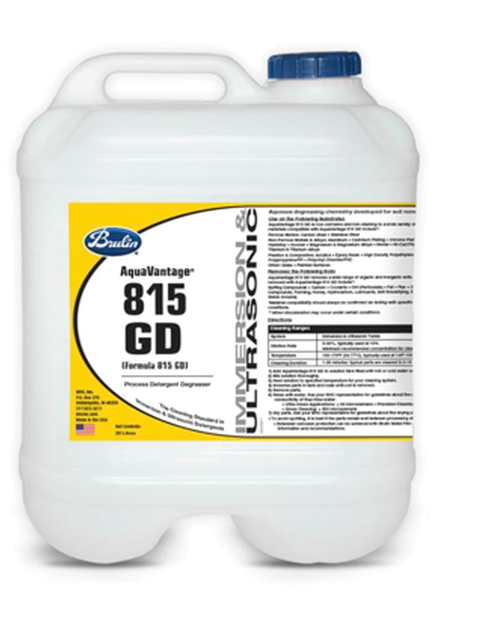
brulin aquavantage 815 gd container

Four AquaVantage grades. Same substrate safety across all of them — the difference is the duty.

One bath, three jobs

Degrease, free rinse, corrosion inhibitor

AquaVantage 815 GD does three jobs in one bath, so a part can come out of the machine ready for the next operation instead of going through three tanks to get there.

1

Degrease

Lifts oils, coolants, buffing compounds, flux, carbon and handling soils off the part. Released oil separates out for skimming instead of emulsifying into the bath, so the tank lasts.

Data sheet: separates oil effectively for easier skimming
2

Free rinse

The surfactant and builder package is picked so it goes back into solution in the rinse water and sheets off the part, instead of beading up or drying to a film. That sheeting is what a water-break-free surface is.

It matters because of what comes next. Anything left on the surface is an adhesion defect in the paint, the bond, the plate or the coating, and it will not show up until that stage fails.

Data sheet: free rinsing — permits improved adhesion
3

Corrosion inhibitor

Two different jobs, and it is worth keeping them apart. In the tank: the bath is alkaline, so steel sits in its passive range and holds a stable oxide, and the inhibitor package adsorbs a film on the surface. None of that follows the part out of the bath.

Out of the tank: a trace carries through the rinse and holds off flash rust for a short while — indoors and dry. It is a residual film, not a coating. For anything going on a shelf, follow it with a dedicated rust preventative.

Data sheet: in-process corrosion control

Getting the protection to survive the rinse

This is where most people lose it. A freshly cleaned part is the worst case there is — you have just taken off the oil film that was protecting it, and bare steel sitting wet in aerated water goes off in minutes. Four things decide whether it holds.

Rinse hot, 60–70 °CParts come out carrying enough heat to flash themselves dry. One change, and it fixes more flash rust than anything else on this list.
Dry straight awayForced air or vacuum. Do not let parts drip-dry on a bench — time sitting wet is the single biggest lever there is.
Wet between, dry afterKeep parts wet from stage to stage so they do not spot, then get them properly dry after the last one. Wet-to-wet is fine; wet-to-air rusts.
Do not over-rinseEvery extra litre takes more inhibitor off. Match the rinse to the spec: under 50 µS/cm for ultra-clean, under 500 for precision. Long hot cascades and DI strip it fastest.

Three tanks become one. Less floor space, one bath to dose and monitor, one drum to buy, and no transfer between stages for the part to flash over in. Dose and temperature are on the dosage calculator →

Why It Wins

Qualification is the product

Any chemistry can claim to clean. What 815 GD carries is different: four decades of aerospace OEMs writing it into their process specifications — Boeing alkaline cleaning, Airbus approved-cleaner listings, Rolls-Royce and Pratt & Whitney overhaul manuals, Lockheed, Sikorsky, SNECMA. When your customer audits your process, the chemistry line is already answered.

The chemistry earns the paperwork. Mildly alkaline (pH 12 concentrate, inhibited), it cavitates superbly and separates oil instead of emulsifying it — released oils rise to the weir, the bath stays clean, and bath life extends accordingly.

Free-rinsing means what it says. Some cleaning chemistries leave a sticky residue film that clings to the part after rinsing — hard to remove, and a real problem when the next step is coating, bonding or inspection. 815 GD rinses away completely: no film, no coating, a genuinely water-break-free surface that the next process meets clean.

And it protects what it cleans. A built-in corrosion inhibitor provides in-process flash-rust protection — parts hold between cleaning, rinse and the next stage without blooming. For longer holds or storage, step up to a dedicated protective; for the normal flow of a production line, the inhibitor carries it.

Compatibility is its quiet superpower: carbon steel to titanium, aluminium to magnesium — the metal most cleaners ban — plus cadmium, chrome and nickel plating, acrylics, painted surfaces and common polymers. One bath serves mixed-material assemblies that would otherwise need three. The single caution: copper alloys may show minor discolouration.

Its home ground is newly manufactured parts: cutting oils and coolants, drawing and lapping pastes, buffing compounds, fluxes and handling soils — the contamination manufacturing puts on, removed before inspection, coating or assembly. Duration typically 3–10 minutes at 60–66 °C.

Doing MRO and rebuild work — service carbon, baked greases, the soils an operating life bakes on? That is heavier duty than GD is built for: its sibling 815 QR-NF carries the same substrate safety with heavy-duty strength, and it is the better pick. Right tool, same family, same paperwork culture.

Temperature & The Working Window
TYPICAL 60–66 °C 54–77 °C approved range 20 °C100 °C

Foaming tendency is moderate-to-high: run inside the window, degas after make-up, and keep recirculation returns below the surface.

Dilution By Duty

One drum, four working strengths

General precision cleaning7–30%, typically 10%
LOX / breathable oxygen service7–12% — per NASA oxygen-service cleaning procedures
Metal finishing7–25% ahead of plate, anodise and bond
Repair & overhaul7–30% — the MRO workhorse setting

Rinse to duty as well: <50 µS ultra-clean · <500 µS precision · heated rinse where the OEM spec requires. Keep parts wet between stages to avoid spotting.

Which 815?

Two siblings, one decision

This Page · New Manufacture

AquaVantage 815 GD

Cutting oils & coolants · drawing and lapping pastes · buffing compounds · fluxes · general contamination. Precision cleaning of parts as manufacturing made them.

MRO & Rebuild → Go Here

AquaVantage 815 QR-NF

Service carbon · baked greases · tenacious operating soils. Heavy-duty strength, same substrate safety — proven in our 70 °C piston ring-groove work.

View 815 QR-NF →

Qualified for oxygen service

Cleaning for LOX and breathable-oxygen systems is the least forgiving specification in industry — hydrocarbon residue in an oxygen circuit is an ignition source. 815 GD is used under NASA procedures for cleaning of systems and equipment for oxygen service, at the dedicated 7–12% dilution, with verification to your specified test method. If you maintain breathing-air, diving, medical-gas or aerospace oxygen hardware, this is the bath.

Buy AquaVantage 815 GDex GST
10 L$220.00
20 L$390.00
200 L$3,300.00
1,000 L$14,790.00
$220.00

Delivered within Australia. Outside Australia, request a delivered price.
Freight note: flash point none-to-boiling — standard freight, no DG surcharge.
Complete The Job
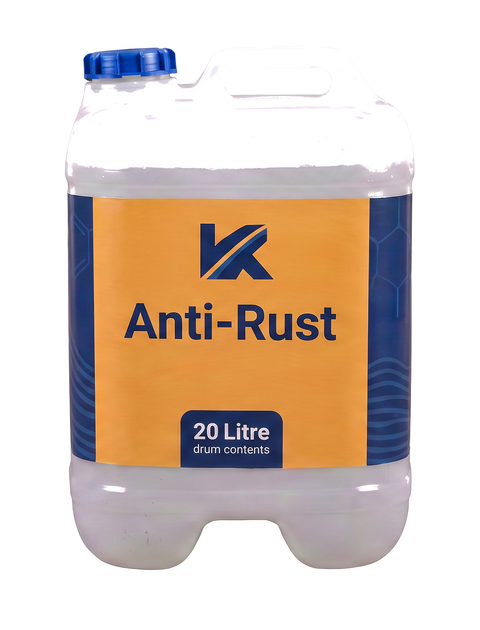
Anti-RustStops flash rust on cleaned steelView & buy →
Compatibility
Steels & stainlessSafe
Aluminium · titaniumSafe
Magnesium & alloysSafe — rare in this class
Cd · Cr · Ni platingSafe
Acrylics · HDPE · PP · PVC · NBRSafe
Glass · painted surfacesSafe
Copper & alloysMinor discolouration possible
Per prescribed use — the cleaning trial confirms on your parts; the TDS governs. Full range matrix →
Compliance, Standards & Conformance

Approved and conformant — by name

The OEM process specifications, standards and test compliances AquaVantage 815 GD holds, as listed on its product technical data sheet. If your process is governed by one of these, the chemistry is already qualified for it.

Airframes
  • Airbus AIPI 09-01-003 · CML 08AKB1
  • Airbus UK ABP 8-1290
  • Boeing BAC 5749 · 5753 · 5763
  • Boeing HP 9-25 · PS 12024
  • Bombardier BAPS 180-040
  • Northrop C-24 · Sikorsky SS 8423
Engines
  • Rolls-Royce CSS 204 Type A · OMAT 1/24S
  • Pratt & Whitney PMC 1437-1 · SPMC 184
  • IAE V2500 CoMat 01-487
  • SNECMA CFM56 CP2597
  • Safran PR-1500 · DMP 13-300
  • GE Aviation CT-882
Space & Defence
  • NASA — Cleaning for Oxygen Service
  • Lockheed Martin EPS G32.016
  • Lockheed LMA-PG006 · STP-57301
  • American Eurocopter QA-DCR/10-06/01
  • UTC Aerospace (Rohr) ×3
  • Honeywell SPM · Meggitt AP-842
Test Compliance
  • ARP 1755B Stock Loss (Cat. 10)
  • ASTM F-483 · F-484 · F-485 · F-502
  • ASTM F-519 Hydrogen Embrittlement
  • ASTM F-945 Ti Stress · F-1110 · F-1111
  • PWA 36604 Hot Corrosion & O-Rings
  • No cyanides · No sulfides
Bath Life — How To Measure It

This is not a single-use chemical

A common misconception treats industrial chemistry like dishwater — used once, tipped out. A defended 815 GD bath works for weeks of production: the oil-splitting formulation sends released oils to the weir instead of into emulsion, filtration removes solids, and in-process corrosion control keeps doing its job cycle after cycle.

Better still, bath condition is measurable. A five-minute titration tells you the working concentration exactly — no guessing, no premature dumping, no under-strength cleaning. Top up to specification and keep running; change out on evidence, not anxiety.

Brulin publishes full aqueous-tank maintenance guidelines — flowchart and step-by-step video — and we set your titration schedule during commissioning.

Concentration check — the actual method

KitBrulin Titration Kit (Prod. No. XTRKIT)
Sample5 mL of working bath
Titrant1.0 N HCl · indicator: Bromophenol Blue (2 drops)
Concentration %drops of titrant × 0.81
Alternative10 mL sample: mL titrant × 0.42 · burette: to pH 3.8, mL × 1.25

Five minutes, a drop counter, and your bath stops being a mystery.

Storage

Drum and bath, both looked after

The Concentrate
  • Store cool, ventilated and sealed, out of direct sunlight — away from foodstuffs, acids and incompatibles
  • Non-flammable (flash point none to boiling) — no flammable-store requirement
  • Original containers only; label integrity matters for your chemical register
Compliant with the product SDS — full document available for your chemical register.
The Working Bath

Lid the tank between shifts — holds temperature, limits evaporation, keeps airborne dust out of a precision bath.

Idle periods: a warm, stagnant aqueous bath is a growth medium once its preservative system depletes. Circulate the bath periodically during shutdowns, keep concentration at specification (titrate), and never leave an open tank standing for weeks.

Extended shutdown: drain to sealed, labelled containers — or schedule the changeover for restart day and start clean.

815 GD FAQ

Asked at the tank

815 GD or 815 QR-NF — which one for my work?
By the soil's history. New manufacture — cutting oils, coolants, pastes, fluxes, handling contamination — is 815 GD territory: precision strength for soils that were applied, not baked. MRO and rebuild — carbon, varnish and greases that an operating life has cured on — wants 815 QR-NF: heavy-duty strength with the same substrate safety and approval culture. Mixed workload? The trial runs both and the results pick for you.
Can algae really grow in a cleaning bath?
In a neglected one, yes. 815 GD is formulated with preservative protection [algaecide inhibitor — confirm scope with Brulin], but any warm, stagnant, diluted aqueous bath left unused for extended periods becomes a candidate for biological growth as the protective system depletes.

Prevention: run or circulate the bath periodically even in quiet weeks, keep concentration at specification (the titration check takes five minutes), and lid the tank against airborne spores and dust.

If it happens: do not dose on top of a bloom — drain the bath, clean the tank thoroughly including weir and lines with hot fresh solution, rinse, and refill at specification. Growth is a symptom of an under-maintained bath, and the fix is maintenance, not stronger chemistry.
How do I test the dilution ratio? The titration test, step by step
Five minutes with the Brulin Titration Kit (XTRKIT):

1. Draw a 5 mL sample of the working bath and let it cool.
2. Add 2 drops of Bromophenol Blue indicator — the sample turns blue.
3. Add 1.0 N HCl titrant one drop at a time, swirling, until the colour changes to yellow.
4. Count the drops used: drops × 0.81 = concentration %.
5. Below target (typically 10%)? Top up with concentrate and re-test. On target? Keep running.

Larger samples improve precision: 10 mL sample → mL of titrant × 0.42; burette method to pH 3.8 → mL × 1.25. Log each result — the trend tells you drag-out rate and predicts top-ups before cleaning fades. We set your titration schedule at commissioning.
Does it stop flash rust?
In-process, yes — the built-in corrosion inhibitor protects parts through the clean-rinse-next-stage flow, which is exactly where flash rust normally strikes. For parts holding longer than the production flow, or going to storage, add a dedicated protective stage; the inhibitor is process insurance, not preservation.
What does "free-rinsing" actually mean for my parts?
That nothing stays behind. Some chemistries leave a sticky surfactant film after rinsing — it attracts dust, interferes with coating and bonding, and takes serious rinse effort to shift. 815 GD releases from the surface completely with a normal water rinse, leaving a water-break-free finish. If your next step is paint, adhesive, plating or inspection, that difference is the whole game.
How long does a bath actually last?
Measured in work processed, not days: with the weir removing split oils and filtration removing solids, weeks of production is normal. Titrate weekly (drops × 0.81 = concentration %), top up to specification, and change out when soil loading — not the calendar — says so.
Why does my quality system prefer this over a cheaper detergent?
Because the approvals transfer. When the OEM manual names the cleaner, using it closes the audit question; substituting an unlisted chemistry opens one. The drum premium is trivial against a qualification finding.
Is it really safe on magnesium?
Yes — magnesium and its alloys are on the published compatibility list, which is genuinely rare for alkaline cleaners. Confirm as always on your specific parts in trial; copper alloys are the one family to watch (minor discolouration possible).
What about foam?
Foaming tendency is moderate-to-high, so respect the pattern: work inside the 54–77 °C window, degas after every make-up, and keep filtration returns below the surface. Run this way it cavitates superbly — the TDS calls it a water-break-free result, and that is what the trial demonstrates.
Which dilution do I start at?
10% for general precision work; 7–12% for oxygen service; up to 25–30% for metal finishing and heavy MRO soils. The trial fixes your number and the titration keeps you on it.
On the drum

The icons on the label, and what they mean

ConcentrateSupplied concentrated. Dilute before use.
All MetalsMarked for use across ferrous and non-ferrous metals.
AerospaceMarked for aerospace work. Named approvals are listed under Compliance.
MedicalMarked for medical device component cleaning.
Eco-FriendlyKleentek's environmental mark for the formulation.
All SurfacesMarked for metals, plastics and hard surfaces.

These are the manufacturer’s own label marks, not third-party certifications. Where a named approval exists it is listed in full on this page. The compatibility table above is what governs.

Documents & Safety

The paperwork, on the page

Safety Data Sheet (SDS)
AquaVantage 815 GD — Australian GHS SDS for your chemical register and risk assessments. PDF, 489 KB. Issued 01/07/2026.
View SDSDownload
Technical Data Sheet (TDS)
Kleentek KT-TDS-AV815GD · Rev 2 · issued 8 Sep 2026. Dose, temperature, material compatibility, soils, bath control and transport. PDF, 700 KB.
View TDSDownload
On file
TDSAquaVantage 815 GD Product Technical Data Sheet Download
SDSGHS-compliant Safety Data Sheet Download
ApprovalsFull OEM approval & conformance listing (TDS pp.1–2)
MaintenanceBrulin aqueous-tank maintenance guidelines + titration method
PPE & exposure controls
  • National occupational exposure limits: No value assigned for this specific material by Safe Work Australia.
  • Biological Limit Values: As per the "National Model Regulations for the Control of Workplace Hazardous Substances (Safe Work Australia)" the ingredients in this material do not have a Biological Limit Allocated.
  • Engineering Measures: Natural ventilation should be adequate under normal use conditions.
  • Hygiene measures: Keep away from food, drink and animal feeding stuffs.
  • When using do not eat, drink or smoke.
  • Wash hands prior to eating, drinking or smoking.
  • Avoid contact with clothing.
  • Avoid eye contact and skin contact.
  • Avoid inhalation of vapour, mist or aerosols.
  • Ensure that eyewash stations and safety showers are close to the workstation location.
Compliant with the product SDS — full document available for your chemical register.
First aid
  • If poisoning occurs, contact a doctor or Poisons Information Centre (Phone Australia 131 126, New Zealand 0800 764 766).
  • Inhalation: Remove victim from exposure - avoid becoming a casualty.
  • Remove contaminated clothing and loosen remaining clothing.
  • Allow patient to assume most comfortable position and keep warm.
  • Keep at rest until fully recovered.
  • Seek medical advice if effects persist.
  • Skin Contact: If skin or hair contact occurs, immediately remove contaminated clothing and flush skin and hair with running water.
  • Continue flushing with water until advised to stop by the Poisons Information Centre or a Doctor; or for 15 minutes and transport to Doctor or Hospital.
  • Eye contact: If in eyes, hold eyelids apart and flush the eyes continuously with running water.
  • Continue flushing until advised to stop by the Poisons Information Centre or a Doctor; or for at least 15 minutes and transport to Doctor or Hospital.
Compliant with the product SDS — full document available for your chemical register.
Storage & handling
  • Handling: Avoid eye contact and skin contact.
  • Avoid inhalation of vapour, mist or aerosols.
  • Storage: Store in a cool, dry, well-ventilated place and out of direct sunlight.
  • Store away from foodstuffs.
  • Store away from incompatible materials described in Section 10.
  • Store away from sources of heat and/or ignition.
  • Keep container standing upright.
  • Keep containers closed when not in use - check regularly for leaks.
Compliant with the product SDS — full document available for your chemical register.
Disposal
  • Persons conducting disposal, recycling or reclamation activities should ensure that appropriate personal protection equipment is used, see "Section 8.
  • Exposure Controls and Personal Protection" of this SDS.
  • If possible material and its container should be recycled.
  • If material or container cannot be recycled, dispose in accordance with local, regional, national and international Regulations.
Compliant with the product SDS — full document available for your chemical register.
Transport & dangerous goods
  • Not classified as Dangerous Goods by the criteria of the "Australian Code for the Transport of Dangerous Goods by Road & Rail" and the "New Zealand NZS5433:
  • Transport of Dangerous Goods on Land".
  • MARINE TRANSPORT Not classified as Dangerous Goods by the criteria of the International Maritime Dangerous Goods Code (IMDG Code) for transport by sea.
  • AIR TRANSPORT Product Name: Aquavantage 815GD Reference No:
  • KT-CC-BLN-815GD Issued: 2023-10-24 Version: 1.2 Safety Data Sheet Not classified as Dangerous Goods by the criteria of the International Air Transport Association (IATA) Dangerous Goods Regulations for transport by air.
Compliant with the product SDS — full document available for your chemical register.

Prove it on your parts

The trial runs 815 GD at your duty — dilution, temperature, cycle and rinse conductivity documented against your specification. For oxygen-service work, verification to your named test method.

Talk to an engineer Back to the Range
Goes with this

Filter bags for this bath

The bag is what keeps the bath working — it takes the soil out before it settles back onto the next load. This is a strong alkaline bath, and that rules the media in and out before micron rating comes into it.

what we would sendPolypropylene needlefeltStrong alkaline bath · pH above 11 · caustic

Rated to pH 14. This is what it is for. Start at 25 µm unless something downstream needs finer.

Not polyester or nylon. Caustic hydrolyses polyester — the ester bond is cleaved and the bag loses strength until it tears. Heat makes it fast. Use polypropylene. Nylon is rated pH 3–11. Above 11 it is out of spec.
Which size, media and micron — the full guide →
Payment is processed by Stripe; we do not see your card number. We use your details to process and deliver the order, as our Privacy Policy describes.