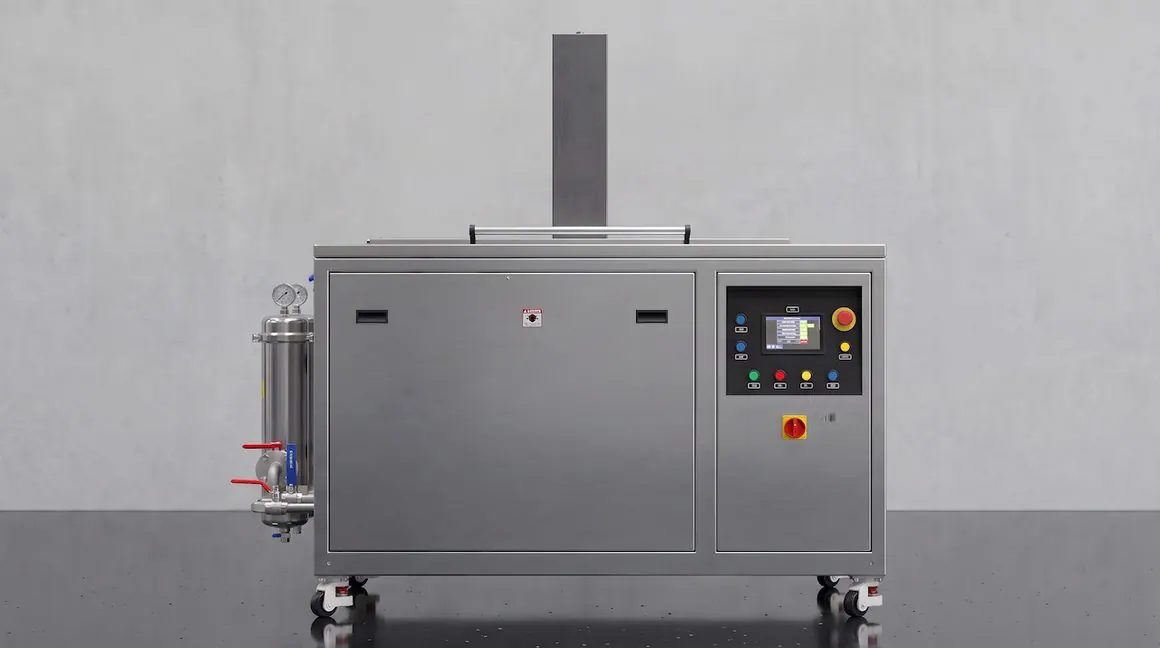
Ultrasonic tanks for cleaning DPFs (diesel particulate filters) in your own workshop. Two baths: one strips the soot and oil, the second dissolves the ash that regeneration leaves behind. A flow test before and after shows what came out.
Floor machines are quoted to site.

A DPF is a ceramic honeycomb. The channels are plugged at alternate ends, so every flow path is a blind hole. Soot is carbon. Regeneration burns it off. Ash is what is left once everything combustible has gone. It comes mostly from the engine oil additive package: calcium, zinc, magnesium and phosphorus. No regeneration temperature removes it.
Ash packs the channel ends and stays there. Regens come closer together. In the end back-pressure is still high straight after a completed regeneration. At that point the restriction is ash, and another regen changes nothing.
Carbon and oil come off in alkaline chemistry. Mineral ash comes off on the acid side. No single bath does both well. That is why a DPF cleaning machine is two tanks, not one.
Inspect and weigh. Record the part number, the weight and the condition of both faces. A cracked or melted filter stops here. Cleaning will not bring it back.
Flow test, before. On the bench, at a fixed test point. Write the number down.
Bath one: carbon and oil. Alkaline chemistry, heated, ultrasonics running. This stage takes the soot, the unburnt hydrocarbons and the oil. Oil has to go first because it binds the ash into a paste.
Rinse. Carry-over between an alkaline bath and an acid bath neutralises both.
Bath two: the ash. RegeniK dissolves the calcium ash, zinc phosphate and magnesium oxides. The ash leaves in solution rather than as a particle that has to be pushed through a blocked channel.
Flush, rinse and dry. A directional flush drives the freed ash out of the blind channels. Dry the filter thoroughly. A filter refitted damp to a hot exhaust is a thermal shock event.
Flow test, after, and weigh again. Same bench, same test point. Two flow numbers and the grams of ash that came out. That is the record that goes back with the filter.
Why ultrasonics. The filter is fully submerged, so every channel is in contact with the bath, including the ones that are completely blocked. Cavitation works inside blind geometry, so the filter is cleaned without cutting the can open. Power and exposure are limited for the ceramic substrate.
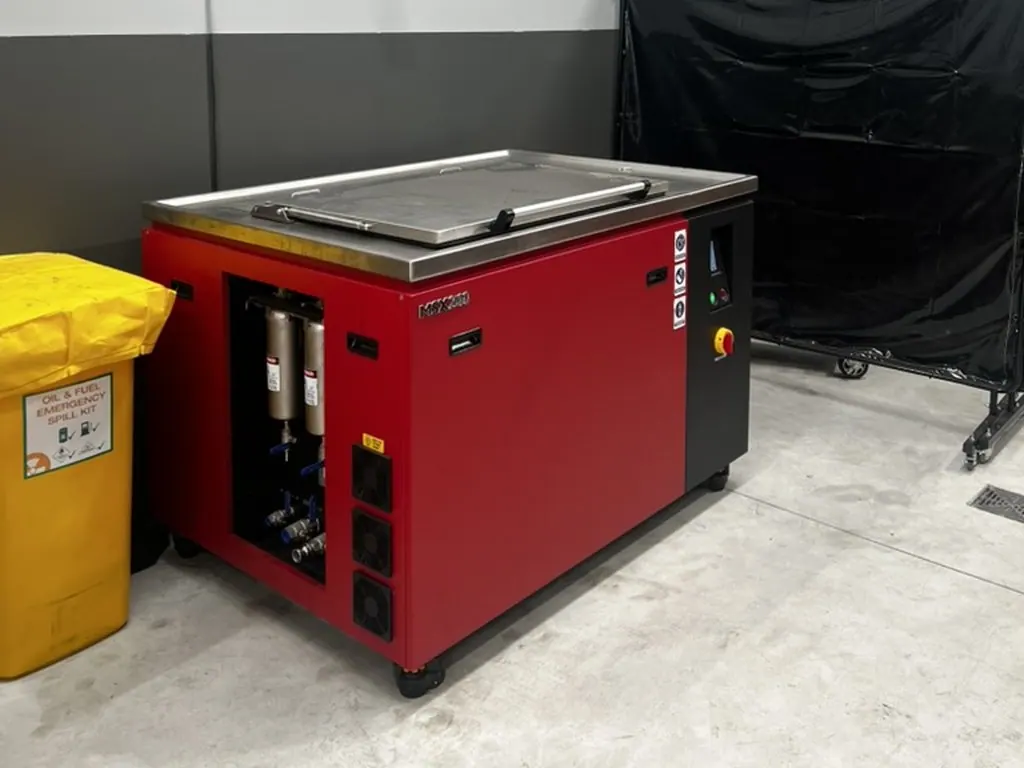
Size the tank to the largest filter in the fleet. The working depth has to cover it standing, with liquid over the top. You need two tanks, one for each bath. Both stages work faster warm, and filtration takes the ash out of the bath so it does not settle on the next filter.


| Machine | Tank | Basket or tank opening | Working depth | Power supply |
|---|---|---|---|---|
| MSX 70 | 70 L | Basket 600 × 400 mm | 300 mm | 240 V single phase |
| MSX 140 | 140 L | Basket 700 × 500 mm | 400 mm | 415 V three-phase |
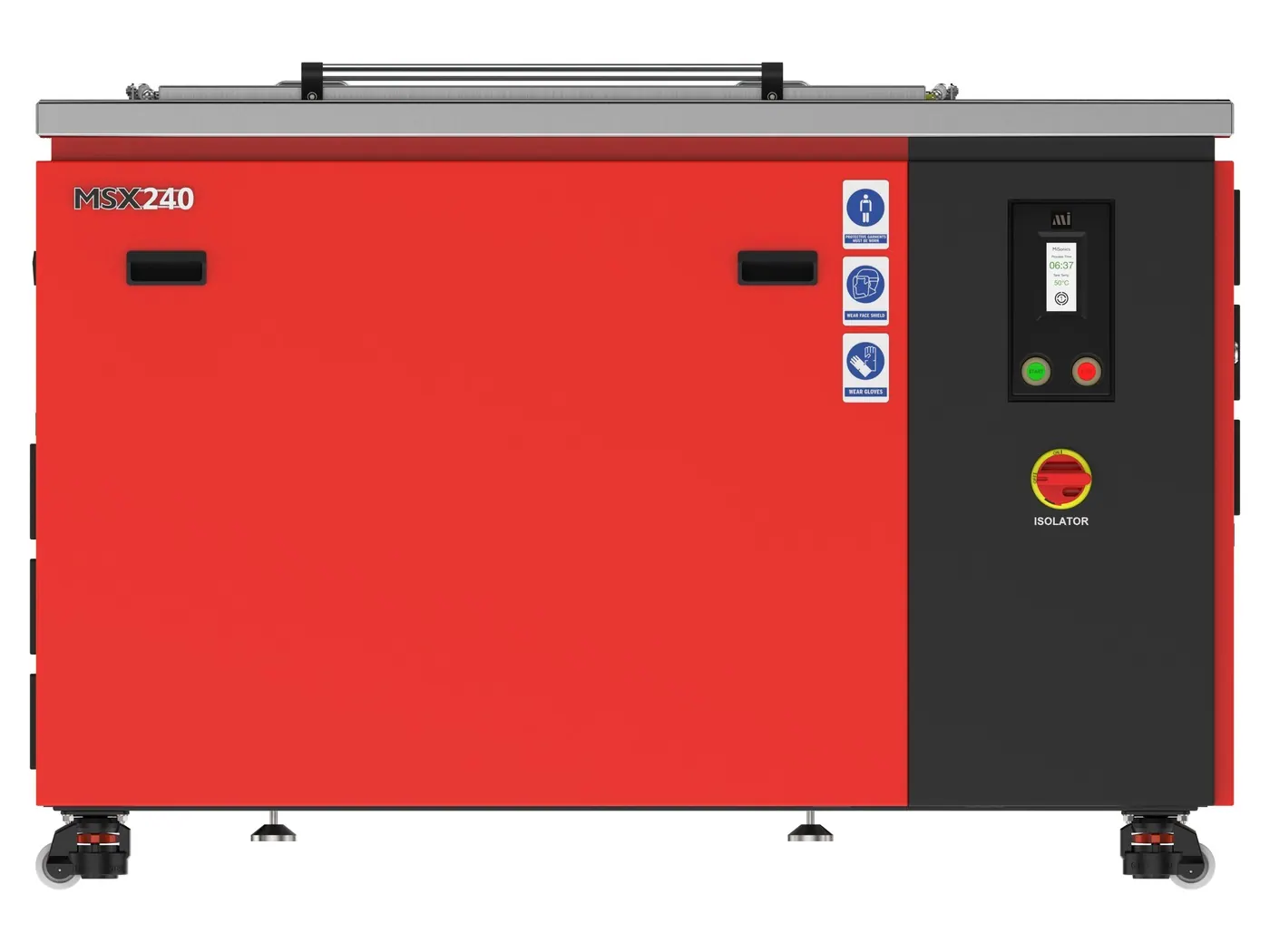
| MSX 240 | 240 L | Basket 900 × 500 mm | 500 mm | 415 V three-phase |
| EVS 180 | 180 L | Tank 750 × 500 mm | 480 mm | 415 V three-phase |
| EVS 600 | 600 L | Tank 1200 × 800 mm | 550 mm | 415 V three-phase |
| Custom EVS | To your filter | Drawn around your basket and floor | To your filter | 415 V three-phase |
Specifications are confirmed in writing at quotation. Floor machines are quoted to site: power, chemistry, baskets and commissioning in one number.
Power. The MSX 70 runs from 240 V single phase. The MSX 140, MSX 240 and every EvoSonic tank need 415 V three-phase. We confirm site requirements on every quote.
Drainage and bunding. MSX tanks drain through a 1" stainless ball valve. Plan where spent solution goes. A bund under the machine keeps spills off the floor. See integrated work areas.
Handling. A wet core in a basket is a two-person lift unless the machine is specified to avoid it. EvoSonic tanks can be fitted with an elevator platform that lowers the basket into the bath.
A flow bench. Without a flow number before and after, the job produces no evidence.
Rinse water. The filter is rinsed between the baths and before drying.
Most fleets start by sending filters away. Four figures decide whether to stop:
The case is usually made on turnaround. A workshop that can clean a filter overnight does not need the spares a two-week turnaround demands. On a remote site those spares are money sitting on a shelf.
Where the numbers do not support it, we will say so. A workshop doing a handful of filters a year should keep sending them out.
Carbon stage, ash stage, flush, dry and flow test against a clean baseline, recorded per filter serial.
Read the case study →GuideSoot against ash, how to tell which one is blocking the filter, and four cleaning methods compared.
Read the guide →ChemistryUsed neat, ambient to 50 °C, 10 to 20 minutes. SDS and TDS on the page.
View RegeniK →Not properly. Carbon and oil come off in alkaline chemistry. Mineral ash comes off on the acid side. One bath does one of those jobs and leaves the other. A DPF cleaning machine is two tanks: a carbon bath and an ash bath, with a rinse between them.
Start from the largest filter in the fleet. The working depth has to cover it standing, with liquid over the top. Send us the filter dimensions and how many you clean a year and we will tell you which tank fits.
The MSX 70 runs from 240 V single phase. The MSX 140, MSX 240 and the EvoSonic tanks need 415 V three-phase. We confirm site requirements on every quote.
Measure it. Flow before and after on the same bench at the same test point. Weight before and after, which tells you how many grams of ash came out. Then differential pressure once the filter is refitted.
Power and exposure are limited for the ceramic substrate. There is no cutting, no burnout thermal shock and no rodding. Dry the filter thoroughly before it goes back on. A filter that is already cracked or melted is scrap, and the inspection before cleaning is there to catch it.
It depends on filters a year, cost per send-out with freight, turnaround and the spares you carry to cover it. Turnaround usually makes the case. A workshop doing a handful of filters a year should keep sending them out.