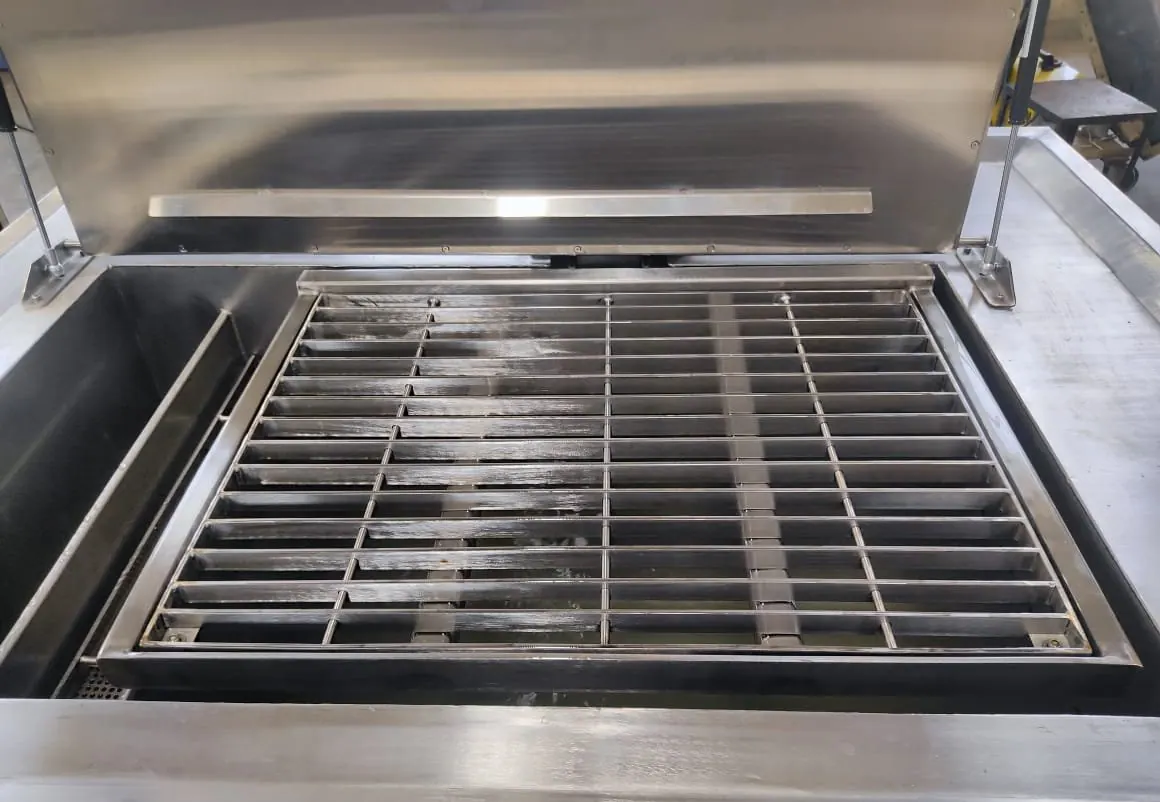
Transducers, generator, heater, weir, filtration, basket and controls — what each one does, the numbers behind it, and the cycle from fill to dry. Written from the tanks we build, sell and commission.
An industrial ultrasonic cleaning tank is a stainless bath that turns electrical power into sound, and sound into millions of collapsing bubbles on the surface of the part. Everything else on the machine — heater, weir, filtration, basket, controls — exists to make that collapse happen evenly, at the right temperature, in the right chemistry, load after load. This page takes the machine apart, names every piece, and puts real numbers on each one from the tanks we build and sell.
The generator takes mains power and drives the transducers at 25 or 40 thousand cycles a second. Each cycle stretches the liquid and then squeezes it. On the stretch, microscopic bubbles open; on the squeeze, they collapse, and each collapse fires a jet at the nearest surface. That is cavitation, and it happens on every wetted face of the part at once — inside bores, under flanges, in the root of a thread. The heater brings the bath to the temperature where the chemistry works. The weir skims what floats off. The pump and filter take out what sinks. The basket holds the part where the sound is and keeps it off the floor that is making it. What happens inside one bubble is its own article; this one is about the machine.
Stainless steel, because cavitation erodes anything softer and most chemistries attack anything else. Wall thickness goes up with the duty: 0.7 mm 304 on a 3 to 20 L bench unit, 1.5 mm 316L on the MSX 15, 3 mm 316 with insulation on the MSX 140. One number matters more than the litres on the badge. Working depth is how deep the liquid is with the basket in (100 mm on a PS 610, 400 mm on an MSX 140).
The part never sits on the tank floor. The floor is the radiating face; a part resting on it damps the field, shadows everything around it and wears the steel. The basket also sets the load limit — 2 kg on a 3 L bench tank, 8 kg on an MSX 15, and in a 300 L EVS a basket of clutch packs or drill components goes in on a hoist. Parts are spaced so the liquid reaches every face; a crowded basket cleans the outside of the pile and leaves the middle dirty.
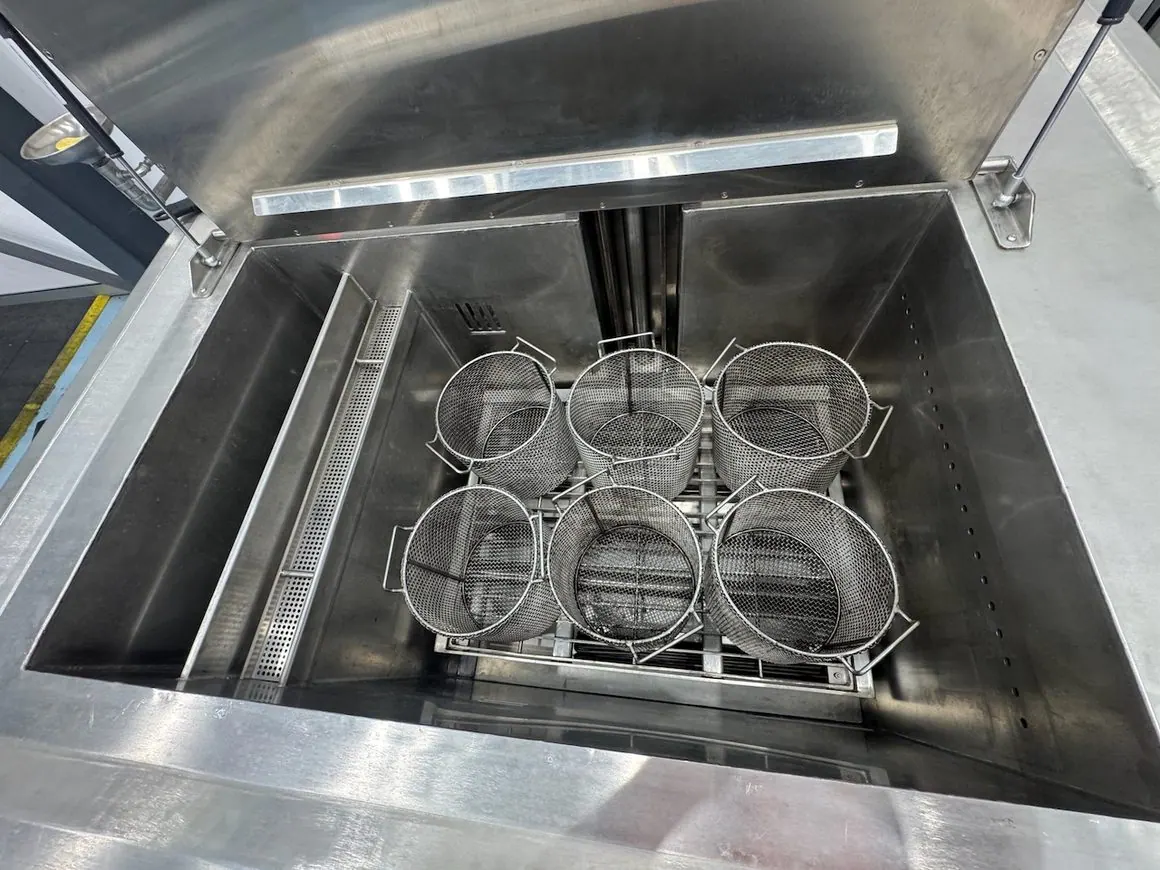
Water, plus a concentrate chosen for the soil and the metal: an alkaline degreaser for oil and carbon, a neutral or mildly acidic product for aluminium and brass, an enzymatic for instruments. The liquid does two jobs. It carries the sound, and it dissolves or lifts what the cavitation knocks loose so it cannot settle back on the part. Fresh water is full of dissolved air that soaks up ultrasonic energy before it reaches the part. On an older tank that means a degas run before the first load; on a current generator with pulse mode the air leaves on its own during the first clean or two in a new solution. The full guide is at ultrasonic cleaning chemistry.
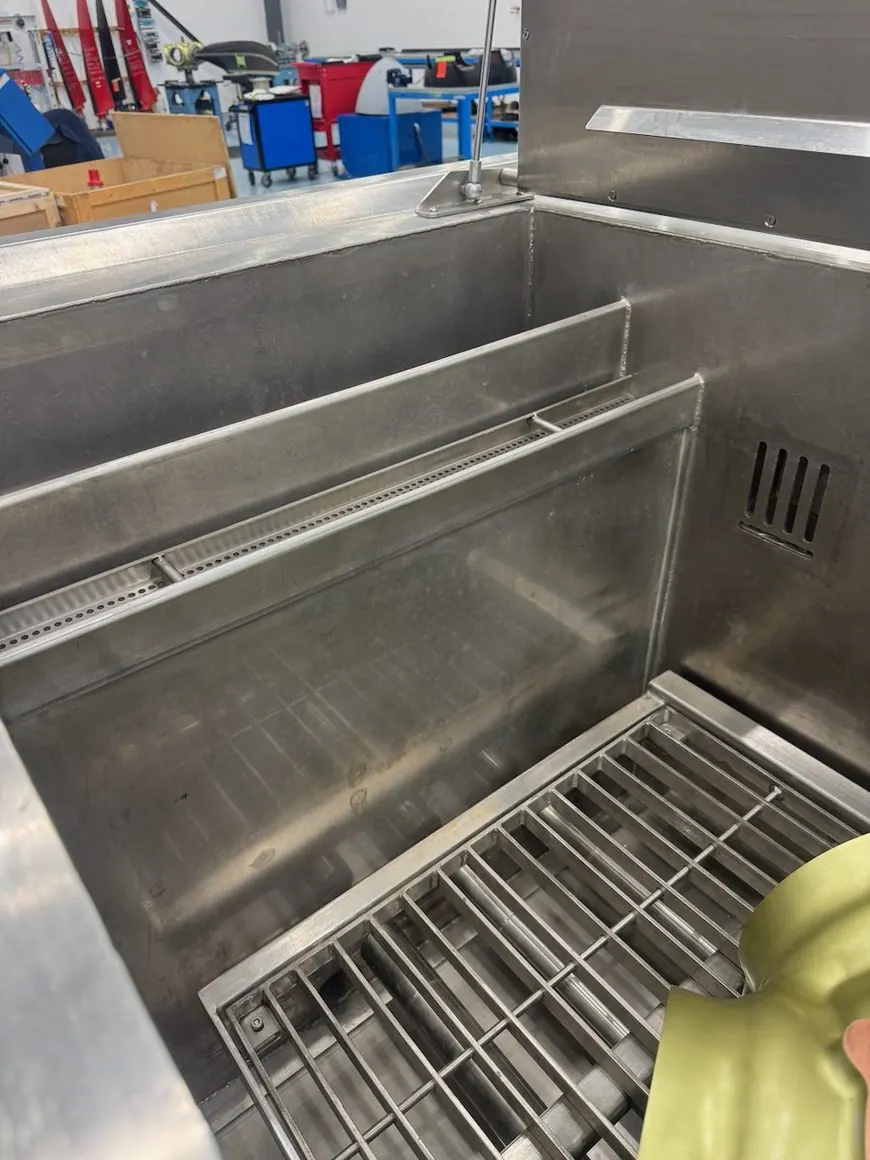
Degreasing floats oil. Left on the surface, it coats every part on the way out and goes back into the bath on the way in. A displacement weir keeps the liquid level a few millimetres above the lip so the surface, and the oil on it, spills continuously into a side chamber. From there an interceptor or coalescer separates oil from solution and the clean solution returns. On the MSX 140 this is standard; on the EVS 7000 there are three weirs across a 4,433 L bath. The whole subject is covered in oil removal: weirs and coalescers.
A transducer is a stack of piezo-ceramic discs clamped between a steel back mass and an aluminium horn by a single bolt — a bolt-clamped Langevin transducer. Drive it at its resonant frequency and it changes length by a few microns, tens of thousands of times a second. On a bench or workshop tank the transducers are bonded to the underside of the floor and driven as one bank, so the floor itself becomes the loudspeaker. That is cheap, compact and right for a 3 to 50 litre tank with a shallow basket.
It has a geometry problem the moment the tank gets deep. The field leaves the floor in one direction and fades with distance; the bottom layer of a tall basket cleans beautifully and the top layer comes out grubby, and anything shaded by another part sits in a dead zone. Settled sludge lands on the one surface that is doing the work and insulates it until the bond cooks. The foil test shows all of this in ten seconds.
So in the large tanks we move the transducer off the floor and into the bath. A 360° rod resonator is a solid stainless or titanium-alloy waveguide driven from one end by a transducer stack; the rod resonates along its length and radiates from its whole cylindrical surface, so the intensity follows the rod top to bottom instead of fading from a distant floor. On a foil map a base plate reads roughly 100 at the floor, 55 mid-basket and 30 at the top of a deep load; a rod holds about 90 along its immersed length. The wetted part is a sealed solid with nothing to flood and no horizontal face to bury — sludge falls past it, not onto it. That is why the EVS 7000 drives 4,433 litres evenly from 42 rods, and why a rod set drops into a tank a customer already owns and makes it ultrasonic without a rebuild.
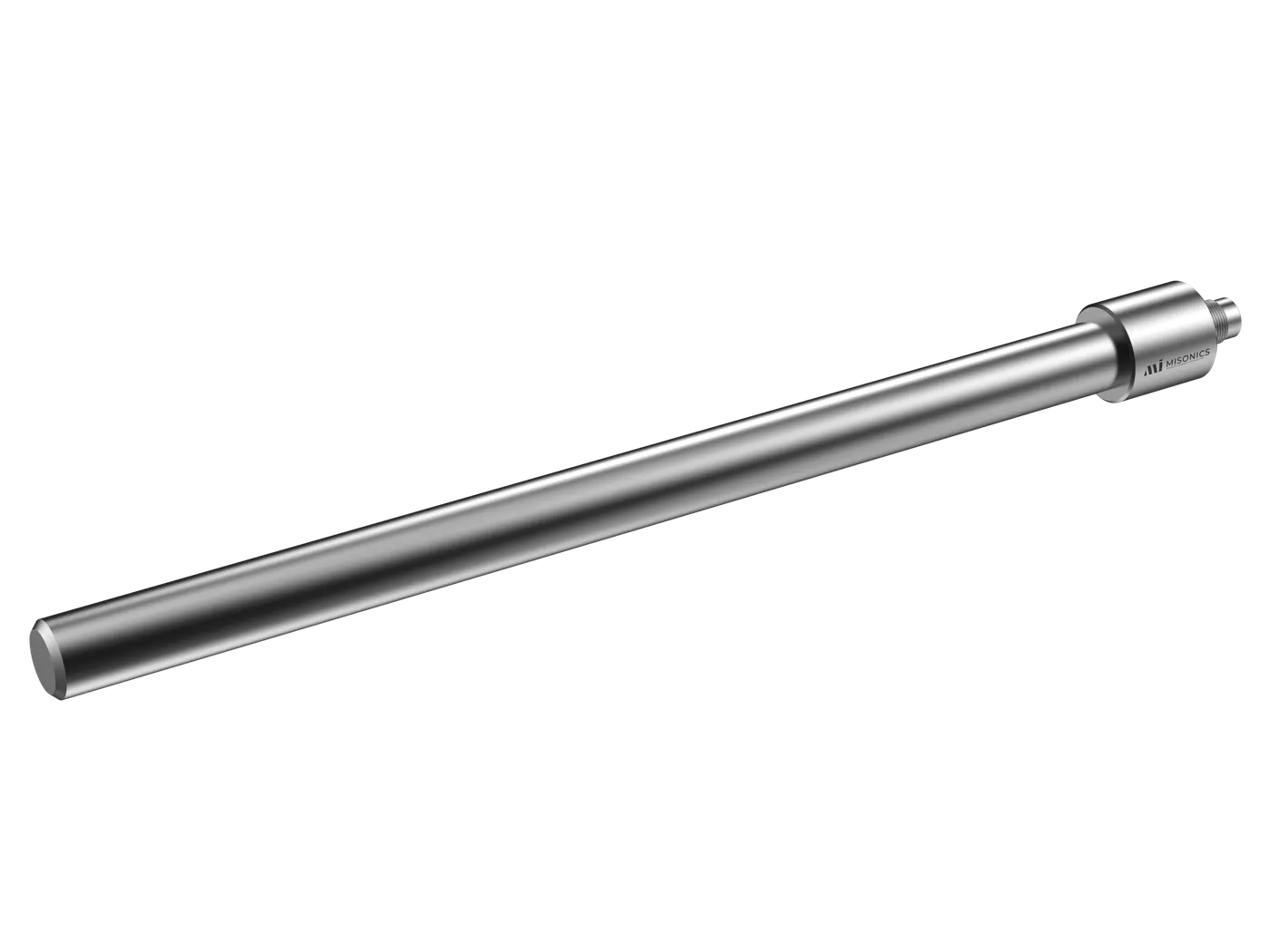
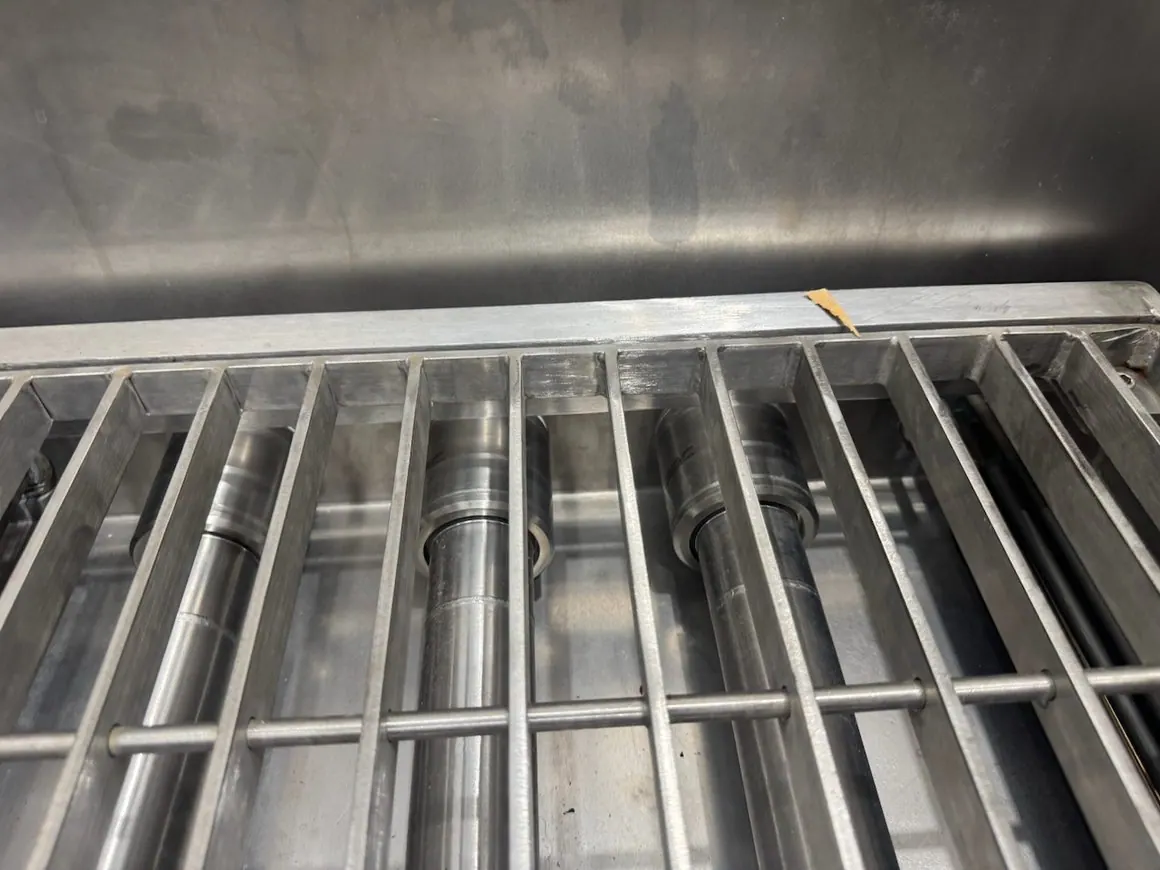
The honest limit: each rod runs one frequency — 40 kHz on the short ones, 25 kHz from 476 mm up — and its strength is robust, even, deep-field cleaning. Precision multi-frequency work stays on bonded and immersible plate platforms. The rod owns depth, retrofit and abuse. The full argument, with the foil maps, is in the 360° rod resonator; the retrofit path is Naked Sonics.
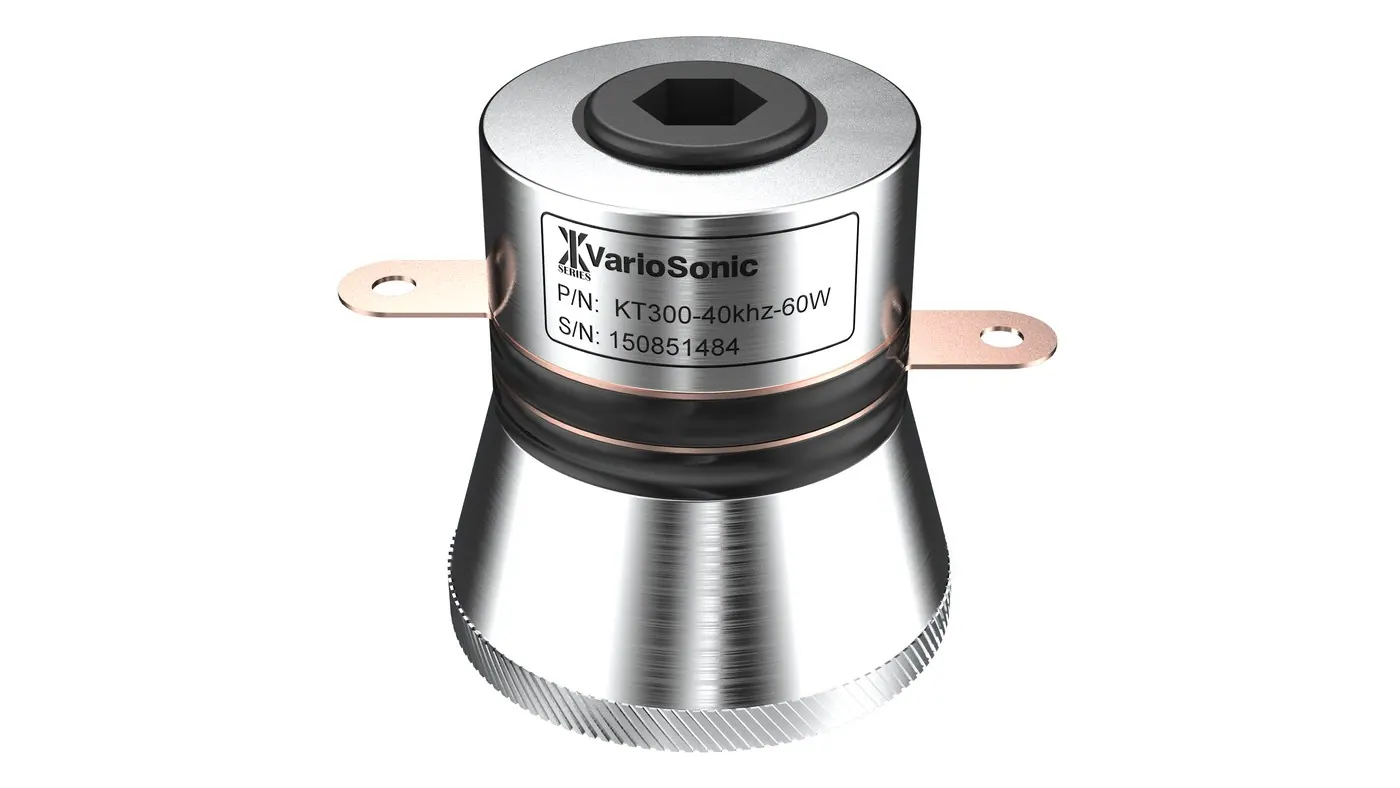
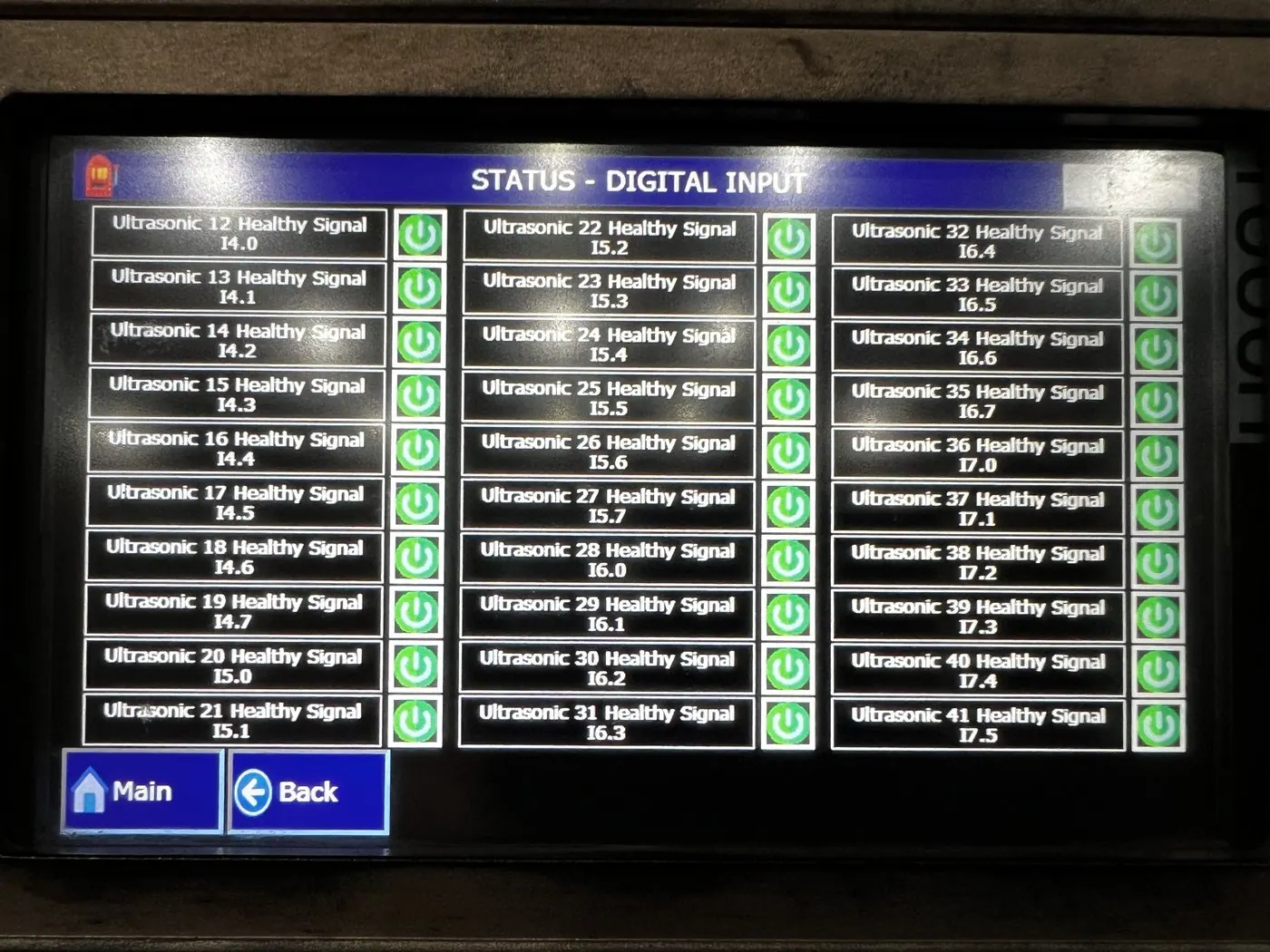
The generator is the electronics. It converts 240 or 415 V mains into the high-frequency drive the transducers need, holds them on resonance as the bath warms and the load changes, and carries the three settings that separate a tank that cleans from one that cleans everywhere: sweep moves the frequency a little either side of centre so the standing waves that make stripes never settle; pulse switches the drive on and off to let bigger bubbles form; degas runs a pattern that drives dissolved air out of a fresh bath — and on a current generator the pulse mode does most of that job by itself during the first cycle or two, so a separate degas run is a habit from older tanks. A bench unit has one generator and three buttons. An MSX 140 runs two generators sharing 3,000 W from a touchscreen with stored recipes. An EVS 7000 has 42 channels, each reporting its own health on the HMI, so a failed resonator shows up before the parts do. Sweep, pulse and degas explained.
25 kHz makes bigger bubbles that collapse harder: heavy carbon, baked oil, scale, castings, large tanks. 40 kHz makes smaller bubbles in greater number: general workshop parts, instruments, anything with fine detail. 45 kHz and above for delicate or polished work. The MSX 30 switches between 25 and 45 in one tank. Full treatment: 28 kHz vs 40 kHz.
Silicone pads under the floor on bench tanks, immersion or jacket elements on floor machines. Heating power rises with volume: 0.3 kW on a 5 L PowerSonic, 4 kW on the MSX 140, 70 kW on the EVS 7000. Most aqueous degreasing runs at 50 to 70 °C, with heavy oil and carbon at the top of that range and enzymatic instrument chemistries held at 40 to 45. Hotter is not better without limit: as the bath approaches boiling the bubbles fill with vapour and collapse softly, and the substrate sets its own ceiling — aluminium, plated and heat-treated parts first. The temperature guide works through both limits.
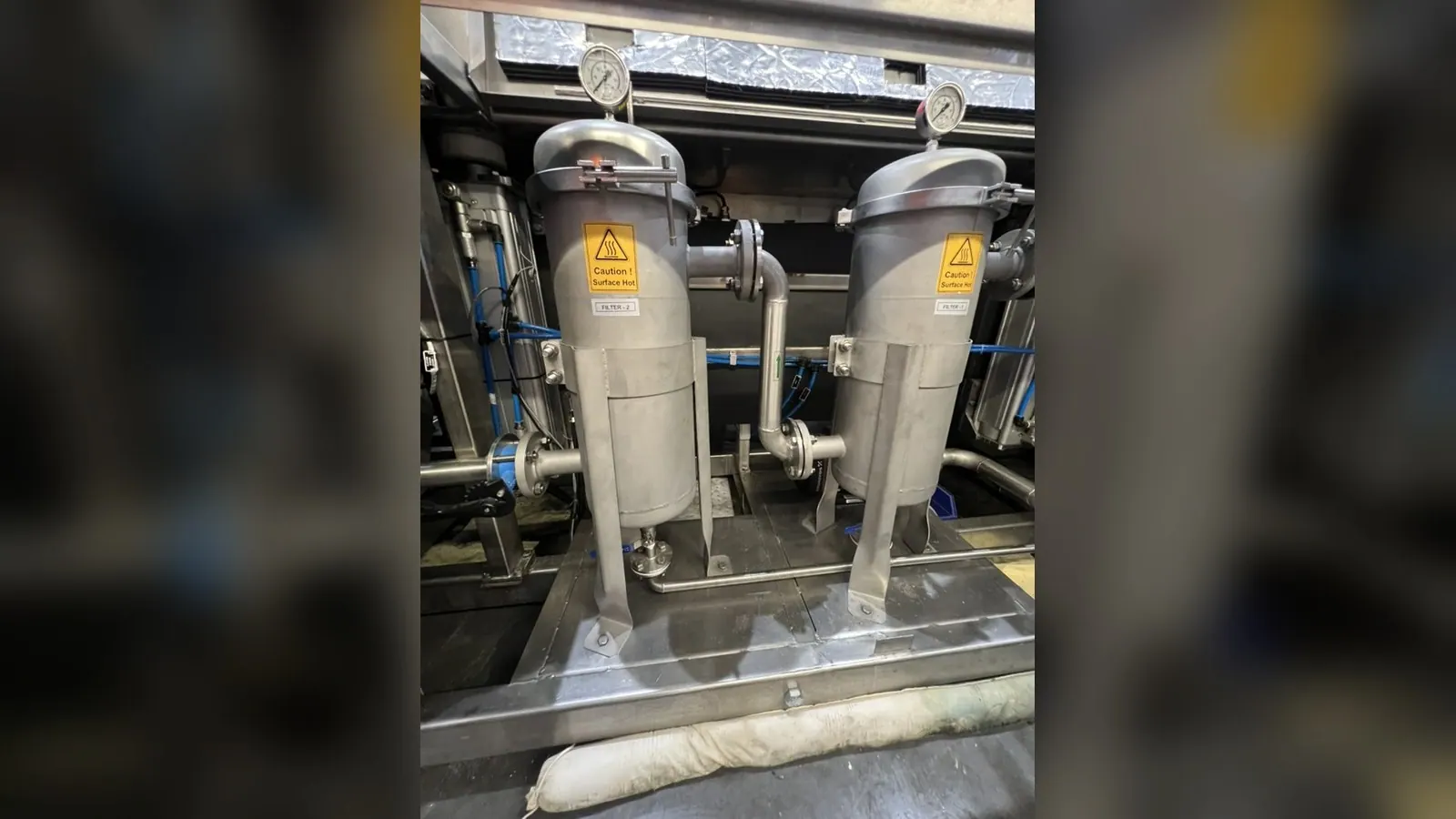
What the cavitation knocks off has to go somewhere. On a bench tank it settles, and the bath is dumped when it stops cleaning in the usual time. On a floor or plant machine a pump draws from the tank through bag or cartridge filters and returns clean solution, so the bath lasts weeks instead of days and the load coming out is not rinsed in yesterday's swarf. The optional filtration skid on an EVS 300 carries the pump, filter housings and the valve manifold; ultrasonic filtration explains how to size it.
The lid holds the heat in, keeps the mist and the noise down, and on a 20 L bench tank is a plastic cover; on a 140 L floor machine it is gas-strutted; on a 4,433 L tank the lid opens over a platform lift that lowers the whole load into the bath. The drain is a ball valve and a hose on the smallest units, because a daily bath change should never mean lifting and tipping a tank of hot solution. Controls run from a membrane panel with a 99-minute timer, through a touchscreen with stepless power and stored recipes, to a PLC and HMI that log every cycle.
Fill to the line and dose. Too little liquid overheats the transducers; too much spills when the basket goes in. Concentrate at the dose on its label, measured, not splashed.
Heat. 50 to 70 °C for aqueous degreasing; 40 to 45 for enzymatics; under the substrate's ceiling always.
Let a fresh bath degas. On an older tank, run it empty first: 5 to 10 minutes on a small tank, 15 to 45 on a large one depending on the type. On a current generator with pulse mode, the first clean or two in a new solution drives most of the air out on its own, so you load and go.
Load the basket. Parts spaced, hinged items open, nothing on the floor, under the basket's weight limit.
Run. 3 to 20 minutes for most workshop loads; carbon, scale and baked-on oil run longer. Lift and look rather than guess.
Rinse and dry straight away. Clean water rinse, then dry so bare steel does not flash-rust on the bench. On a line, a hot-air dryer does this in 15 to 40 minutes.
Keep the bath. Skim the oil between loads. Change the solution when it stops cleaning in the usual time, not on a calendar.
Five settings and one habit. Frequency matched to the soil. Delivered power — measured in the bath, not read off the nameplate — spread evenly: our range runs about 20 to 60 watts per litre on bench tanks and leaner on large volumes, because an established field in a big tank sustains cavitation more efficiently. Temperature under the substrate ceiling. Chemistry matched to soil and metal. Loading that lets the liquid reach every face. And the habit: prove it. A strip of foil in the bath shows the field in ten seconds; a protein or soil test shows the result. The foil test and clean is a number show how.
Heat exchanger cores and tube bundles, where the fouling is inside the passages and the only alternative is a lance: the EVS 7000 on a heat-exchanger service floor runs 4,433 L for exactly that. Filter elements and screens, recovered instead of replaced. Carburettors, injectors and cylinder heads in automotive workshops. Clutch packs and drill components in mining and heavy vehicle. Aerospace structures on a four-tank line from wash to dry. In every case the tank was sized to the part first and the litres followed.
See also: Ultrasonic cleaning, explained.
Part dimensions, what comes off it and how many a day. We come back with the tank, the frequency, the chemistry and a price — and if ultrasonics is the wrong answer we will tell you.