Home / Knowledge / Ultrasonic cleaning
The plain guide · Benchtop to plant

Ultrasonic cleaning: how it works, what it cleans and the machine you need

Ultrasonic cleaning is a heated tank of cleaning solution with transducers bonded underneath. Sound at a pitch you cannot hear makes millions of cavitation bubbles in the liquid. Each one collapses against the part and lifts the dirt off. Nothing touches the surface but the liquid, so it cleans inside holes, threads, ports and jets that no brush reaches.

The same process cleans a ring, a carburettor, a set of injectors, a cylinder head and a 2,000 kg heat exchanger bundle. The difference is the size of the tank, the power in it and the solution you put in.

How it works

What the cavitation bubbles do

A transducer under the tank floor turns electrical power into vibration at 25 to 45 kHz. That vibration stretches and squeezes the liquid thousands of times a second.

On the stretch, the liquid tears and a tiny vacuum bubble forms. On the squeeze, the bubble collapses. It collapses hardest where it meets a solid surface, and the jet it throws out knocks the dirt loose. There are millions of these cavitation bubbles in a running tank, all collapsing against every face the liquid touches at once. The solution then holds the dirt in suspension so it does not settle back.

Three things set how well it cleans: the power going into the tank for each litre of liquid, the temperature, and the solution. Heat matters because most soils soften between 50 and 70 °C. Frequency matters less than people think: 40 kHz is gentler and suits small and delicate parts, 25 to 28 kHz hits harder and suits carbon, baked oil and heavy castings. The MSX 30 switches between the two.

The longer explainer, from the physics to the tank →
See it work

Cavitation on the surface, a part coming out, a basket going in

Our own tanks, filmed on our own jobs. Press play; there is no sound.

Cavitation on the surfaceWhat a running bath looks like: the cavitation bubbles breaking at the top of the liquid. The same thing is happening against every face of the part below.
A gear coming outLifted straight from the basket: oil and grime gone from the teeth and the bore, no brush, no blasting.
A basket going inA plant-size tank loads the same way a bench bath does: parts in a basket, lowered under the liquid, clear of the floor.
What it cleans

What ultrasonic cleaning does well, and what it will not do

It is a surface process. If the liquid can reach the dirt and the right solution can loosen it, the cavitation bubbles will take it off.

Cleans well

  • Oil, grease, coolant and cutting fluid off metal
  • Carbon and varnish out of ports, jets, injectors and manifolds
  • Polishing compound and rouge from jewellery, watch parts and spectacle frames
  • Flux and residue from circuit boards and brass
  • Scale, lime and light rust, with an acid descaler in its own tank
  • Blood, tissue and debris from dental, veterinary and surgical instruments before sterilising
  • Brake dust, road grime and old lubricant from bike, kart and mower parts
  • Resin, paint overspray and ink from tooling, screens and spray tips

Will not do

  • Strip cured paint or powder coat on its own; that needs a stripper first
  • Clean what the liquid cannot reach: a sealed bearing, a closed cavity
  • Pearls, opal, emerald, turquoise or anything glued: the cavitation bubbles find the weak spot
  • Polish or deburr; it removes what is on the surface, not the surface
  • Run on plain water for anything oily; water alone has nothing to carry the dirt away
  • Replace drying: steel that comes out wet has to be dried straight away or it flash-rusts
Will it clean my…

Straight answers by what you are cleaning

Most people searching ultrasonic cleaning have one part in mind. Find yours and the right tank is one click away.

Not sure which one? Send the part and the dirt.

Ask an engineer
Which machine

Pick the tank by the part, not by the litres on the box

The part has to fit in the basket, fully under the liquid, clear of the tank floor. Measure your largest part, then start here.

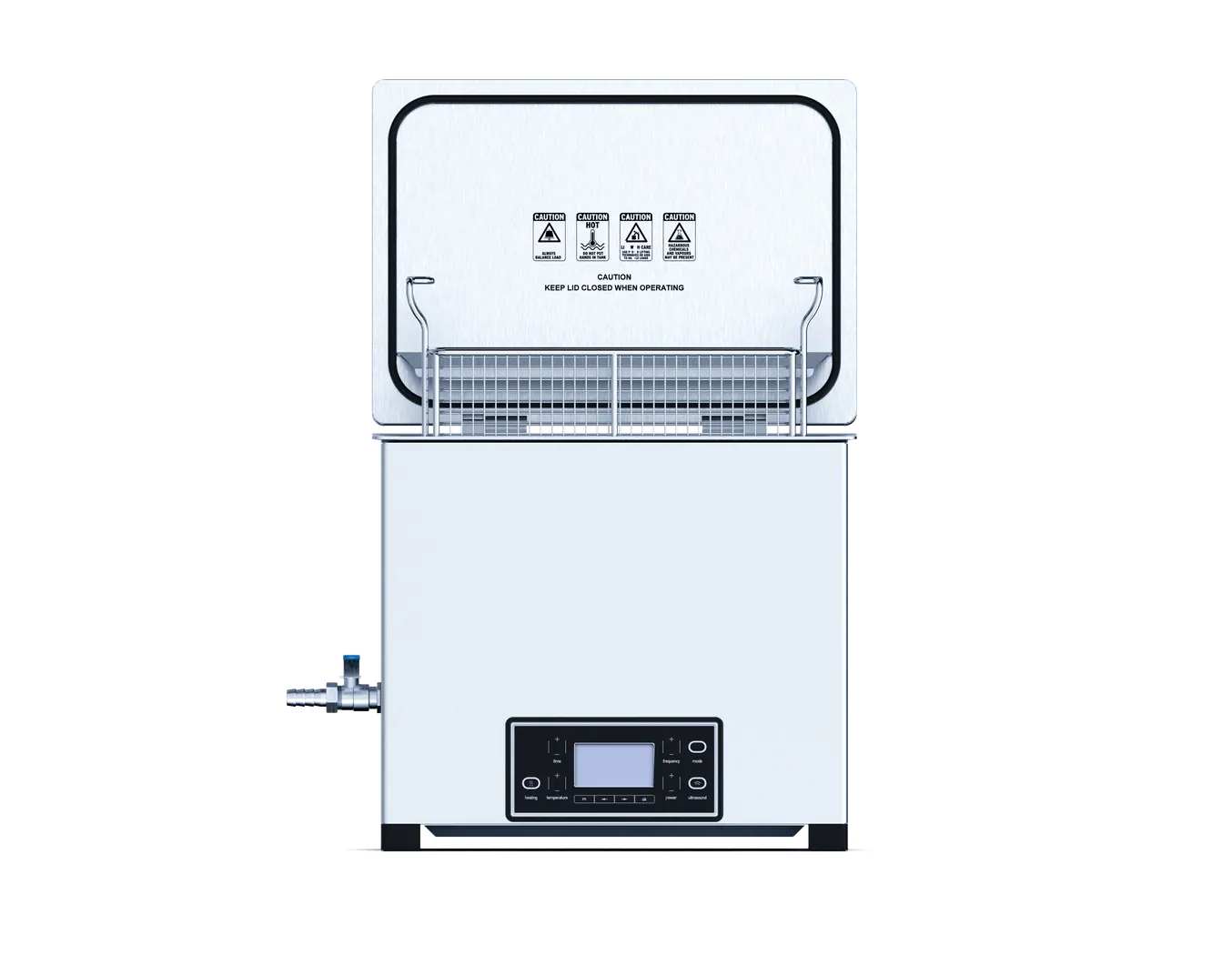
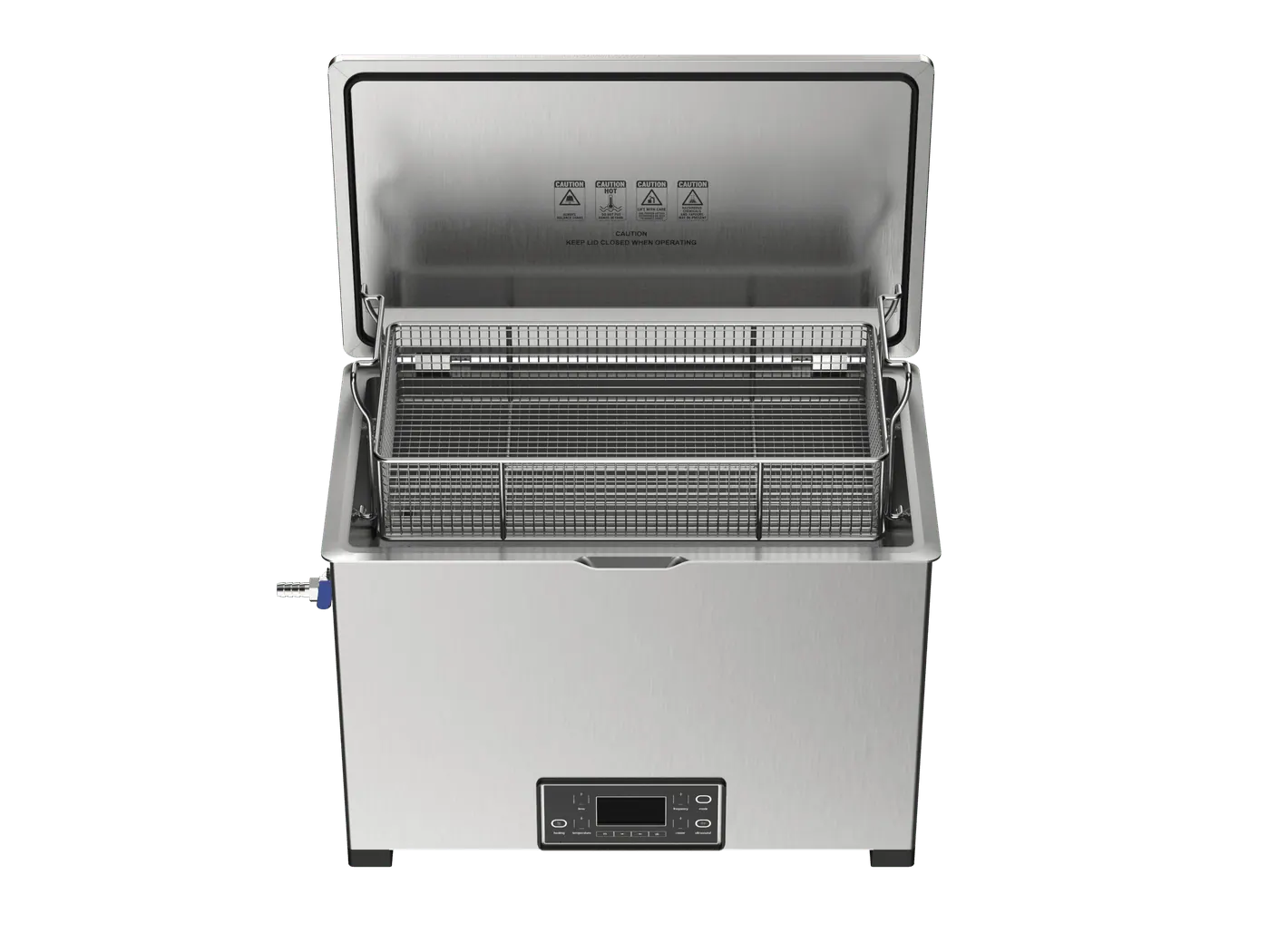
Bigger than a bench? The MSX 50 to MSX 240 floor-standing tanks take heads, housings and batch trays, with weir, oil capture and filtration on the larger models. EvoSonic tanks and multi-stage wash, rinse and dry lines are built to the part and the throughput. The size guide runs from 3 L to 46,000 L.

What to check before you buy any ultrasonic cleaner →
The solution

The cavitation bubbles do the scrubbing. The solution decides what comes off.

Water on its own cleans dust. For anything oily you need a few per cent of a concentrate that wets the soil and holds it in suspension. Pick it by the dirt and by the metal, and keep to the dose: more concentrate does not clean faster, it only leaves residue.

Never put petrol, thinners, acetone or any flammable solvent in an ultrasonic tank. The heat and the cavitation bubbles throw vapour off the surface.

The full solution guide: dose, temperature and pH for each →
Doing it

How to run an ultrasonic cleaning cycle

  1. Fill to the line with water and add the concentrate at its dose. Too little liquid overheats the transducers; too much spills when the basket goes in.
  2. Heat it to 50 to 70 °C. Heavy oil and carbon want the top of the range.
  3. Degas a fresh bath for 5 to 10 minutes before the first load. New water is full of dissolved air that soaks up the energy.
  4. Use the basket. Parts on the tank floor damp the bath and wear the tank. Keep parts apart so the liquid reaches every face.
  5. Run 3 to 20 minutes, longer for carbon and scale. Lift and look rather than guess.
  6. Rinse and dry straight away. Clean water rinse, then dry so steel does not flash-rust.
  7. Change the bath when it stops cleaning in the usual time, not on a calendar. Skim the oil off the top between loads.
Parts not coming clean? Five fixes →
Buying one

Be honest about the job before you spend the money

If you want to clean a ring, a pair of glasses or a watch band a few times a year, and your budget is under $1,000, a small tank from Vevor or an online marketplace will do that job. They are not a Misonics machine and they are not meant to be. For a one-off home job they are the better bet, and we would rather tell you that than sell you a bath you do not need.

Whatever tank you buy, the solution decides what comes off. A small machine run on water or dish soap disappoints; the same machine run on a concentrate formulated for ultrasonics and for the part in front of you is a different tool. For the home mechanic, bike or kart builder, FX Degreaser at 15% in water for oily engine parts comes in a 10 L pack for $132 inc GST, and that pack makes about 65 L of bath, or ten fills of a 6 L tank. For aluminium carburettors, castings and anything you want to come out bright, AquaVantage 815 GD is the step up, 10 L for $242 inc GST. Yes, the solution can cost more than a cheap tank. It is also the part that does the cleaning. Jewellers and watch repairers: ask us about a jewellery cleaning solution in small packs.

The picture changes the moment the tank goes into a workshop, a lab, a clinic or a plant and runs every day. Then four things decide whether it keeps cleaning in a year's time, and they are the four things the price pays for.

Where the money goes on a proper machine

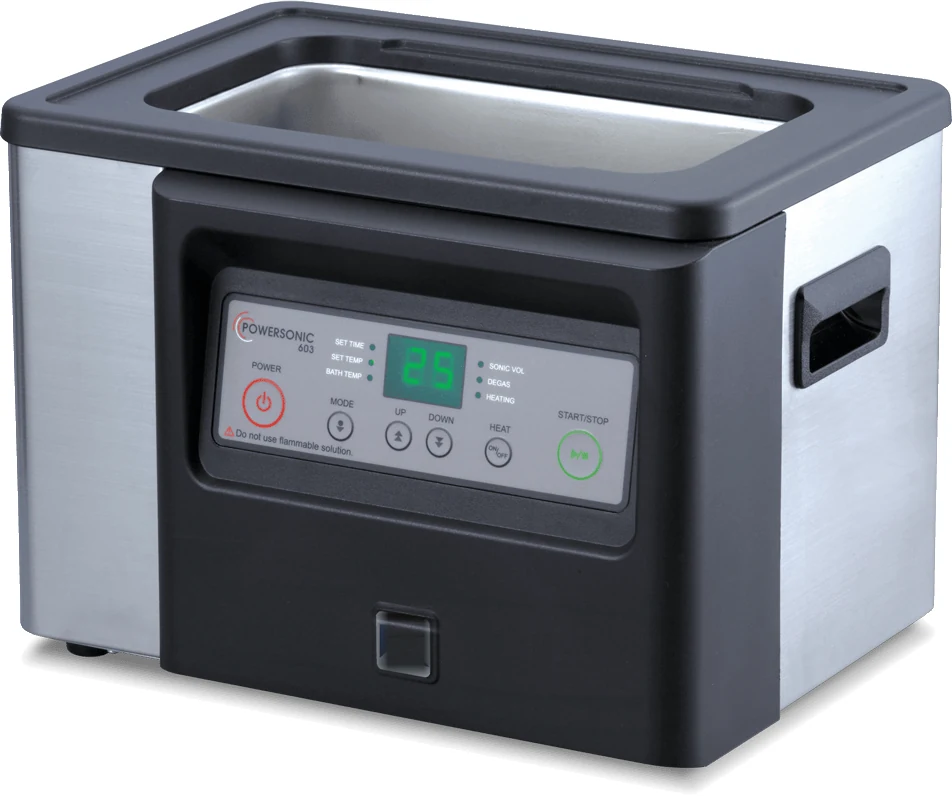
  • Power for each litre. A PowerSonic PS 603 puts 200 W into 2.6 L. An MSX 30 puts 650 W into 16.2 L. The cheap tanks quote a peak figure and put a fraction of it into the liquid, so a job that takes 5 minutes in a bath that is rated honestly takes 30 in one that is not, or never comes clean at all.
  • The tank. Thin stainless pits and cracks under cavitation. PowerSonic baths use 304 stainless; the MSX tanks are 1.5 mm and 3 mm 316L. A cracked tank is a dead machine.
  • Heat that gets there. Most solutions work between 50 and 70 °C. A small heater in a thin tank struggles to get there and loses it the moment cold parts go in. The MSX 15 heats to 80 °C and holds it.
  • Someone who answers. Every machine we sell carries a warranty held in Australia by people who can send a transducer, a generator or a basket, and who will tell you which solution to use for the part in front of you.

Who should buy what

  • Home, hobby, once a month: a small online tank, and a 10 L pack of the right solution from us so it works properly.
  • Jeweller, optician, dental or vet clinic, lab, watchmaker: a PowerSonic bath from $1,622.50 inc GST. Built to run every day, lidded, heated, with a basket that fits the work.
  • Workshop, reconditioner, bike shop, marine, race team: an MSX 15 or MSX 30. Carbon and oil every day, 316L tank, stepless power, load sensing, two frequencies on the 30, made and assembled in Australia.
  • Plant, fleet, MRO, manufacturer: the MSX floor range, EvoSonic tanks and multi-stage lines, built to the part and the throughput and quoted to site.

Quality costs money. For a commercial or industrial buyer it costs less than the machine that stops, the parts that come back dirty and the technician standing beside a tank that will not reach temperature. Before you buy anything, from anyone, check the power density in watts per litre of tank volume, whether the frequency sweeps, the basket size against your largest part, and who holds the warranty.

The full buying checklist →
Questions

Ultrasonic cleaning questions

What is ultrasonic cleaning?
Cleaning parts in a tank of heated solution that is vibrated at 25 to 45 kHz. The vibration makes millions of cavitation bubbles that collapse against the part and lift the dirt off every surface the liquid reaches, including blind holes, threads and ports.
Does ultrasonic cleaning damage parts?
Not metal, glass, hard plastics or ceramics, with the right solution. It can damage soft and porous gems (pearls, opal, emerald), glued joints, and anodised or soft coatings in the wrong chemistry. Match the solution to the metal and start with a short cycle.
What liquid do you use in an ultrasonic cleaner?
Water plus a cleaning concentrate matched to the dirt and the metal: a mild detergent such as FX Degreaser for light soils, a heavy-duty alkaline such as 815 QR-NF for carbon and oil, an acid descaler for scale in its own tank. Never flammable solvents.
How long does ultrasonic cleaning take?
Most parts take 3 to 20 minutes once the bath is degassed and at temperature. Heavy carbon, baked oil and scale can take 30 to 60 minutes. Jewellery and glasses take 2 to 5 minutes.
Can I use an ultrasonic cleaner for carburettors?
Yes. It is the best way to clear the idle and pilot circuits without stripping every jet. The MSX 15 takes one carburettor or a set of injectors; the MSX 30 takes a bank of four. Use a solution that is safe on the zinc and aluminium body.
What size ultrasonic cleaner do I need?
The smallest one your largest part fits in, fully under the liquid and clear of the tank floor. Compare the basket and the working depth, not the litres on the box. A 2.6 L bath takes a 240 mm basket; a 225 L tank takes 900 mm.
Is a cheap ultrasonic cleaner any good?
For a ring, glasses or a watch band a few times a year, yes: a small tank under $1,000 does that job and we would say so. For daily use in a workshop, lab or clinic, no: the power for each litre, the tank steel, the heating and the warranty are where the price goes, and a tank that falls short on them costs more in time and rework than it saved.
What frequency is best for ultrasonic cleaning?
40 kHz for small and delicate parts, jewellery, instruments and electronics. 25 to 28 kHz for carbon, baked oil and heavy castings. A dual-frequency machine such as the MSX 30 does both.
Read next

Related pages

Tell us what you are cleaning

Send the part, the dirt and how many you do a week. An engineer comes back with the tank, the solution and the cycle.

Send an enquiryCall 1300 647 664See the benchtop range