Added to cart
Home / Chemicals / Degreasing & General Cleaning / AquaVantage 815 QR-NF
Brulin EngineeredBest sellerPratt & Whitney PMC 1339ARP 1755B (Cat. 10)PWA 36604

AquaVantage 815 QR-NF

Immersion & UltrasonicIMMERSION& ULTRASONICImmersion & Ultrasonic

Heavy-duty cleaning with aerospace credentials

Carbon and grease off steel, aluminium and titanium — with P&W approval behind it.

P&W PMC 1339 · ARP 1755B credentialsHeavy soils off steel, aluminium AND titaniumProven in our 70 °C ring-groove case work
From $220.00 ex GST
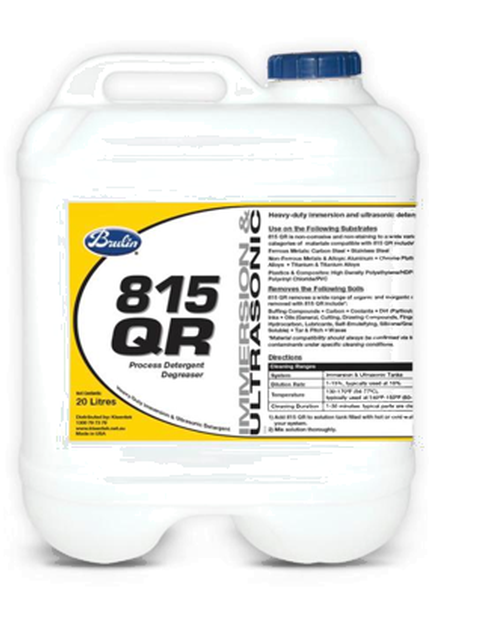
brulin aquavantage 815 qr nf container

Four AquaVantage grades. Same substrate safety across all of them — the difference is the duty.

One bath, three jobs

Degrease, free rinse, corrosion inhibitor

AquaVantage 815 QR-NF does three jobs in one bath, so a part can come out of the machine ready for the next operation instead of going through three tanks to get there.

1

Degrease

Lifts oils, coolants, greases, tar, pitch and waxes off the part. Released oil separates out for skimming instead of emulsifying into the bath, so the tank lasts.

Data sheet: separates oil effectively for easier skimming
2

Free rinse

The surfactant and builder package is picked so it goes back into solution in the rinse water and sheets off the part, instead of beading up or drying to a film. That sheeting is what a water-break-free surface is.

It matters because of what comes next. Anything left on the surface is an adhesion defect in the paint, the bond, the plate or the coating, and it will not show up until that stage fails.

Data sheet: free rinsing — permits improved adhesion
3

Corrosion inhibitor

Two different jobs, and it is worth keeping them apart. In the tank: the bath is alkaline, so steel sits in its passive range and holds a stable oxide, and the amine chemistry adsorbs a film on the surface. None of that follows the part out of the bath.

Out of the tank: a trace of that inhibitor carries through the rinse and holds off flash rust for a short while — indoors and dry. It is a residual film, not a coating. For anything going on a shelf, follow it with a dedicated rust preventative.

Data sheet: in-process corrosion control; short-term flash-rust inhibitor

Getting the protection to survive the rinse

This is where most people lose it. A freshly cleaned part is the worst case there is — you have just taken off the oil film that was protecting it, and bare steel sitting wet in aerated water goes off in minutes. Four things decide whether it holds.

Rinse hot, 60–70 °CParts come out carrying enough heat to flash themselves dry. One change, and it fixes more flash rust than anything else on this list.
Dry straight awayForced air or vacuum. Do not let parts drip-dry on a bench — time sitting wet is the single biggest lever there is.
Wet between, dry afterKeep parts wet from stage to stage so they do not spot, then get them properly dry after the last one. Wet-to-wet is fine; wet-to-air rusts.
Do not over-rinseEvery extra litre takes more inhibitor off. Match the rinse to the spec: under 50 µS/cm for ultra-clean, under 500 for precision. Long hot cascades and DI strip it fastest.

Three tanks become one. Less floor space, one bath to dose and monitor, one drum to buy, and no transfer between stages for the part to flash over in. Dose and temperature are on the dosage calculator →

Why It Wins

Heavy-duty cleaning with aerospace credentials

Most heavy-duty chemistry buys its strength by sacrificing substrates; most substrate-safe chemistry cannot touch real carbon. 815 QR-NF refuses the trade: heavy soils — grease, carbon, tenacious films — off steel, aluminium and titanium alike, with Pratt & Whitney PMC 1339 approval and ARP 1755B compliance behind it.

We proved it ourselves at 70 °C on diesel piston ring-groove carbon — staged ultrasonic cycles, dimensions untouched, documented in our case work. APE/NPE-free for global regulatory acceptance, it is the working chemistry for aerospace MRO and any industrial line that needs aerospace-grade substrate safety.

One operating note from its published data: its foaming tendency is high, so run it hot and degas after make-up — exactly the pattern the trial documents for your parts.

Cleaning newly manufactured parts — cutting oils, coolants, pastes rather than service-baked soils? Its general-duty sibling 815 GD is the sharper match: precision strength for manufacturing contamination, same substrate safety, same approval pedigree.

Applications

Where it earns its keep

Heavy aerospace and industrial soils — carbon and grease on steel, aluminium and titanium.

AerospaceAutomotiveMining
Material caution: Not for copper, brass or bronze — the ethanolamine content attacks copper alloys and can crack brass. Aluminium-safe despite pH (inhibited). High foaming tendency: run hot, degas after make-up.
Temperature & Dose
SWEET SPOT 63 °C54–77 °C20 °C100 °C

Dose: 5–30% (typ. 10%). The trial sets your exact process values; the TDS governs.

Run It Right

The working process

The 815 Family

Right product, right job

This Page

QR-NF — heavy duty MRO

Service-baked soils, substrate-safe.

Also Consider

AquaVantage 815 GD

New-manufacture soils — the sharper match

View →
Buy AquaVantage 815 QR-NFex GST
10 L$220.00
20 L$390.00
200 L$3,300.00
1,000 L$14,790.00

Delivered within Australia. Outside Australia, request a delivered price.
Complete The Job
Anti-RustStops flash rust on cleaned steelView & buy →RegeniKThe ash stage after carbonView & buy →
Compatibility
Mild & carbon steelSafe in prescribed use
Stainless steelSafe in prescribed use
Cast ironSafe in prescribed use
Aluminium & titaniumAluminium and titanium on the TDS list
Magnesium & soft alloysMagnesium and its alloys on the TDS list
Zinc & galvanisedNot on the TDS list — test first
Copper & brassDo not use — ethanolamine attacks copper alloys; brass can crack
Plated finishes (Cd·Cr·Ni)Chrome plating listed; cadmium and nickel — test first
Plastics & rubbersHDPE · nitrile · PVC on the TDS list
Painted / coated surfacesNot on the TDS list — test first
Per prescribed use — the cleaning trial confirms on your parts; the TDS governs. Full range matrix →
Transport
TransportDangerous goods — UN 2491, Class 8, PG III (Ethanolamine solution)
Bath Life

This is not a single-use chemical

A common misconception treats industrial chemistry like dishwater — used once, tipped out. A defended bath of AquaVantage 815 QR-NF works for weeks of production: the oil-splitting formulation sends released oils to the weir, solids leave through the filter, and the chemistry keeps working until genuine depletion.

Change out on evidence, not anxiety: when cycle times stretch or results fade at correct concentration, the bath has earned its retirement. Top-ups at specification carry it between changes.

Keep It In Spec
  • Skim or weir oils continuously — oil load is bath killer #1
  • Filter solids; drain settled sludge from the sump
  • Verify concentration on schedule — titration method on the product TDS
  • Log it — the trend predicts top-ups before cleaning fades
Storage

Drum and bath, both looked after

The Concentrate
  • Precautions for safe handling Before use carefully read the product label.
  • Use of safe work practices are recommended to avoid eye or skin contact and inhalation.
  • Observe good personal hygiene, including washing hands before eating.
  • Prohibit eating, drinking and smoking in contaminated areas. 7.2 Conditions for safe storage, including any incompatibilities Store in a cool, dry, well ventilated area, removed from incompatible substances, heat or ignition sources and foodstuffs.
  • Ensure containers are adequately labelled, protected from physical damage and sealed when not in use.
  • Check regularly for leaks or spills.
  • Large storage areas should be bunded and have appropriate ventilation systems.
  • Store between 4°C and 49°C. 7.3 Specific end uses No information provided.
Compliant with the product SDS.
The Working Bath

Lid the tank between shifts — holds temperature, limits evaporation, keeps dust out.

Idle periods: a warm, stagnant aqueous bath can support biological growth over extended stagnation. Circulate periodically, keep concentration at specification, never leave an open tank standing for weeks.

Extended shutdown: drain to sealed, labelled containers — or schedule changeover for restart day.

On the drum

The icons on the label, and what they mean

ConcentrateSupplied concentrated. Dilute before use.

These are the manufacturer’s own label marks, not third-party certifications. Where a named approval exists it is listed in full on this page. The compatibility table above is what governs.

Documents & Safety

The paperwork, on the page

Safety Data Sheet (SDS)
AquaVantage 815 QR-NF — Australian GHS SDS for your chemical register and risk assessments. PDF, 598 KB. Issued 27/06/2025.
View SDSDownload
Technical Data Sheet (TDS)
Kleentek KT-TDS-815QRNF · Rev 2 · issued 8 Sep 2026. Dose, temperature, material compatibility, soils, bath control and transport. PDF, 767 KB.
View TDSDownload
Hazard identification
Per Safe Work Australia GHS 7
Hazard statements
H314Causes severe skin burns and eye damage.
H318Causes serious eye damage.
H401Toxic to aquatic life.
H412Harmful to aquatic life with long lasting effects.
Key precautions
P260Do not breathe dust/fume/gas/mist/vapours/spray.
P264Wash thoroughly after handling.
P273Avoid release to the environment.
P280Wear protective gloves/protective clothing/eye protection/face protection.
P331IF SWALLOWED: Rinse mouth.
P353IF ON SKIN (or hair): Remove/Take off immediately all contaminated clothing.
Compliant with the product SDS — full document available for your chemical register.
PPE & exposure controls
  • Control parameters Exposure standards TWA STEL Ingredient Reference ppm mg/m³ ppm mg/m³ Diethanolamine SWA [Proposed] 0.11 0.5 -- -- Diethanolamine (h) SWA [AUS] 3 13 -- -- Ethanolamine SWA [AUS] 3 7.5 6 15 Biological limits No biological limit values have been entered for this product. 8.2 Exposure controls Engineering controls Avoid inhalation.
  • Use in well ventilated areas.
  • Where an inhalation risk exists, mechanical extraction ventilation is recommended.
  • SDS Date: 09 Oct 2020 Revision No: 1 PRODUCT NAME AQUAVANTAGE 815QR PPE Eye / Face Wear splash-proof goggles.
  • Hands Wear butyl or nitrile gloves.
  • Body Wear coveralls.
  • Respiratory Where an inhalation risk exists, wear a Type A (Organic vapour) respirator.
  • If spraying, wear a Type A-Class P1 (Organic gases/vapours and Particulate) respirator or an Air-line respirator.
Compliant with the product SDS — full document available for your chemical register.
First aid
  • Description of first aid measures Eye If in eyes, hold eyelids apart and flush continuously with running water.
  • Continue flushing until advised to stop by a Poisons Information Centre, a doctor, or for at least 15 minutes.
  • Inhalation If inhaled, remove from contaminated area.
  • To protect rescuer, use a Type A (Organic vapour) respirator or an Air-line respirator (in poorly ventilated areas).
  • Apply artificial respiration if not breathing.
  • Skin If skin or hair contact occurs, remove contaminated clothing and flush skin and hair with running water.
  • Ingestion For advice, contact a Poisons Information Centre on 13 11 26 (Australia Wide) or a doctor (at once).
  • If swallowed, do not induce vomiting.
  • Rinse mouth with water.
  • First aid facilities Eye wash facilities and safety shower should be available. 4.2 Most important symptoms and effects, both acute and delayed Causes skin and eye burns. 4.3 Immediate medical attention and special treatment needed Treat symptomatically.
Compliant with the product SDS — full document available for your chemical register.
Storage & handling
  • Precautions for safe handling Before use carefully read the product label.
  • Use of safe work practices are recommended to avoid eye or skin contact and inhalation.
  • Observe good personal hygiene, including washing hands before eating.
  • Prohibit eating, drinking and smoking in contaminated areas. 7.2 Conditions for safe storage, including any incompatibilities Store in a cool, dry, well ventilated area, removed from incompatible substances, heat or ignition sources and foodstuffs.
  • Ensure containers are adequately labelled, protected from physical damage and sealed when not in use.
  • Check regularly for leaks or spills.
  • Large storage areas should be bunded and have appropriate ventilation systems.
  • Store between 4°C and 49°C. 7.3 Specific end uses No information provided.
Compliant with the product SDS — full document available for your chemical register.
Disposal
  • Waste treatment methods Waste disposal For small amounts, absorb with sand, vermiculite or similar and dispose of to an approved landfill site.
  • For large quantities, contact the manufacturer/supplier for additional information.
  • Prevent contamination of drains and waterways as aquatic life may be threatened and environmental damage may result.
  • Legislation Dispose of in accordance with relevant local legislation.
  • SDS Date: 09 Oct 2020 Revision No: 1 PRODUCT NAME AQUAVANTAGE 815QR
Compliant with the product SDS — full document available for your chemical register.
Transport & dangerous goods
  • INFORMATION CLASSIFIED AS A DANGEROUS GOOD BY THE CRITERIA OF THE ADG CODE LAND TRANSPORT (ADG) SEA TRANSPORT (IMDG / IMO) AIR TRANSPORT (IATA / ICAO) 14.1 UN Number 2491 2491 2491 14.2 Proper ETHANOLAMINE SOLUTION ETHANOLAMINE SOLUTION ETHANOLAMINE SOLUTION Shipping Name 14.3 Transport 8 8 8 hazard class 14.4 Packing Group III III III 14.5 Environmental hazards Not a Marine Pollutant. 14.6 Special precautions for user Hazchem code 2X GTEPG 8A1 EmS F-A, S-B
Compliant with the product SDS — full document available for your chemical register.
AquaVantage 815 QR-NF FAQ

Asked at the tank

What dilution and temperature do I run?
5–30% (typ. 10%) at 54–77 °C, typically 60–66 °C, for 3–10 minutes — and the trial sets your exact process values against your soil. Running richer than specified wastes chemical without cleaning faster. That range is the chemistry’s window — not the whole answer. The substrate sets its own ceiling, and it is usually lower: aluminium and anodised finishes discolour above about 65 °C, zinc and coated parts lower again, and magnesium is governed by pH before temperature. Run at the lower of the two. Bath temperature — chemistry vs substrate →
When do I change the bath?
When cycle times stretch, results fade, or filtration stops holding the debris. Drain, clean the tank, refill — never lay fresh solution over settled sludge.
Can algae grow in the bath if it sits unused?
Over extended stagnation, any warm diluted aqueous bath can support growth as preservative systems deplete. Prevention: circulate periodically, hold concentration at specification, lid the tank. If a bloom happens: drain, clean the tank including weir and lines with hot fresh solution, rinse and refill — never dose on top of growth.
Can I get the SDS before buying?
Yes — every product ships with its SDS, and documents are available ahead of purchase for your chemical register and risk assessments.

Prove it on your parts

The trial pairs AquaVantage 815 QR-NF with your components — concentration, temperature and cycle documented before you order a drum. Wrong chemistry for your soil? The trial says so.

Talk to an engineer Back to the Range
Compliance, Standards & Conformance

Approved and conformant — by name

AquaVantage 815 QR-NF is the APE/NPE-free quick-rinse member of the 815 family. It carries a narrower approval set than 815 GD — if your process calls up a specific 815 GD approval, check which grade the specification names.

Engines
  • Pratt & Whitney PMC 1339
Test Compliance
  • ARP 1755B Stock Loss (Cat. 10)
  • PWA 36604 Hot Corrosion
Formulation
  • APE / NPE-free
  • Quick-rinse grade
Note
  • Distinct product from 815 GD-NF
  • Approvals are not interchangeable

Source: Brulin published product data. This product is not listed in the Brulin Specification Conformance & Testing bulletin (750-042Z) — its approvals are published separately. Confirm the current revision with Misonics before writing it into a process specification.

Goes with this

Filter bags for this bath

The bag is what keeps the bath working — it takes the soil out before it settles back onto the next load. This is a strong alkaline bath, and that rules the media in and out before micron rating comes into it.

what we would sendPolypropylene needlefeltStrong alkaline bath · pH above 11 · caustic

Rated to pH 14. This is what it is for. Start at 25 µm unless something downstream needs finer.

Not polyester or nylon. Caustic hydrolyses polyester — the ester bond is cleaved and the bag loses strength until it tears. Heat makes it fast. Use polypropylene. Nylon is rated pH 3–11. Above 11 it is out of spec.
Which size, media and micron — the full guide →
Payment is processed by Stripe; we do not see your card number. We use your details to process and deliver the order, as our Privacy Policy describes.