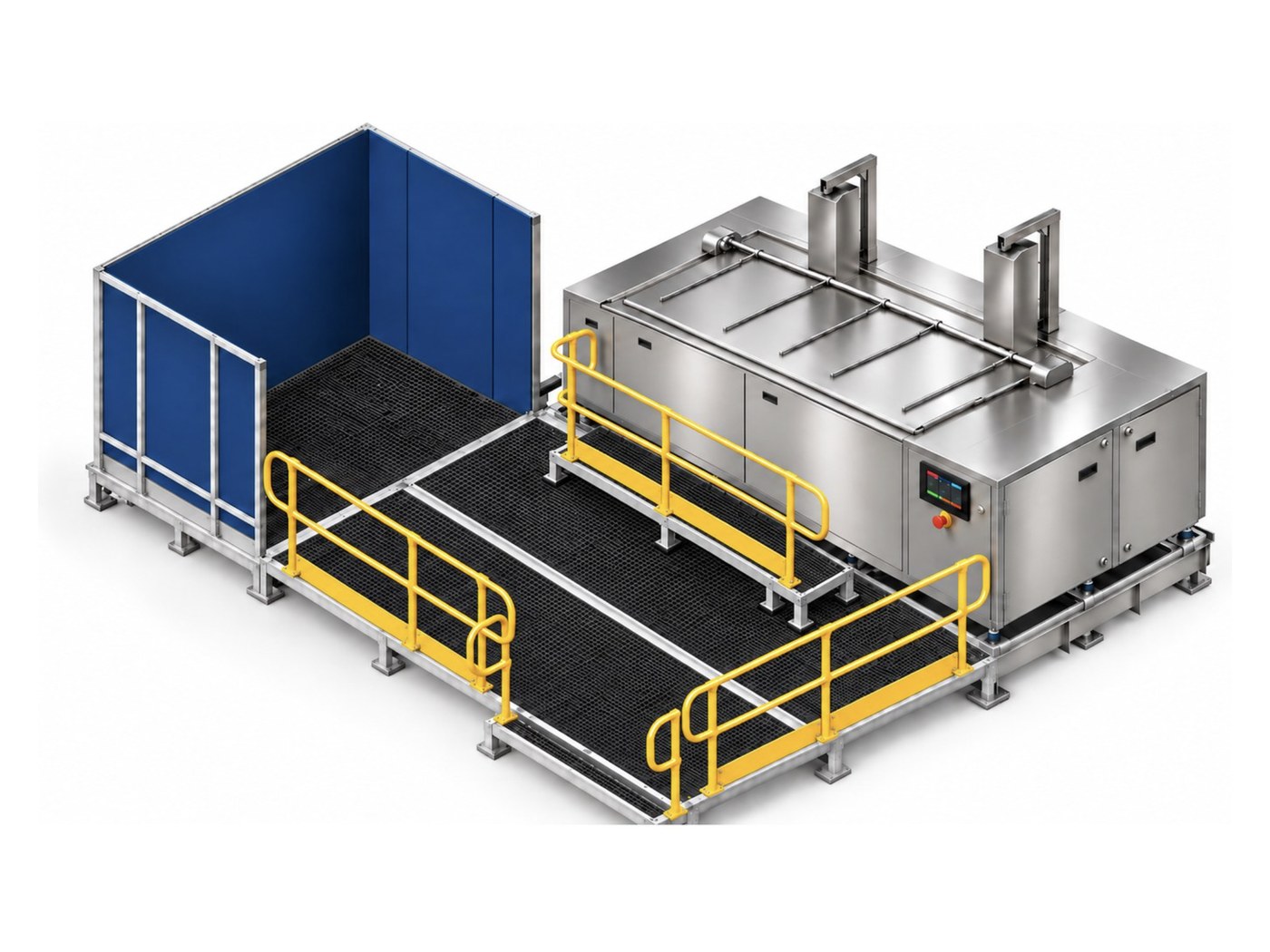
The largest standard tank we build · heavy industrial

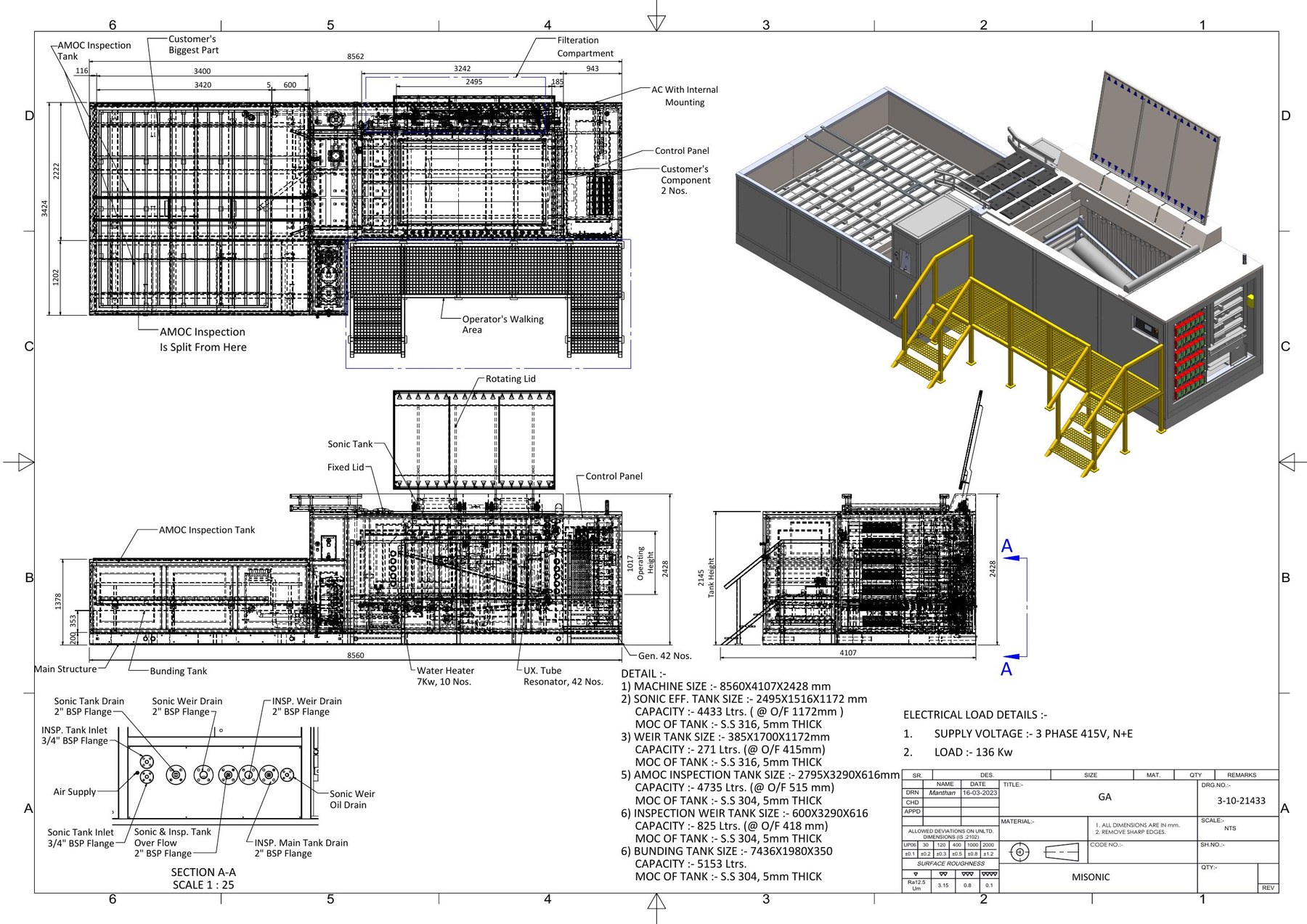
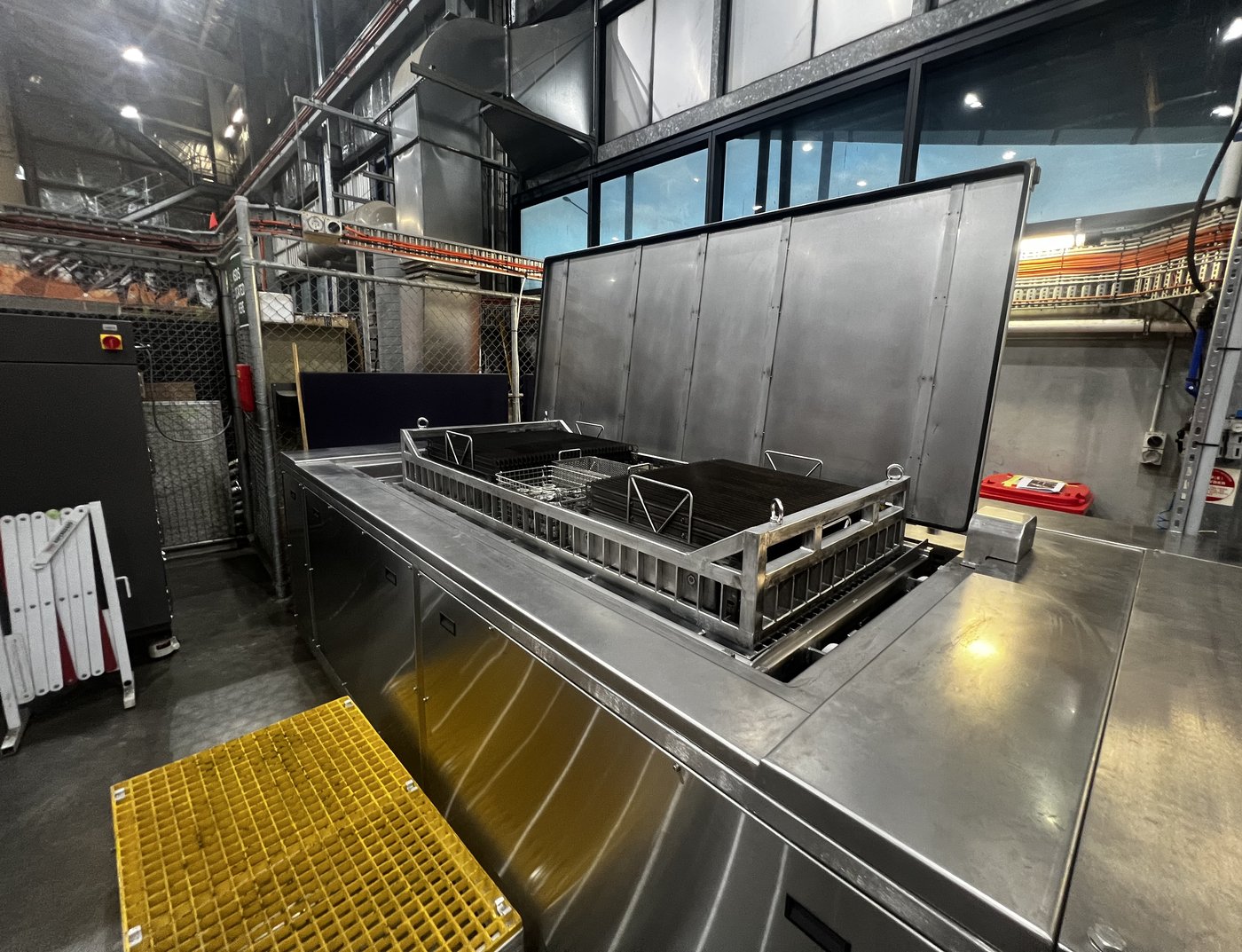
The general arrangement is dimensioned; the machine is photographed on the factory floor and in service. Renders show the current build.
Quoted as a working system: machine, services check, chemistry, baskets, commissioning and first recipes — one number, ex GST.
All specifications — incl. dimensions, ultrasonic power and volume — are confirmed at quotation.
Filmed in service: the 1-tonne basket rigged on its lifting beam, the lock-before-lift handles the operators actually use, and the AMOC inspection tank surfacing fouled cores out of the working bath. This is what four and a half thousand litres of heavy duty looks like on a working floor.
Clips are silent and load only when you press play. Filmed on a working installation.
The EVS 7000 is the top of the standard catalogue: nearly four and a half thousand litres in 5 mm SS316, driven by forty-two generators totalling 63,000 watts of 25 kHz. Working depth is 1,172 mm; the connected load is 136 kW; the control system is Siemens TP700 HMI on S7 PLC with the remote-access gateway. Access platforms and stairs are part of the machine.
This is the tank for heat-exchanger bundles, large fabrications, rail and power-generation hardware — the work photographed in our archive on skids and inspection tables. Beyond it, the same engineering goes fully custom: the TM-series builds in our records went bigger still.

In most factories, lifting a heavy basket into a tank means booking the overhead crane — the most fought-over asset in the building. The EVS platform ends that: parts go on by trolley, forklift or hand at deck height, the platform lowers them into the bath, and the crane goes back to jobs only a crane can do.
It cleans better — with agitation the platform works the load through the field — and it manages parts better: raise to drain, let drag-out run back, unload on the operator's schedule, not the hoist's.
Ask any operator who has run one: the platform is the feature they will not give back.
Case studies → · Industries we serve → · See the platform working on the EVS 1500 page →
Blocks, heads and housings at truck scale — the documented one-immersion strip.
Final drives, cylinders, undercarriage and GET — wash-bay soils at wash-bay scale.
Whole-core immersion for bundles and radiators — see the case study.
Turbine hardware, filters and exchangers — the sector page covers the duty.
Drawn from the Misonics operating manual and machine specification.
The EVS 7000-PL delivers the ultrasonics and oscillation stages. We quote the matching rinse tank and drying stage alongside the machine — see the multistage guide.
The daily bath for oils, grease and workshop soils — 5% in water, works from warm.
Product, SDS & TDS →Ferrous carbon & paintGrease, rust, scale, carbon and paint off steel and cast iron in one bath — the chemistry the 1.5 mm SS316 tank was built to hold. pH 14, so ferrous only.
Product, SDS & TDS →Precision & approvalsAerospace-approved aqueous for new-manufacture and precision work; 815 QR-NF for MRO carbon.
Product, SDS & TDS →POA is not a brush-off. Tell us the duty and the options, and what comes back is a real number on a real proposal — machine, options, delivery and commissioning to your site.
Each choice becomes a priced line. Not sure? Pick “advise me” and we size it from your duty.
This is what makes the price real — the deposit and the throughput decide chemistry, cycle and filtration.
4,433 L · 63,000 W at 25 kHz · 42 generators · 2495 × 1516 mm opening, 1,172 mm working depth · 70 kW heating · Siemens PLC/HMI + remote gateway
The same elevator-platform system is on video, working a live trial, on the EVS 1500-PL page. Between sizes or past them? Build your own EVS.

Bunding to catch what comes off the load, a raised grated deck so the work happens at working height, and a screened washbay for the wet work beside the bath.
Built into the machine from the start, or as a separate unit that drops in beside one already on the floor. Quoted as its own line, ex GST.
Bunding, raised platforms and washbays →Australian-owned and engineered. Built locally and internationally to Misonics drawings, specifications and testing requirements, then supported from Melbourne with parts, service and the people who wrote the process. Sold direct and through our distribution partners.