Specification
| Model | G4-1040/80 |
|---|---|
| Ultrasonic frequencies | 40 & 80 kHz |
| Rated power | 1,000 W |
| Power adjustment | 10–100 %Linear control across the range |
| Power supply | 220 VAC ±10 %, 50/60 Hz |
| Control topology | Full-bridge phase shift |
| Power regulation | Constant power control |
| Frequency control | Automatic trackingLoad self-adaptation |
| Frequency switching | 24 VDC ±10 %, 20 mA |
| Communications | RS485 (Modbus RTU) |
| Protection class | IP21 |
| Ambient conditions | 0–40 °C, 0–90 % RH |
| Enclosure size | 412 × 160 × 238 mmL × W × H — 19-inch cabinet integration supported |
| Conversion efficiency | Up to 95 % |
What the control actually does
| Full-bridge phase shift | Stable, efficient power conversion for industrial ultrasonic loads. |
|---|---|
| Constant power output | Holds controlled output as the load and the bath conditions change. |
| Automatic tracking | Follows the resonant frequency and adapts to impedance changes — no manual retuning visit. |
| Peak power | Available on demand for stubborn contamination — the figure is confirmed against the model. |
| Sweep | Breaks up standing waves and evens out the energy distribution. |
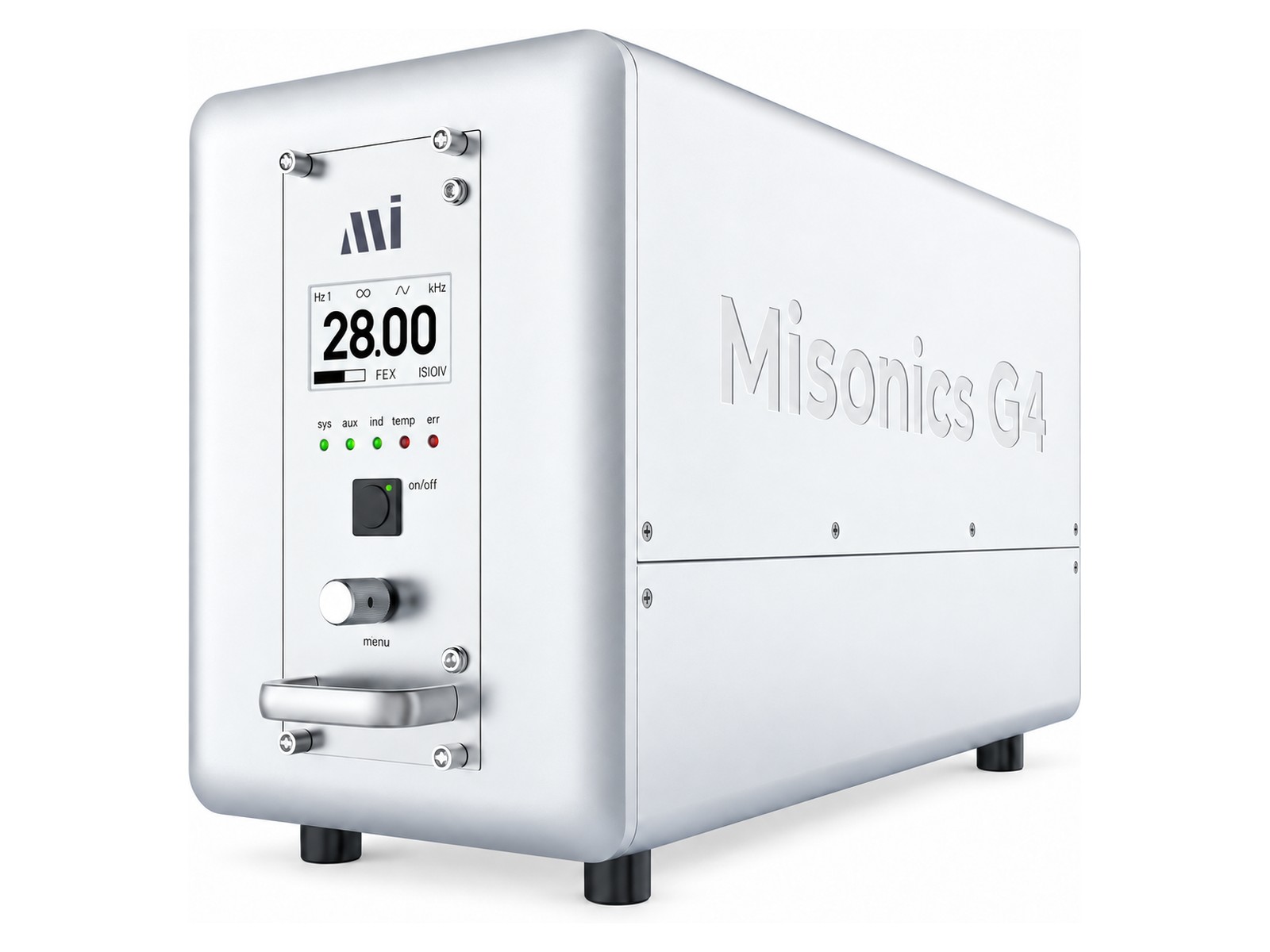
| Monitoring | Voltage, current, phase, status, temperature, run time and both frequencies on the front LCD. |
| Protection | Over-current, over-voltage and short circuit, internally. |
| Integration | Remote control to PLC and HMI, RS485 Modbus RTU, 19-inch cabinet mounting. |
VarioSonic G4-1040/80
One generator, two selected operating frequencies — aggressive soil removal and fine cleaning on the same platform. Pick the frequency pair your parts need, then the power your transducer set draws.
Which frequency should I choose? → How loud is each band? →
Only after a generator? Read this firstOpen
We do not sell a generator on its own to drive transducers we have not specified, and we do not sell transducers to run on a generator we did not supply. It is not a policy about paperwork — the two are tuned to each other, and an unmatched pair usually means no cavitation, a drive running hot, and both halves replaced inside a year.
There is no warranty on an unmatched pair. If you already own one half, tell us what it is and roughly when it went in and we will tell you where you stand before you spend anything.