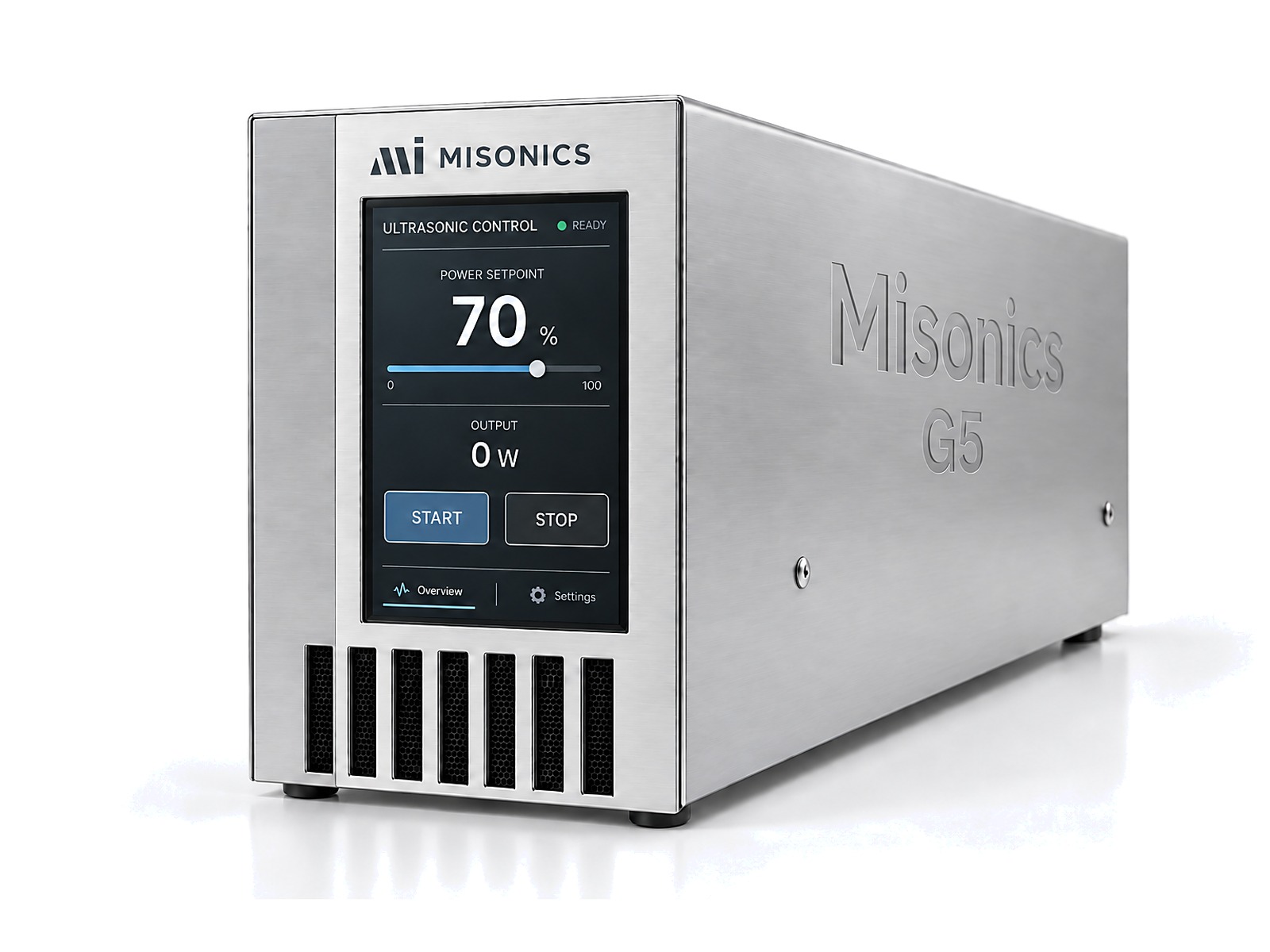
Product render of the SonoDrive G5. A photograph of the delivered unit will replace it.
What is fixed
| Pairing | Matched to the rodSized to the resonator's power output — the two are quoted together |
|---|---|
| Frequency | Fixed25 kHz standard across the Solo 360 range |
| 40 kHz option | AvailableOn the two shortest rods, and to order — on application |
| Rod power range it covers | 800 to 1,500 WThe Solo 360 range, 340 to 1327 mm |
| Not interchangeable | Rods onlyThe multi-frequency VarioSonic G4 drives immersibles and plates, not rods |
Specification
| Frequency range | 20 – 170 kHzThe platform tracks the range; built as a Solo 360 drive it is set to the rod and holds it |
|---|---|
| Power output | To 1,500 WSized to the resonator it drives |
| Output stage | IGBTMicrocontroller managed, fully automatic |
| Frequency control | AutomaticHolds the resonant point as the bath and the load change |
| Cooling | IndirectThe cooling air never contacts the electronics — built for a dirty plant room |
| Display | 4.3″ colour touchOr a blind version with no screen, on application |
| Communications | RS485 (Modbus RTU) |
| Digital I/O | DB-25Control and monitoring, plus five DC-isolated 24 V inputs so a PLC can set the power |
| Data | SD card, USB, EthernetOn-board logging |
| Protection | Over-temperature, over-current, short circuit, no-loadPlus the safety interlocks |
| Enclosure size | 105 × 155 × 390 mmW × H × D — bench, 19-inch rack, DIN rail or wall |
| Supply, IP rating, ambient | Confirmed at quotationStated against the build, with the rod it is matched to |
What the control actually does
| Sweep | Breaks up standing waves and evens out the energy distribution. |
|---|---|
| Pulse or continuous | Selectable, with on and off times set on the panel. |
| Wave shape | Triangular, saw-tooth or random, each with its own parameters. |
| Boost | Extra drive on demand for stubborn contamination. |
| Automatic degas | Drives dissolved air out of a fresh bath before the work goes in. |
| Timed start | Real-time clock with six time channels — the bath can degas before the shift. |
| Constant output | Holds the set power as temperature, liquid level and work load change. |
| Monitoring | Messages, warnings and faults on the screen; run data to SD, USB or Ethernet. |
| Integration | RS485 Modbus RTU to PLC and HMI, five isolated 24 V inputs, 19-inch cabinet mounting. |
SonoDrive G5
Fixed frequency · matched for power output
A rod resonator is not driven by a general-purpose generator. The SonoDrive G5 is specified against the rod it runs — its power output matched to the resonator, its frequency fixed rather than swept across bands.
Start from the rod, not the generatorPick the length your working depth allows and the SonoDrive follows from it. If you have not chosen a rod yet, do that first — it decides the generator.
Only after a generator? Read this firstOpen
We do not sell a generator on its own to drive transducers we have not specified, and we do not sell transducers to run on a generator we did not supply. It is not a policy about paperwork — the two are tuned to each other, and an unmatched pair usually means no cavitation, a drive running hot, and both halves replaced inside a year.
There is no warranty on an unmatched pair. If you already own one half, tell us what it is and roughly when it went in and we will tell you where you stand before you spend anything.
Price on application
Quoted with the rod resonator it drives
The generator follows the rod. Power is sized to the resonator and the frequency is set to it, so the two are specified and quoted together rather than picked separately. Supply, IP rating and ambient limits are stated against your build.
Delivered within Australia. Outside Australia, request a delivered price.