There is no catalogue box. An immersible is built to the tank it goes in — your dimensions, your material, the frequency your parts need, and the mounting your vessel will actually take.
Work through the seven below. The specification builds on the right; send it and we quote it with a VarioSonic G4 to drive it — or against a VarioSonic G4 you already have.
Fitting types
How it mounts and how the cable leaves
Converting a tank you already own? Start with the retrofit page. The drawing below shows every fitting we supply. Tell us
where the unit sits in the tank and how you want the cable brought out. Most enquiries leave both
out, and we have to ask.
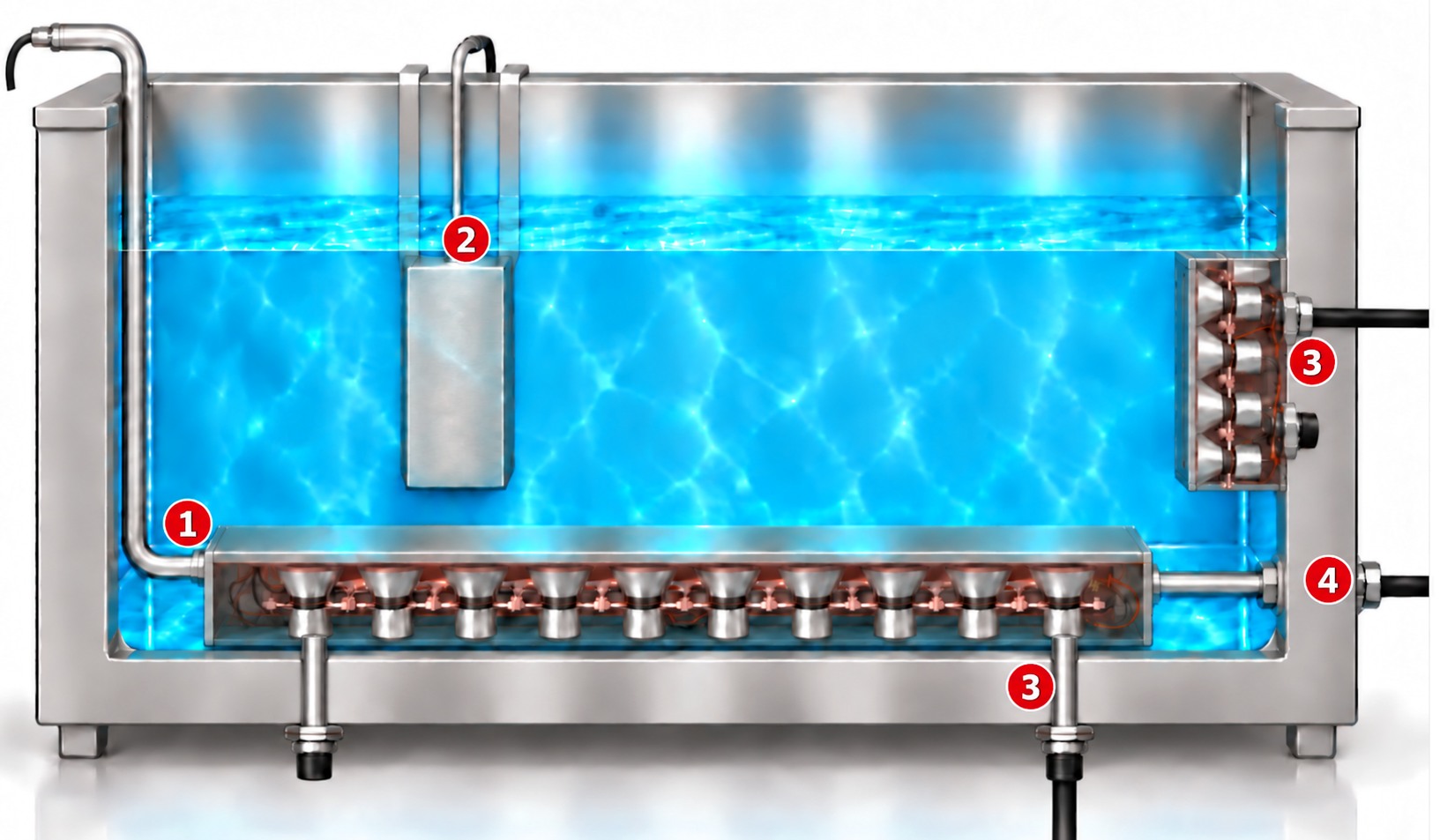
Cutaway showing the four arrangements in one vessel.Illustration generated by Misonics.
Conduit over the rimRigid conduit off the drive end, up the inside wall and out over the top. Nothing is drilled and the tank stays sealed — the arrangement to ask for when the vessel cannot be modified.
Hung from the rimThe unit suspended from the top lip on a bracket, sitting in the liquid without touching the walls or floor. Lifts straight out for maintenance. This is what a plating-line retrofit normally looks like.
Bulkhead exitA sealed bulkhead fitting taken through the tank at the unit itself — shown here through the side wall on the wall-mounted unit, and straight down through the base on the floor unit. Same fitting, whichever face it goes through.
Extended bulkhead exitThe same bulkhead fitting, run out to the tank side wall instead of straight through at the unit. What you ask for when there is no clearance under the tank, or the exit has to land somewhere serviceable.
In the field
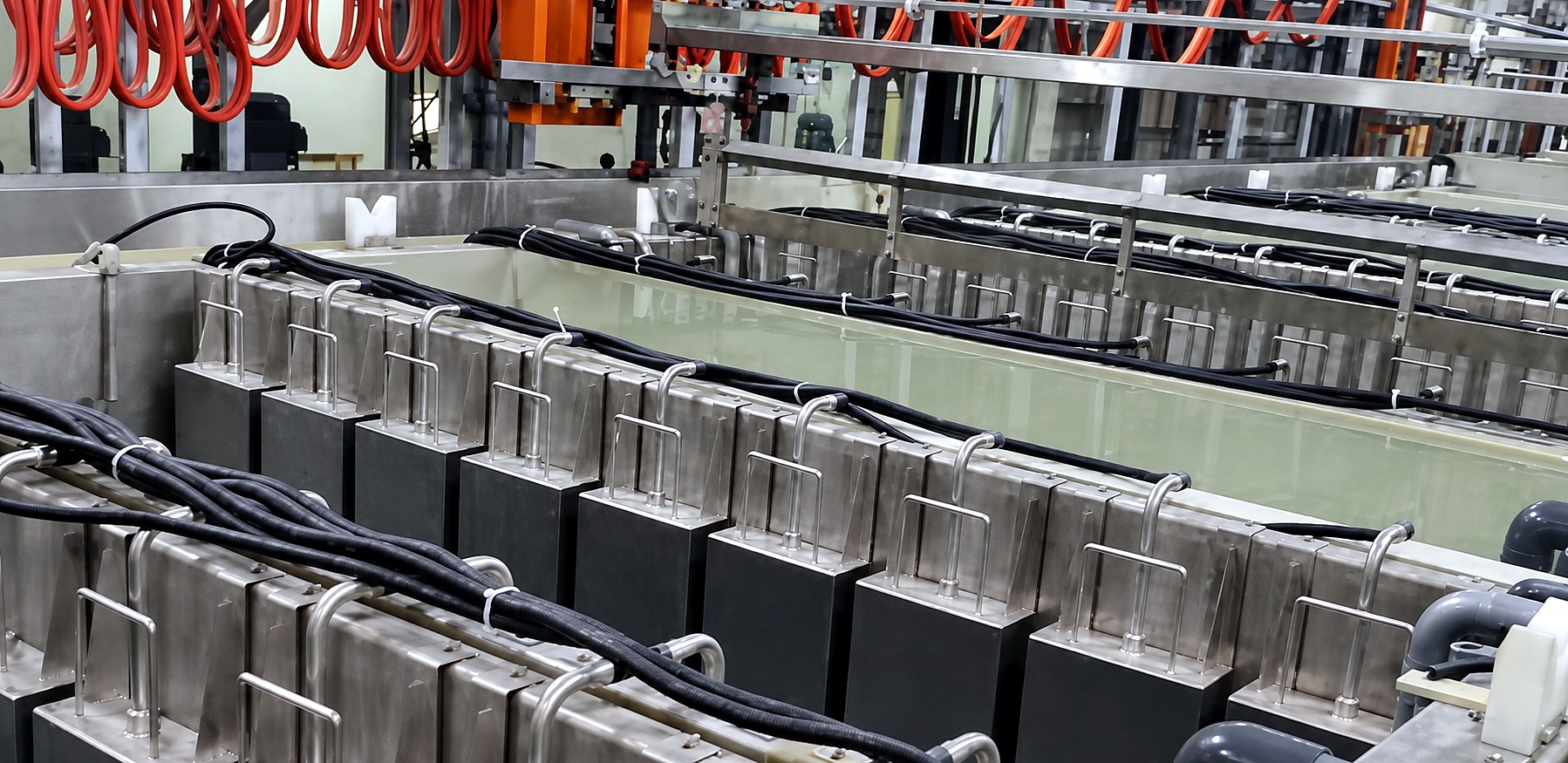
A plating line, retrofitted
The clearest case for an immersible is a line that is already built. These tanks were not designed for ultrasonics — the boxes hang on the rim, the cable runs along the top, and nothing was drilled, cut or re-plumbed to fit them.
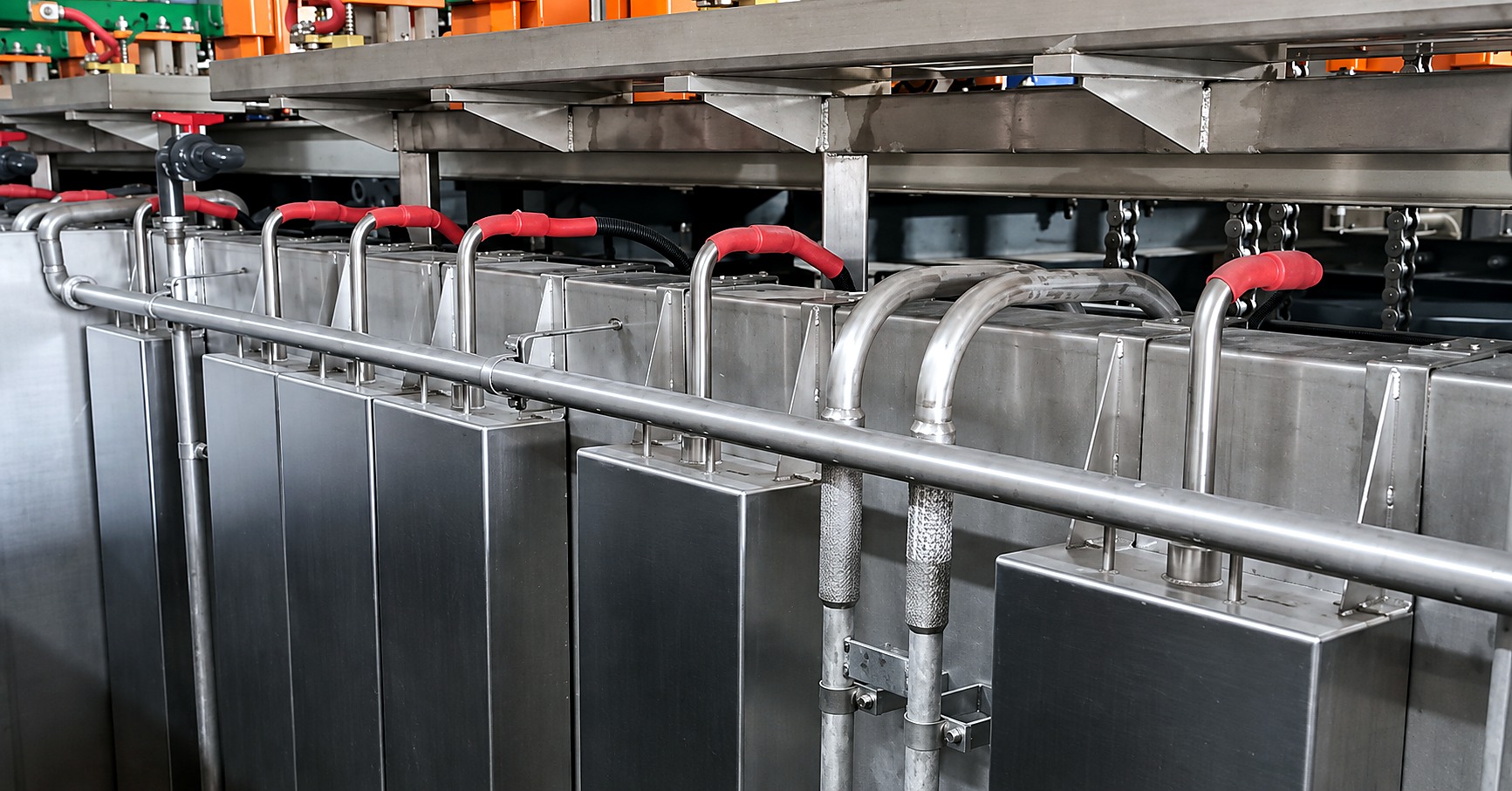
One box per tank, hung on the lip by its bracket and cabled back along the run. The tanks are unchanged.Fitted around the pipework that was already there — no re-plumbing, no lost tank volume.
Why plating lines suit this. The tanks are sound, the chemistry is set and the line cannot come apart for a rebuild. A hung immersible adds cavitation to a stage that already works, one tank at a time, without touching the vessel — and it lifts out again for maintenance or when the line is re-purposed.
1 — How it mounts
This is the one that decides everything else, and the one people forget to tell us. Where the box sits sets how it is held and how the cable leaves the tank. Pick the closest — if your vessel is none of these, say so at the bottom.
How the cable leaves the tank
Pick the mounting first — it sets what is possible here.
Cable lengthaffects the quote
Measured box to generator, including the run up and out of the tank. Five metres is standard; longer is made to order.
2 — Box size
Three boxes are held as stock builds. Pick the one that fits your tank, or size one to it.
Stock boxes are 90 mm deep and carry the frequency and power shown. Anything else is built to the tank.
3 — Material
316L is the default for anything acidic, chlorinated or left in the bath. 304 is fine for general alkaline duty and costs less.
Surface finishaffects the quote
The radiating face takes the cavitation. Hard chrome plating puts a harder skin on it, which is worth having on abrasive soils and long-running baths.
4 — Frequency
Chosen by the deposit and by what the substrate will take. The G4 runs one band or two — a heavy band for the soil and a fine one for the finish, on the same rack. Which frequency should I choose? →
The low bands are also the loud ones. If the tank is going somewhere people work all day, read the noise section first →
5 — Ultrasonic power
Power follows the box size and how many transducers go in it. If you know the figure, give it. If not, give us the tank above and we will size it.
6 — How many
Block count is normally specified to tank volume and duty rather than guessed. Put a number if you have one.
7 — The generator
A new generator is not compulsory. If you already run a Misonics VarioSonic G4, tell us which one and we will check it against this set before quoting another.
Which generator
We check it on frequency, power and load before quoting. If it matches this set, it drives them.
We do not drive these from a generator we did not supply. That is our rule, not a law of physics — other suppliers will drive a set they did not build after a bench check. For a Misonics VarioSonic G4 or SonoDrive G5 we hold the model, the matching network, the band and the rating, so we can say what happens when we connect it. For anything else we hold none of that, and a matching label is not a matching load: two boxes both marked 40 kHz can differ in capacitance, phase and mechanical response. We will not warrant a set on a generator we cannot characterise. The two systems do not cross over either — immersibles run on the G4, rod resonators on the SonoDrive G5.
Next step
Send the tank
Send the specification
Press the button in the specification panel and it fills the message for you. Add anything else it does not cover.