Clean the parts in a heated ultrasonic tank with a carbon-removing chemistry matched to the metal. Iron and steel take a strong alkaline stripper at 60 to 80 °C. Aluminium needs a chemistry that is safe on aluminium. Rinse, then protect iron and steel against flash rust. Nothing touches the machined surfaces, so grooves, seats and faces keep their size.
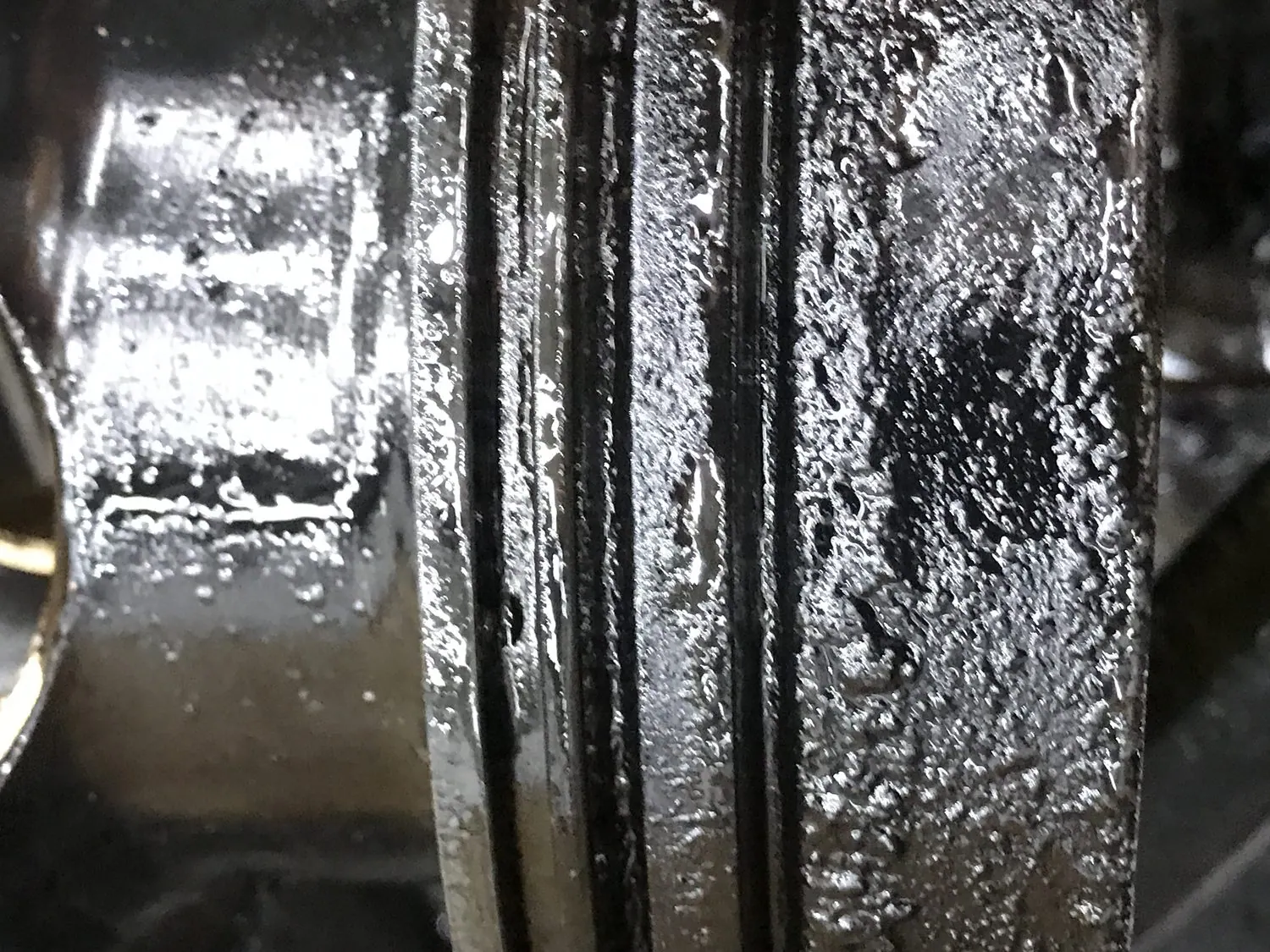
Why scraping and blasting are the wrong tool
Engine carbon is baked on over thousands of hours. It does not dissolve in solvent and it bonds into groove roots and corners. Any tool that reaches it also touches the metal around it.
Scraping and wire wheels remove or deform metal. Bead blasting can strip a skirt coating or mark a groove, and a groove out of spec scraps the piston. A soak tank softens the oil but leaves the hard carbon on.
Methods compared
| Method | What it does to carbon | Risk to the part |
|---|---|---|
| Scraper or wire wheel | Takes surface carbon, misses corners and groove roots | Removes or deforms metal |
| Bead or sand blast | Takes carbon by hand, slowly, part by part | Marks grooves, strips coatings, can leave media embedded |
| Soak tank, 1 to 3 days | Softens oil and loose dirt; hard carbon stays | Low, but the job is not finished |
| Heated ultrasonic tank and matched chemistry | Lifts carbon from every wetted surface, including galleries and groove roots | None to dimensions when the chemistry suits the metal |
Pick the chemistry by the metal
The metal decides first, the dirt second. A stripper that is right for cast iron will eat an aluminium head.
| Parts | Chemistry | Dose and heat | Keep out |
|---|---|---|---|
| Cast iron heads and blocks, steel parts | MetalTek 100 | 10–30% (typ. 25%) · 60–80 °C, never above 80 °C | Aluminium, zinc, tin, brass, bronze, magnesium |
| Aluminium pistons, steel and cast iron with heavy oil | AquaVantage 815 QR-NF | 5–30% (typ. 10%) · 54–77 °C | Copper, brass and bronze. Test zinc first |
| Aluminium and zinc with carbon and paint | Alloy System | 10% of the mixed system · 40–70 °C · typ. 30 min | Magnesium. Swells nitrile seals |
| Sludge and gross carbon, as a pre-wash | Desludge | 10–20% (typ. 15%) · 40–60 °C | Zinc, galvanised, magnesium |
Figures are from each product’s data sheet. Prices, data sheets and the rest of the range are on ultrasonic cleaning solution. Not sure which one? Use the chemical selector.
How to do it, step by step
- Pre-wash very dirty parts. Sump sludge and fuel varnish use up the main bath. A Desludge pre-wash takes the worst off first.
- Make up the main bath. Add the concentrate at the dose for your metal and heat the tank to working temperature. The dosage calculator works out the litres.
- Load the basket. Single layer where you can, holes and galleries up or sideways, parts off the tank floor. See how to load the basket.
- Run the ultrasonics. For heavy carbon, run staged cycles and filter the bath between cycles so the carbon that comes off stays out of the next load.
- Hot rinse. Flush the chemistry out of grooves, galleries and water jackets.
- Protect iron and steel. Dip in Anti-Rust at 2–5% for one to two minutes and leave it on. Keep Anti-Rust off aluminium, zinc, brass and copper.
- Dry and check. Inspect, and gauge the critical sizes before the parts go to machining or assembly.
Two jobs, with the settings
Diesel pistons: ring grooves
AquaVantage 815 QR-NF at 10% and 70 °C, 25 kHz with sweep, staged cycles with filtration between them. Carbon and ash came out of all three grooves. Groove width, depth and flank flatness gauged unchanged. Full write-up: piston ring groove carbon removal.
Engine blocks and heads, cast iron
A heavy-duty alkaline deruster at 15–20% (7% proven in marine overhaul work), 70–80 °C, 40 kHz, one to two hours of wash time. Rust in the water jacket, carbon in the galleries and old paint on the faces came off in one immersion. Then a hot rinse and an anti-rust dip. Full write-up: engine block and head cleaning.
Which machine
Size the tank against your largest part, not the litres. The MSX 50 is the smallest machine in our range specified for cylinder heads. The MSX floor range suits smaller rebuild parts. For blocks and heads, the EvoSonic EVS 600 or EVS 800. Engine rebuild shops can see the full set on ultrasonic parts cleaners.
Questions we are asked
Can you remove carbon from aluminium pistons?
Yes, with a chemistry that is safe on aluminium. AquaVantage 815 QR-NF is safe on aluminium at 5 to 30% and 54 to 77 °C. Never put aluminium in MetalTek 100: it attacks aluminium fast.
Will ultrasonic cleaning damage piston ring grooves?
No. In our piston study the grooves were cleaned in 815 QR-NF at 10% and 70 °C with staged 25 kHz cycles. Groove width, depth and flank flatness gauged unchanged afterwards. Nothing touched the groove.
How long does it take to decarbonise an engine block?
One to two hours of wash time at 70 to 80 °C and 40 kHz in a heavy-duty alkaline deruster, for iron blocks and heads. That replaces a soak of one to three days plus blasting and scraping.
Why not just soak the parts?
A soak tank softens oil and loose dirt but leaves hard carbon on. In our piston study the pistons had sat in a soak tank for one to three days and the ring belt carbon was still there.
Why do cleaned steel parts rust?
A freshly cleaned iron or steel part is bare, warm and wet. Rust bloom can start within the hour. Rinse, then dip in Anti-Rust at 2 to 5% for one to two minutes and leave it on.
Can I use a pre-wash for very dirty parts?
Yes. Desludge at 10 to 20% and 40 to 60 °C takes sludge, fuel residue and gross carbon off first, so the main bath lasts longer. Desludge is not for zinc or magnesium.
Related: Mining engine overhaul · Does ultrasonic cleaning damage aluminium? · Cleaning blind holes and galleries · DPF cleaning
Send us a carboned part
Tell us what the part is made of and what is on it. We clean it and send back the result with the settings used.