Spray cabinet, solvent tank or ultrasonic bath: all three are sold as parts washers, and they do not do the same job. A spray cabinet blasts the outside of a part. A solvent tank dissolves fresh oil and not much else. An ultrasonic bath cleans the inside of a part as well as the outside, oil galleries and blind holes included, with heated water-based chemistry instead of solvent. Misonics builds ultrasonic parts washers for Australian workshops and plants, from a bench tank that runs off a power point to a sealed chamber that washes, rinses and dries without anyone handling the parts.
Every parts washer puts cleaning energy on the part somehow. A spray cabinet uses impact, a soak tank uses dissolving, and an ultrasonic tank uses cavitation in a heated bath. Where the energy comes from decides what the machine can reach.
A turntable or basket under high-pressure jets of hot aqueous detergent. Line of sight: the jet cleans what it hits. Fast on outer faces and bulk soil, blind on the inside of a bore, a cross-drilling or a thread root.
Parts sit or are brushed in a bath of solvent. Like dissolves like, so fresh oil and grease come off well. Baked carbon, varnish and scale have changed chemically and stay put. Then there is the solvent itself: disposal, fumes and the flammability rules near heat.
A heated water-based chemistry driven by transducers. Cavitation carries the energy through the liquid, so the inside of a gallery is cleaned at the same strength as the outside. Nothing mechanical touches the surface, and the time, temperature and concentration can be written on a process card.
| Spray cabinet | Solvent soak | Ultrasonic tank | |
|---|---|---|---|
| Cleaning action | Impact of hot detergent jets | Dissolving in solvent | Cavitation in heated chemistry |
| Blind holes, galleries, threads | Only where a jet reaches | Wetted, not scrubbed | Cleaned wherever the liquid goes |
| Baked carbon, varnish, scale | Partly, with long cycles | Stays on the part | Removed with the matching chemistry |
| Fresh oil and grease | Good | Good | Good |
| Bulk mud and heavy debris | Best of the three | Poor | Pre-rinse first |
| Operator time | Load, run, unload | Hands in the bath | Load, run, unload |
| Consumable | Aqueous detergent, water, heat | Solvent, filters, disposal | Aqueous chemistry, water, heat |
| Repeatability | Fixed cycle | Depends on the operator | Time, temperature and concentration set and logged |
| Fumes and fire | Steam | Solvent vapour; flammability rules apply | Steam; no solvent |
If the soil is mud and the parts are big and simple, a spray cabinet or a pressure washer is quicker. If the parts have internals that matter, or the soil is baked on, the ultrasonic tank is the one that finishes the job. Many rebuilders run both: spray for the gross clean, ultrasonic for the parts that have to be right. Our six-method comparison goes into the chemistry and the physics.
The part and the soil choose the machine. These are the jobs that come through Australian workshops and plants, and the washer that suits each.
Oil galleries, water jackets and blind bolt holes. A spray cabinet cleans the faces; the galleries need immersion. Floor-standing ultrasonic tank, 50 L and up, with an alkaline degreaser. Read the engine block case study.
Jets and drillings smaller than a pin. Spray and soak do not reach them. A benchtop ultrasonic cleaner at 40 kHz, with a mild chemistry that protects the alloy. Carburettor cleaning.
Chips and cutting fluid before assembly or coating. Spray moves the bulk; ultrasonics clears what clings in the drillings. For volume, a sealed chamber that washes, rinses and dries without handling.
Baked carbon and varnish. Solvent will not touch it and a spray cabinet needs hours. Heated ultrasonics with a carbon-removal chemistry takes it off in one cycle. Piston ring groove carbon.
Pleats and mesh pack soil where a jet cannot follow. Immersion with cavitation clears the element from the inside. Pleated mesh filter elements.
Bulk soil on big simple shapes. A pressure washer or spray cabinet is the right tool; bring the ultrasonic tank in afterwards only for the parts with internals.
Every Misonics parts washer is ultrasonic. The range runs from a 9 L bench tank on a 10 A socket to a sealed chamber that sprays, ultrasonically washes, rinses and hot-air dries a rotating basket in one programmed cycle.
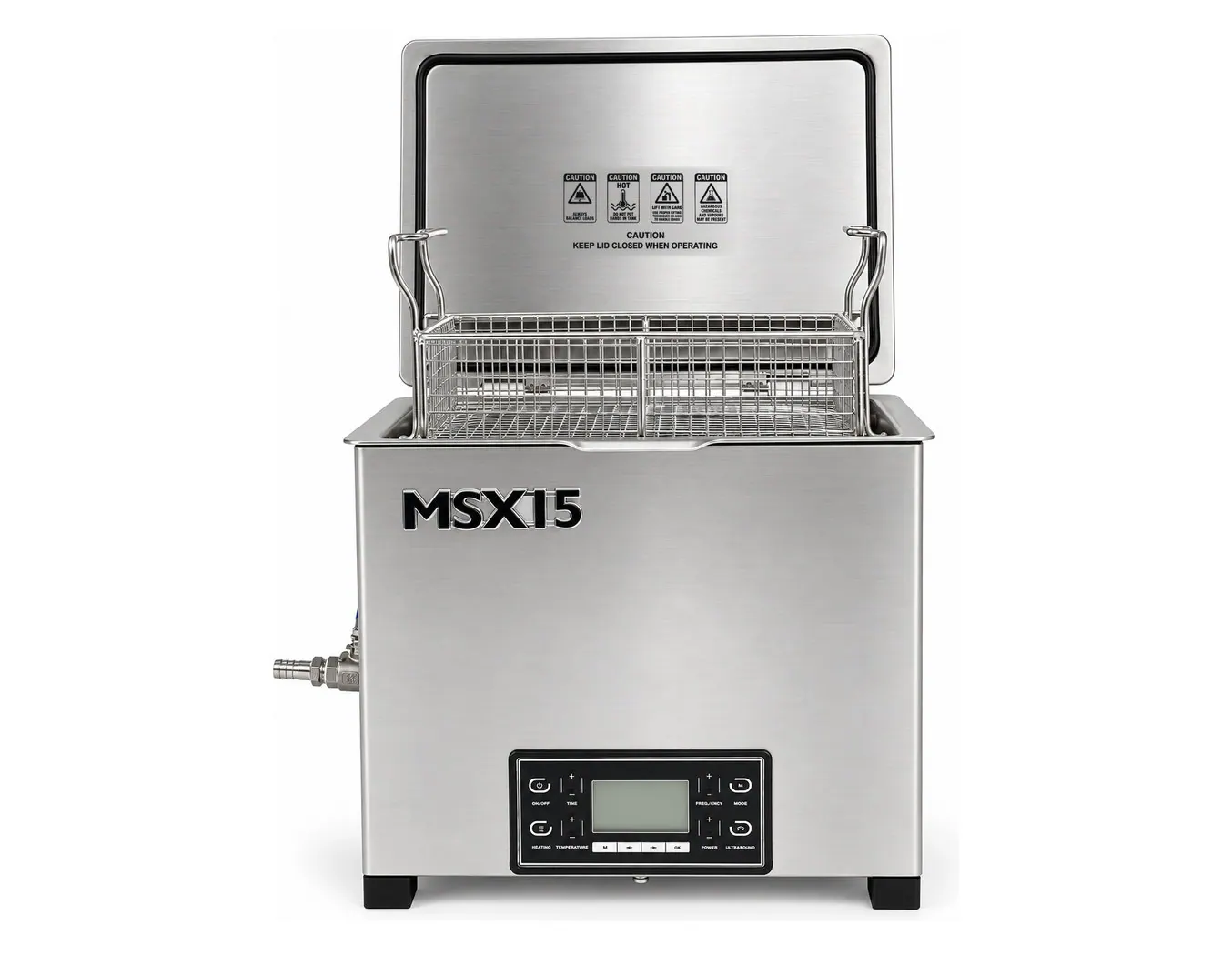
Baskets to 490 × 235 mm, heated to 80 °C, from a standard 240 V 10 A socket. The daily bench washer for carburettors, injectors, tooling and small assemblies.
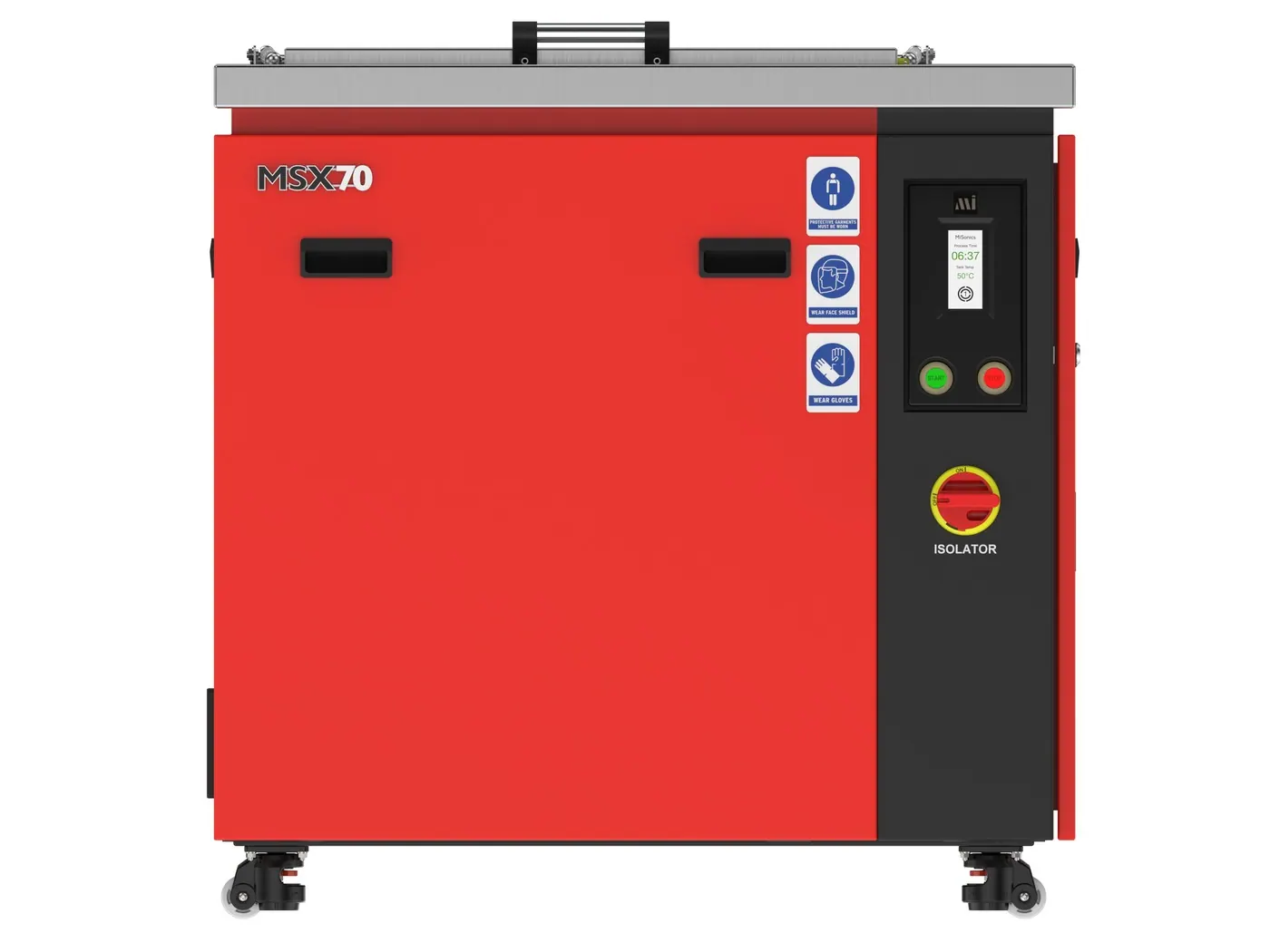
Baskets to 600 × 400 mm with 300 mm working depth, 1,500 W at 25 kHz with load sensing, 240 V 15 A. Heads, housings and batch trays.
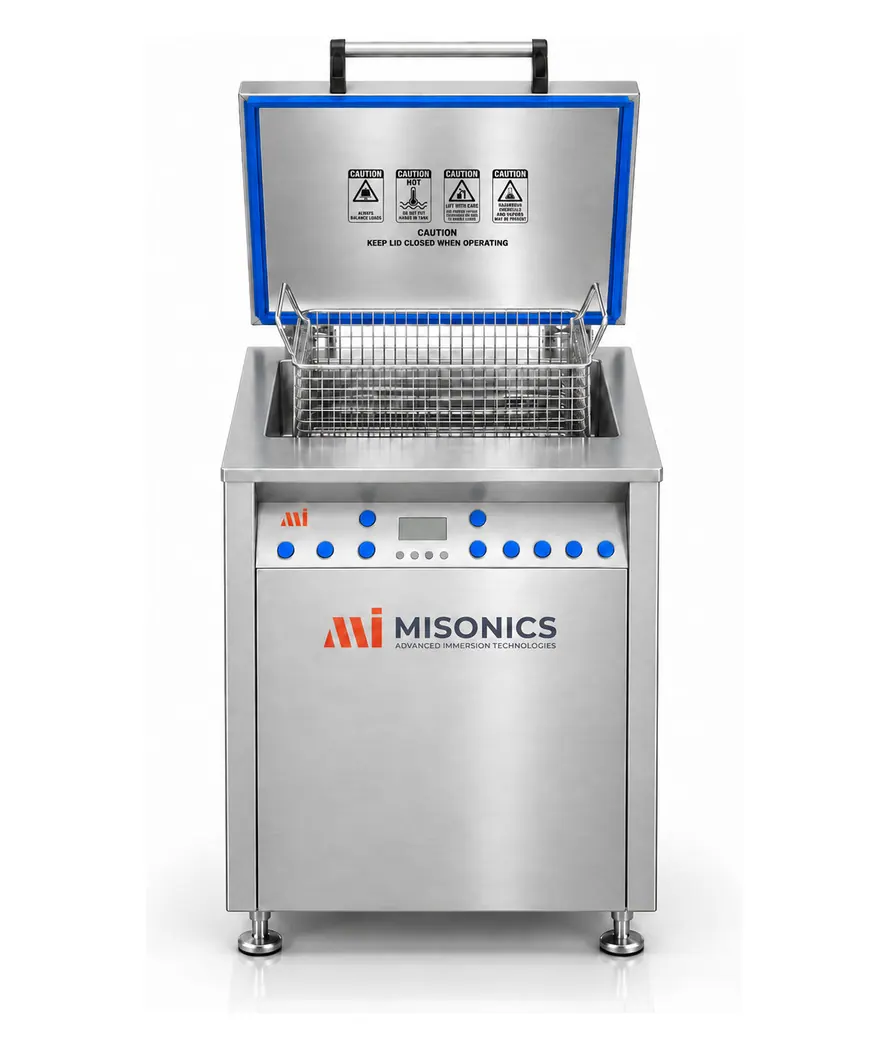
Four industrial sizes, to 35 kg a basket, 25/45 kHz in one tank. The same platform as the automated levels, so a process proved here climbs with you.
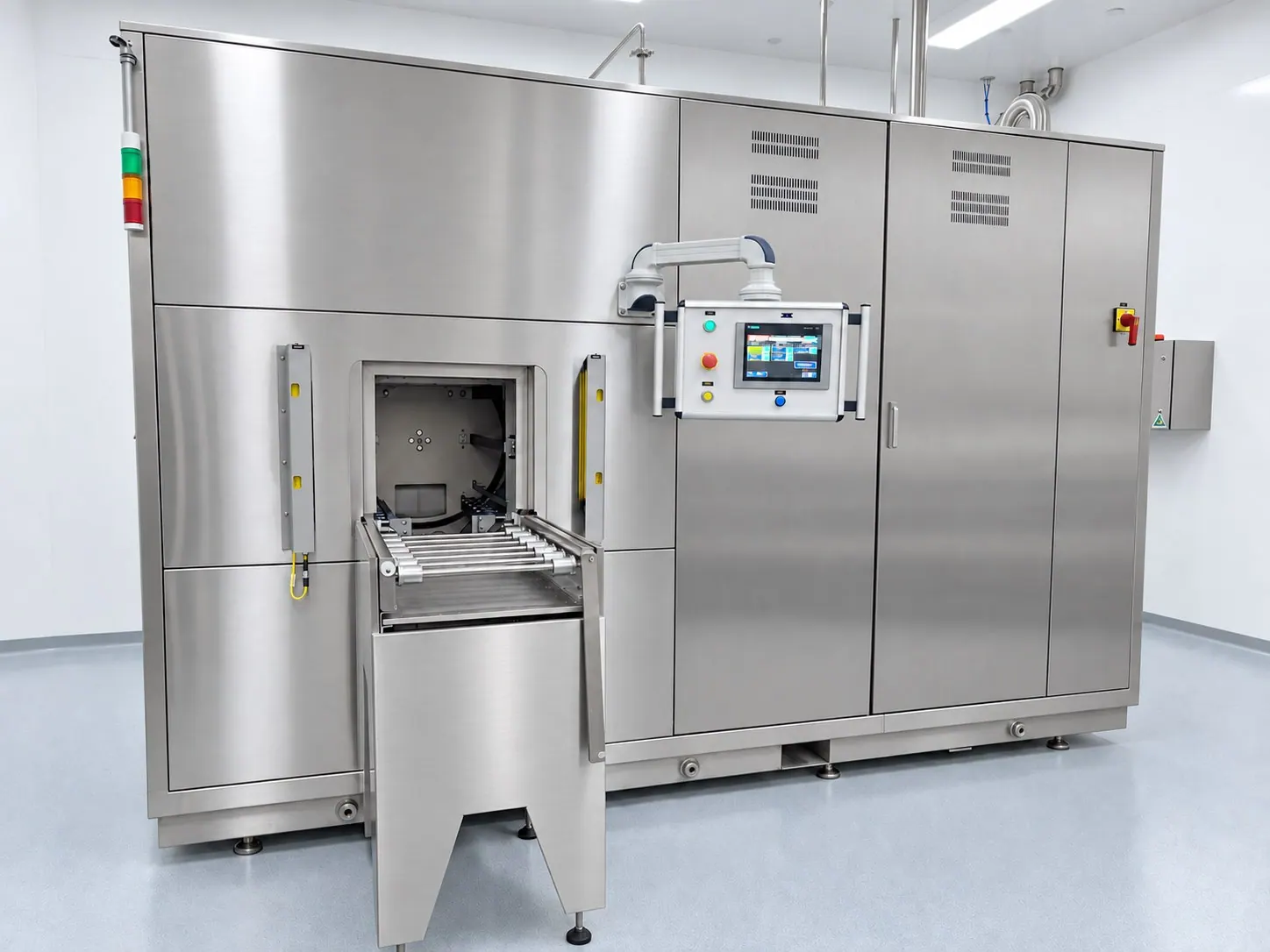
Spray wash, rotating ultrasonics, flush, rinse, RO rinse, forced hot-air and vacuum dry in one door. Load, press start, unload assembly-dry.
| Machine | Type | Working volume | Basket | Ultrasonics | Supply | Price |
|---|---|---|---|---|---|---|
| MSX 15 | Benchtop ultrasonic | 9.4 L | 320 × 225 mm · 130 mm deep · 8 kg | 300 W, 40 kHz | 240 V, 10 A socket | $4,367 inc GST |
| MSX 30 | Benchtop ultrasonic | 16.2 L | 490 × 235 mm · 140 mm deep · 12 kg | 650 W, 25/45 kHz | 240 V, 10 A socket | $6,578 inc GST |
| MSX 50 | Floor-standing ultrasonic | 45 L | 500 × 300 mm · 300 mm deep | 1,500 W, 25 kHz | 240 V, 15 A socket | Quoted to site |
| MSX 70 | Floor-standing ultrasonic | 72 L | 600 × 400 mm · 300 mm deep | 1,500 W, 25 kHz | 240 V, 15 A socket | Quoted to site |
| SonoWash 85 | Manual immersion, dual frequency | 60 L (85 L tank) | 510 × 330 mm · 25 kg | 1,500 W, 25/45 kHz | 240 V, own circuit | On application |
| UltraWash 70 | Automatic sealed chamber | 70 L chamber | 470 × 320 × 160 mm, rotating | 1,500 W, 25 kHz | 415 V 3-phase | Quoted to site |
| UltraWash 150 | Automatic sealed chamber | 150 L chamber | 610 × 320 × 200 mm · 100 kg | 3,000 W, 25 kHz | 415 V 3-phase | Quoted to site |
| UltraWash 300 | Automatic sealed chamber | 355 L chamber | 620 × 380 × 380 mm, rotating | 3,000 W, 25 kHz | 415 V 3-phase | Quoted to site |
Prices include GST where shown. All specifications and pricing are confirmed in writing at quotation. Parts longer than 600 mm go to the MSX 140 to 240 or the EvoSonic range: see ultrasonic cleaner sizes.
A manual tank is the lowest capital step and the right one until the labour arithmetic says otherwise. The signs that it is time to climb: an operator standing at the tank for most of a shift, parts handled wet between wash and rinse, and a cleanliness spec that has to be proved batch by batch.
MSX and SonoWash. The operator loads the basket, sets time and temperature, and lifts it out to rinse and dry. Lowest cost, biggest range of parts, and the process proved here carries straight across to the automatic chamber because the chemistry and frequency are the same.
UltraWash. One door, one button. Spray wash, ultrasonics with basket rotation, flush to drain, hot rinse, RO rinse, forced hot-air and vacuum dry, from a stored recipe. Parts come out assembly-dry and the cycle is logged. Built for throughput and for specs that must be repeatable.
Send the parts and we run them on the machine you are considering, with the chemistry matched to the soil. The recipe that works on the trial is the recipe the machine ships with.
Send the part, the soil and how many you clean a day. An engineer will come back with the washer, the chemistry and the cycle.
Looking only at ultrasonic machines? See the ultrasonic parts cleaner page. Want the wash, rinse and dry done in one closed chamber? See the automatic ultrasonic parts washer. Cleaning carburettors or engine parts? See the ultrasonic carburettor cleaner and ultrasonic cleaner for car parts pages.