Still washing parts in solvent?
On 1 December 2026 the workplace exposure limit for white spirits drops from 790 to 296 mg/m³. If your shop still runs a solvent wash station, check what it costs to keep: fire controls, insurance conditions, health and safety paperwork and waste removal. An ultrasonic parts cleaner running water-based chemistry replaces it and removes baked carbon and scale that solvent leaves on the part. A suitable water-based detergent is not flammable.
Updated · Fred Shaw, Misonics
What a solvent washer costs to keep
The running costs of a solvent wash station, beyond the fluid itself.
Most parts-washer solvents are flammable or combustible liquids. Where the pump, switch and power point sit next to the basin, you may need a hazardous-area assessment (AS/NZS 60079.10.1), storage under AS 1940, a self-closing lid with a fusible link, and distance from grinders, welders and hot work. What applies depends on the solvent, the quantity and the set-up.
Commercial property insurers ask about flammable liquids on site. Flammable liquids on site usually have to be declared, and the insurer may set conditions on where it sits and how it is maintained. A suitable non-flammable water-based detergent takes the cleaning solvent off that list.
Solvent vapour causes headaches, dizziness and drowsiness. Daily hand contact strips the skin's oils and causes dermatitis. From 1 December 2026 the exposure limit for white spirits is less than half the current figure.
For a hazardous chemical this usually means a safety data sheet at the station, a hazardous chemicals register, a risk assessment, ventilation, gloves and eye protection, and air monitoring where exposure could pass the limit. What applies depends on the product and how it is used.
You buy fresh solvent and filters, and pay a licensed waste contractor to remove the dirty solvent and sludge. It cannot go down the drain or in the skip, and in Victoria the load is tracked to a licensed facility.
Solvent lifts fresh oil and grease. Baked carbon, varnish and scale stay on the part, loosened soil settles back on as it drains, and galleries and blind holes get only what the brush reaches.
Workplace exposure limits from 1 December 2026
Safe Work Australia's workplace exposure standards become workplace exposure limits (WEL) on 1 December 2026. Like the current standards, they are limits that must not be exceeded. Most values stay the same, but several common solvents drop sharply. In Victoria the new limits are brought in by amendments to the OHS (Occupational Health and Safety) Regulations and the Dangerous Goods (Storage and Handling) Regulations.
| Solvent | Limit until 30 Nov 2026 (8-hour average) | Limit from 1 Dec 2026 (8-hour average) | Short-term limit from 1 Dec 2026 |
|---|---|---|---|
| White spirits (mineral spirits) | 790 mg/m³ | 296 mg/m³ | 593 mg/m³ (new) |
| Mineral turpentine | 480 mg/m³ | 296 mg/m³ | 593 mg/m³ (new) |
| Toluene | 50 ppm | 20 ppm | — |
| Ethylbenzene (in many xylene blends) | 100 ppm | 20 ppm | — |
| Acetone | 500 ppm | 250 ppm | 500 ppm |
| Perchloroethylene (Victoria: from 1 Dec 2029) | 50 ppm | 20 ppm | 40 ppm |
From Safe Work Australia's workplace exposure limits and its comparison of the old and new lists. Check section 8 of the safety data sheet for what is in your solvent. In Victoria, 15 substances including perchloroethylene move to the new limits on 1 December 2029 instead. Until 1 December 2026 the current exposure standards apply and must still be met. WorkSafe Victoria lists the 15 substances.
Two checklists
Ask your insurer
- Is the solvent washer declared on our policy?
- What conditions apply: location, distance from hot work, self-closing lid, fusible link?
- How much flammable liquid can we hold on site, and how must it be stored?
- Does replacing it with a water-based machine change anything on our policy?
Health and safety
- Safety data sheet at the wash station, current within five years
- Solvent on the hazardous chemicals register
- A risk assessment where the solvent and how it is used call for one, reviewed when anything changes
- Hazardous-area assessment around the washer where flammable vapour can form
- Ventilation or extraction, chemical-resistant gloves and eye protection
- Air monitoring if exposure could pass the new limit
- Licensed contractor for the dirty solvent and sludge, with the paperwork kept
General information, not legal or insurance advice. Your insurer and your state work health and safety regulator have the final word for your site.
An ultrasonic parts cleaner with water-based chemistry
Replace the solvent wash station with an ultrasonic parts cleaner running a water-based detergent. If you also have a heated spray washer, keep it for the gross soil and put the ultrasonic tank beside it.
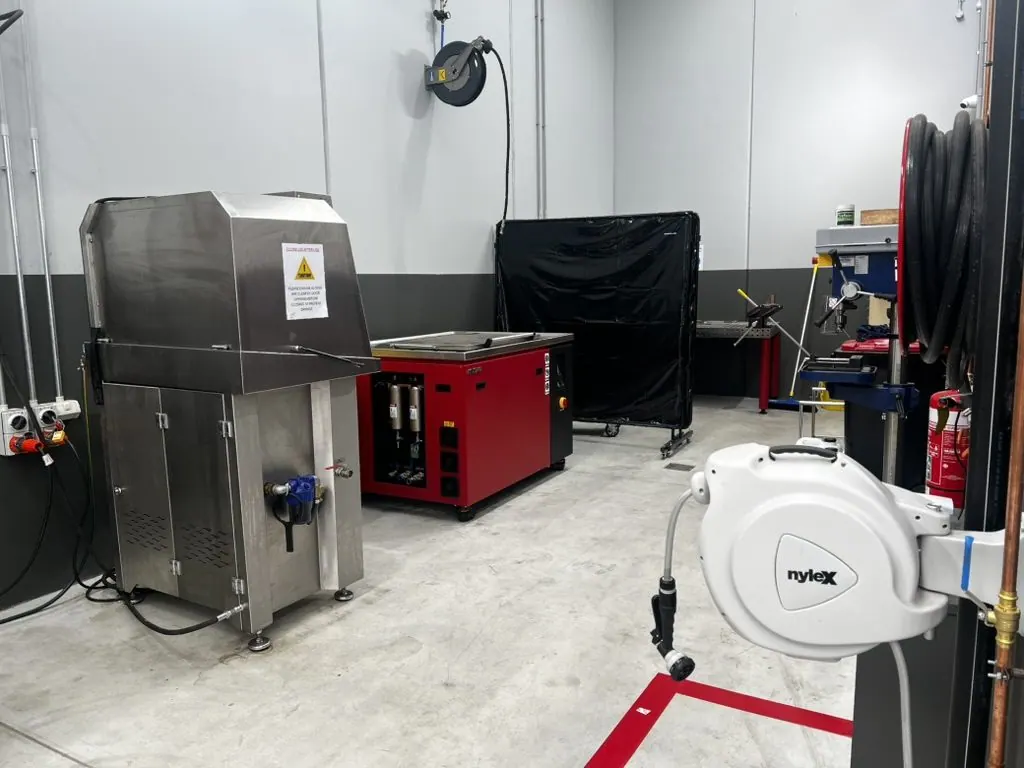
A heated spray cabinet takes off mud, heavy oil and loose dirt fast. Run a low-foam spray-wash detergent such as AquaVantage 1990 GD.
Cavitation reaches blind holes, galleries and thread roots, with the part loaded so trapped air can escape, and takes off baked carbon, varnish and scale. Heavy workshop soil runs in AquaVantage 815 QR-NF. See the MSX floor range.
Where parts must come out clean, rinsed and dry, the UltraWash sprays, runs ultrasonics, rinses and dries behind one door.
| Solvent wash station | Ultrasonic parts cleaner, water-based | |
|---|---|---|
| Flammable cleaning solvent | Yes | No, with a non-flammable detergent |
| Fresh oil and grease | Good | Good |
| Baked carbon, varnish, scale | Usually stays on | Removed with chemistry matched to the soil |
| Galleries, blind holes, threads | Only where the brush reaches | Cleaned where the liquid gets in, with the part loaded so air can escape |
| Vapour at the wash station | Solvent vapour | Water vapour and mist from the heated bath; extraction where the bath runs hot |
| Waste | Dirty solvent and sludge, licensed removal | Spent aqueous bath, oil skimmed and filtered out; disposal set by the chemistry and your local rules |
Moving from solvent to ultrasonic
We run it through a documented trial and send it back with photographs and the cycle card.
We pick the detergent for your soil and your metals, with the dose and temperature from the data sheet.
An ultrasonic parts cleaner sized to your biggest part and your throughput. Installed and your people trained.
The old solvent and sludge go out with a licensed waste contractor. Take it off the hazardous chemicals register and tell your insurer.
Moving off solvent
Is it illegal to use a solvent parts washer?
Does a water-based washer clean as well as solvent?
Do I need to tell my insurer?
What do I do with the old solvent?
When do the new exposure limits start?
Book a trial on your parts
Send us your worst part. We clean it, record the cycle and recommend the machine and chemistry to replace your solvent washer.
Related: Ultrasonic parts cleaners · Parts washers · Chemical safety · Chemistry