
Why some industrial ultrasonic cleaners cost less
Much of the saving is often in parts you cannot see in a photo: the grade and thickness of the steel, the transducers and generators, the electrical components, the filtration and heating, and the lifting safety.
Some of those savings come back later as a repair, a stoppage or a safety risk. These are the questions to ask before you compare prices.
Where the money is saved
The tank
The steel is the first place a cheaper machine saves money, and the place you notice it last.
The ultrasonics
The transducers and generators decide whether the machine keeps cleaning in year five.
Electrics and controls
Hidden inside the cabinet, and the part that has to pass an Australian electrician.
The operator
A machine that is hard to use gets used badly.
The bath
How the machine handles oil and dirt decides how clean the part comes out and how long the chemistry lasts.
Lifting and safety
Heavy baskets and lids are where people get hurt.
The work area
The tank is only part of the job.
Chemistry and experience
The right fluid matters as much as the machine.
The tank
The steel is the first place a cheaper machine saves money, and the place you notice it last.
| Ask | Why it matters |
|---|---|
| What grade of stainless steel is the tank? | SS316 resists pitting and aggressive chemistry better than SS304. A cheaper grade pits and leaks sooner. |
| How thick is the tank wall: 3 mm, 5 mm, or thinner? | Some imported tanks are made from sheet as thin as 0.7 mm. Thin walls flex, crack around the transducers and wear through under cavitation. |
| Does it have a sump and a sloped base? | A sump and a sloped base let you wash the tank out and drain the dirt. A flat base holds sludge. |
| Where are the transducers mounted? | Transducers mounted on the bottom of the tank sit under the dirt that settles there, which deadens the cleaning and is hard to clean out. How an industrial ultrasonic tank works. |
| How thick is the insulation? | Thick insulation holds the heat, cuts energy use and keeps the ultrasonic noise down. |
The ultrasonics
The transducers and generators decide whether the machine keeps cleaning in year five.
| Ask | Why it matters |
|---|---|
| What transducers and generators are fitted? | Many low-cost machines use mass-produced kits with transducers glued to the tank that cannot be replaced on their own. Ask how the transducers are fixed, what sustained power they are rated for, how one is replaced and what that costs. Compare power on the same basis: ultrasonic watts explained. |
| Can a transducer be replaced in the field? | A replaceable transducer is a service call. One that cannot be removed can mean a new tank. |
| What wears out in a cheap transducer? | Three things. Low-grade piezo ceramic cracks and loses output as it runs hot, and its resonant frequency drifts away from the generator. A clamp bolt not held at the right tension lets the ceramic rings shift, crack and arc. The glue line holding a bonded transducer to the tank weakens with heat and thermal shock until it lets go. Each failure leaves a dead patch in the bath. Why we use rod resonators in large tanks. |
| Does the generator use modern wave modulation? | Modulated output spreads the cleaning action evenly through the bath instead of leaving dead spots. |
| Can the generator be connected remotely? | A remote connection lets faults be diagnosed and the generator updated without waiting for a technician. |
Electrics and controls
Hidden inside the cabinet, and the part that has to pass an Australian electrician.
| Ask | Why it matters |
|---|---|
| Are the electrical components international brands, certified to Australian standards? | Imported three-phase circuit breakers, contactors and power supplies must comply with AS/NZS standards. Uncertified parts can fail inspection, fail in service, and leave you exposed to legal liability if something goes wrong. Is the saving worth that risk? |
| Is it wired to Australian colour codes? | Wiring to AS/NZS colour codes is what your electrician expects to find, and what keeps fault finding safe. |
| Is 24 V control wiring kept apart from heavy current, and marked on the drawings? | Separated, labelled circuits are safer to work on and quicker to fault find. |
| Is there surge protection and fusing? | Protection stops a supply spike from taking out the generators and controls. |
| On large tanks, is the cabinet cooled? | Industrial air-conditioning on the cabinet lets the machine run continuously and extends generator life. |
The operator
A machine that is hard to use gets used badly.
| Ask | Why it matters |
|---|---|
| Does the screen give meaningful information, and is it easy to operate? | Operators should see temperature, time and faults at a glance, not hunt through menus. |
| Can an operator wearing gloves start a cycle with a push button? | Dedicated start buttons for set programs save scrolling through menus with wet gloves. |
| Are there status lights? | Lights show tank condition and cycle progress from across the workshop. |
| Is there an early wake mode? | The tank heats before the shift starts, so work begins on arrival. |
| For regulated work, are cycles locked and logged? | Pharmaceutical and other validated processes need locked recipes and a record of every cycle. Where 21 CFR Part 11 applies, the controls must support electronic records and signatures. UltraWash · pharmaceutical cleaning. |
| Is the heating powerful enough to heat the tank quickly? | A strong heater brings the tank up to temperature fast. A weak one has to stay on all the time just to hold temperature. |
The bath
How the machine handles oil and dirt decides how clean the part comes out and how long the chemistry lasts.
| Ask | Why it matters |
|---|---|
| Is the filtration sized for the dirt you produce? | Undersized filters block quickly and let dirt circulate back onto the parts. Filtration in ultrasonic systems. |
| Is there an overflow weir with laminar flow? | The weir skims surface contamination off, so parts are not recoated as they are lifted out. Weirs and oil removal. |
| Is there oil separation? | Removing surface oil keeps the bath working longer before it is dumped. Oil-absorbing filter bags. |
| Are there isolation valves at the filters? | Valves let a filter bag or cartridge be changed without draining the tank. |
| Are the pumps international brands, and are the pump, valve and fitting seals rated for your chemistry and temperature? | Every seal on the machine must suit the chemistry and the heat it runs at. The wrong seal can fail overnight and put thousands of litres of hot caustic on your factory floor. Is the saving worth that risk? Ask for the seal materials in writing, checked against the chemical, its concentration and the temperature. Seal compatibility chart. |
Lifting and safety
Heavy baskets and lids are where people get hurt.
| Ask | Why it matters |
|---|---|
| Does the lifting platform have safety relays of the right category for the risk assessment? | The safety category must match the risk. A cheaper control system may not. Powered-lift cleaners. |
| Are there two-hand controls? | Two-hand controls keep both hands clear of moving parts. |
| What stops pinch points on heavy lids? | Lids need guarding, controlled movement or interlocks so they cannot close on a hand. |
| Is the platform rated for the load, and does it bind under it? | A platform that binds under a full basket is a hazard and a breakdown. |
| Are the pneumatics from recognised international makers, with spares readily available? | Common parts mean a quick repair. Unknown parts mean waiting for shipping. |
The work area
The tank is only part of the job.
| Ask | Why it matters |
|---|---|
| Are rinse and wash bays available? | Parts can be rinsed off after cleaning, in a contained area. Bunding, platforms and washbays. |
| Are access platforms available? | Workers should not have to climb onto makeshift blocks to see into the tank or handle lifting gear. |
| Where heavy contamination enters the tank, is a filtration system available? | Heavy contamination drives chemical costs up, because the bath has to be dumped and refilled sooner. A filtration skid cleans the bath continuously. For fine contaminants, a centrifugal separator removes what bag filters let through. |
Chemistry and experience
The right fluid matters as much as the machine.
| Ask | Why it matters |
|---|---|
| Is there a range of tried and tested ultrasonic cleaning fluids? | The chemistry has to suit both the soil and the metal. Ultrasonic cleaning chemicals · chemical selector. |
| Does the chemistry carry recorded approvals? | Aerospace, defence and pharmaceutical customers often require a cleaner on their approved list. AquaVantage 815 GD carries 40+ OEM approvals, including Boeing, Airbus and Pratt & Whitney, and 815QR-NF is Pratt & Whitney PMC 1339 approved. |
| Has the supplier cleaned parts like yours before? | Experience with your parts, and years behind the advice, is what gets the process right first time. Case studies · sample trial reports. |
Measure the result, not the price
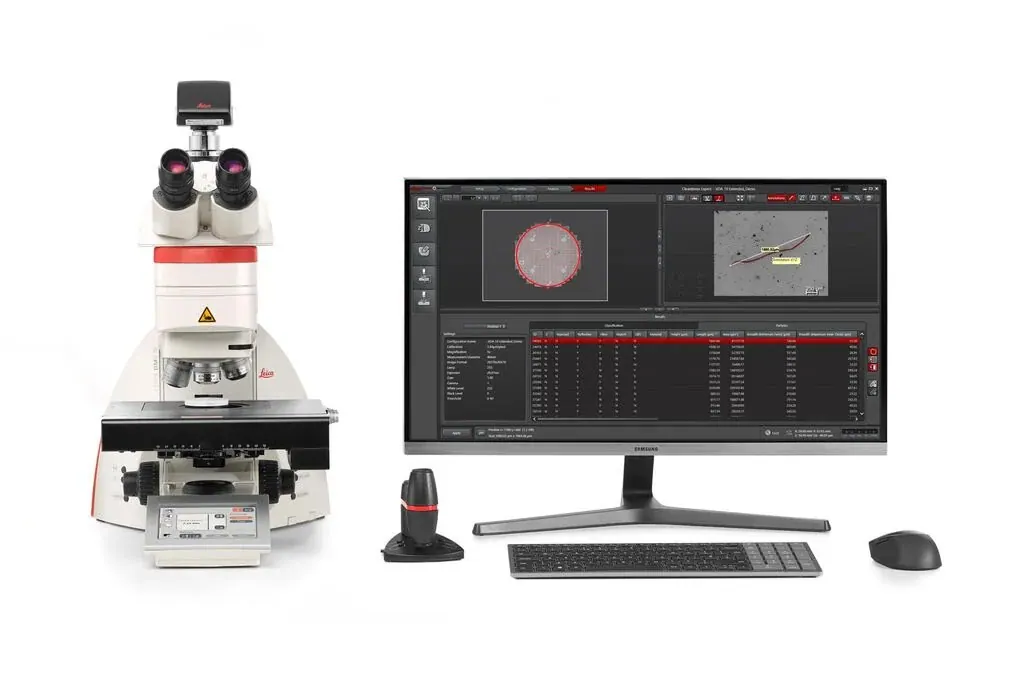
The cheapest machine is the one that cleans your part to the standard you need. Clean is a number: a particle count, a residue weight or a test result. Our laboratory measures it on a Leica DM6 M microscope with cleanliness analysis software, to ISO 16232.
Clean is a number · How to prove a part is clean · See a sample analysis report.
Questions buyers ask
Why are some industrial ultrasonic cleaners so much cheaper?
Much of the saving is often in parts you cannot see: thinner or lower-grade stainless steel, mass-produced transducer kits that cannot be replaced, uncertified electrical components, small filters and heaters, and basic lifting controls. Each one can cost you later in repairs, downtime or safety.
What stainless steel should an industrial ultrasonic tank be made from?
SS316, at a wall thickness suited to the tank size, typically 3 mm or more for industrial tanks. Thin sheet and lower grades wear through faster under cavitation and chemistry.
What should I check in the electrical cabinet?
International-brand components certified to Australian standards, wiring to AS/NZS colour codes, 24 V control separated from heavy current and marked on the drawings, and surge protection and fusing.
Related pages
Buyer's guide
How to choose an industrial ultrasonic cleaner.
Prove it before you buy
The factory test report, trials and commissioning.
Specification checklist
What to write down before you ask for quotes.
Quality and compliance
Pre-despatch testing and electrical safety.
Cleaning chemicals
Fluids matched to the soil and the metal.
Clean is a number
How cleanliness is measured.
Seal compatibility chart
Seal materials against cleaning chemistry.
How a tank works
The parts of an industrial ultrasonic tank.
Ask us these questions
Ask any of them about a Misonics machine. Technical sales will answer from the drawings, the parts list and the factory test report.